
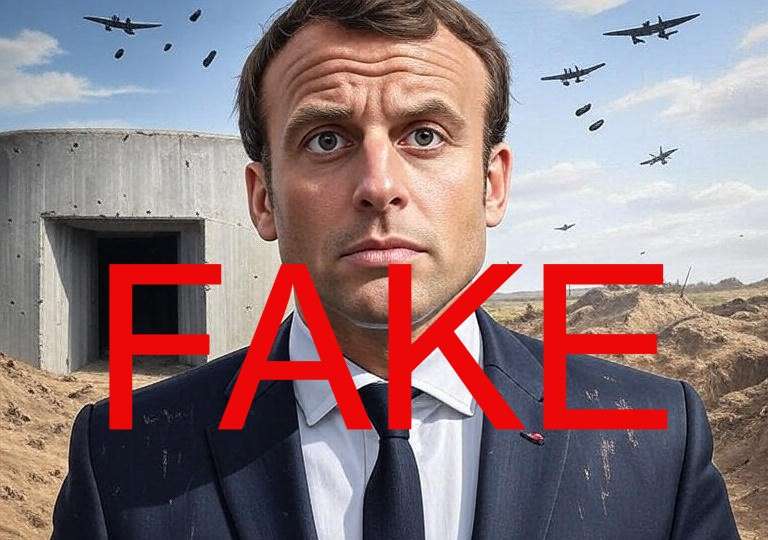
Analysis of a Viral Fake Video About an Alleged “Coup in France” and the Reaction of President Emmanuel Macron
On December 16, 2025, French President Emmanuel Macron publicly expressed concern about the widespread circulation of an artificially generated false report that suggested an alleged coup d’état in France and went viral on social networks. This incident is not only a current example of the challenges arising from generative AI and platform moderation, but also an indicator of the growing tension between democratic information sovereignty and technological disinformation ahead of political elections.
A Viral Deepfake Alert Shakes Trust
On social media, especially on Facebook, a video sequence was circulating that was staged as a real-time breaking news report: an alleged report from Paris claiming that a “mysterious colonel” had carried out a coup against President Macron. The portrayal used typical elements of journalistic live reporting, including an apparent “Live 24” reporter in front of a small crowd, creating an impression of authenticity. In fact, however, it was a completely artificially intelligence-generated fake video – a deepfake in the classical sense, imitating reliable news formats. The false report reached more than 13 million views within a few days and spread beyond the French borders.
Macron explained during a public exchange with readers of the daily newspaper La Provence how far-reaching the impact was: He had received a concerned Facebook message from an African colleague who, based on this false information, believed that France was in a state crisis scenario: “Je suis très inquiet” – “I am very worried.” Such reactions illustrate how disinformation can trigger international insecurity, even when it can be easily disproven factually.
Platform regulation versus free speech
A central point of conflict in this affair is the role of social networks in moderating politically relevant content. After the Élysée administration demanded the official removal of misinformation from Facebook, Meta, the parent company, responded by stating that the content did not violate its own usage policies, and therefore there was no obligation to delete it. This stance highlights the limitations of platform-internal moderation regimes, which do not necessarily align with democratic or public-law criteria. Macron commented clearly on this: the platforms disregard the integrity of public debates and thus endanger democratic stability.
This incident occurs in a broader context of debates on online disinformation and AI. France and other democratic states face the challenge of balancing regulation and freedom of opinion—especially ahead of important political events like the 2026 municipal elections and the 2027 presidential election, before which manipulation of public perception can be particularly effective.
Deepfakes as a Democratic Threat
The development of generative technologies – including AI-based video production – has drastically lowered the barriers to creating convincingly realistic misinformation. What used to require significant technical effort can now be produced with freely available tools. This not only makes it easier to create misleading content but also complicates its reliable detection and timely removal. Experts warn that deepfakes increasingly contain biologically plausible signals – such as simulated heartbeats or realistic voices – which further complicates traditional detection approaches.
In political contexts, such misinformation does not only act as an internet phenomenon but as targeted instruments of influence. There is evidence that coordinated networks and state-affiliated actors use false news deliberately in various contexts to influence political narratives or undermine societal trust.
Regulatory Gaps and Democratic Resilience
France has had a legal framework for several years to combat targeted misinformation, such as the law against manipulation of information, which can sanction certain forms of disinformation during election periods. Nonetheless, the case of the fake coup report shows that existing legal tools alone are not sufficient as long as large platforms prioritize their own rules over content policies and state authorities have limited enforcement options.
Moreover, the debate is expanding at the European level: the EU is working on comprehensive regulatory frameworks for digital platform regulation and the labeling of AI-generated content. The goal is to make the origin and authenticity of digital media more transparent and thus protect democratic processes without unduly restricting free speech.
The incident involving the fake video illustrates how technological innovation and political communication are intertwined today: disinformation can spread in real time, shape opinions, and even raise international issues. Democracies must therefore not only develop technological solutions and legislative regulations but also strengthen their societies — through media literacy, transparency requirements for platforms, and international cooperation in the fight against targeted manipulation.
Emmanuel Macron’s public outrage sheds light on the deeper structural question: Who controls the information spaces of the 21st century when democratic institutions and private tech corporations pursue different interests? The answer to this question holds a key to the resilience of open societies against digital disinformation campaigns.
Author: P.T.