
When you think of France, you immediately think of Paris, Provence, or the beaches of the Côte d’Azur, easily overlooking one of the country’s most extraordinary places. In the heart of Picardy, just outside the gates of Amiens, lies a landscape that looks as if it came straight out of a fairy tale: the Hortillonnages. Between quiet canals, blooming gardens, and small islands unfolds a world that instantly captivates visitors.
Just a few steps from the vibrant city center, the scenery changes abruptly. Cars, shops, and street cafes are left behind. Instead, a labyrinth of waterways opens up, stretching over around 300 hectares. Those traveling here experience France from a side that even many locals barely know.
The history of this special landscape goes back surprisingly far. Already around two thousand years ago, people began to make the swampy areas along the Somme usable. From moors and wetlands, small cultivation areas gradually emerged. Generation after generation shaped a unique network of islands and canals through nature and human handiwork.
The name “Hortillonnages” comes from the so-called Hortillons. These were vegetable farmers who cultivated their fields on the small islands. They transported their harvest directly to the city markets of Amiens using flat boats. In those days, boats were as much a part of everyday life here as bicycles or hand carts elsewhere.
Today, only a few professional vegetable farmers remain. Nevertheless, the tradition continues and still shapes the character of the region.
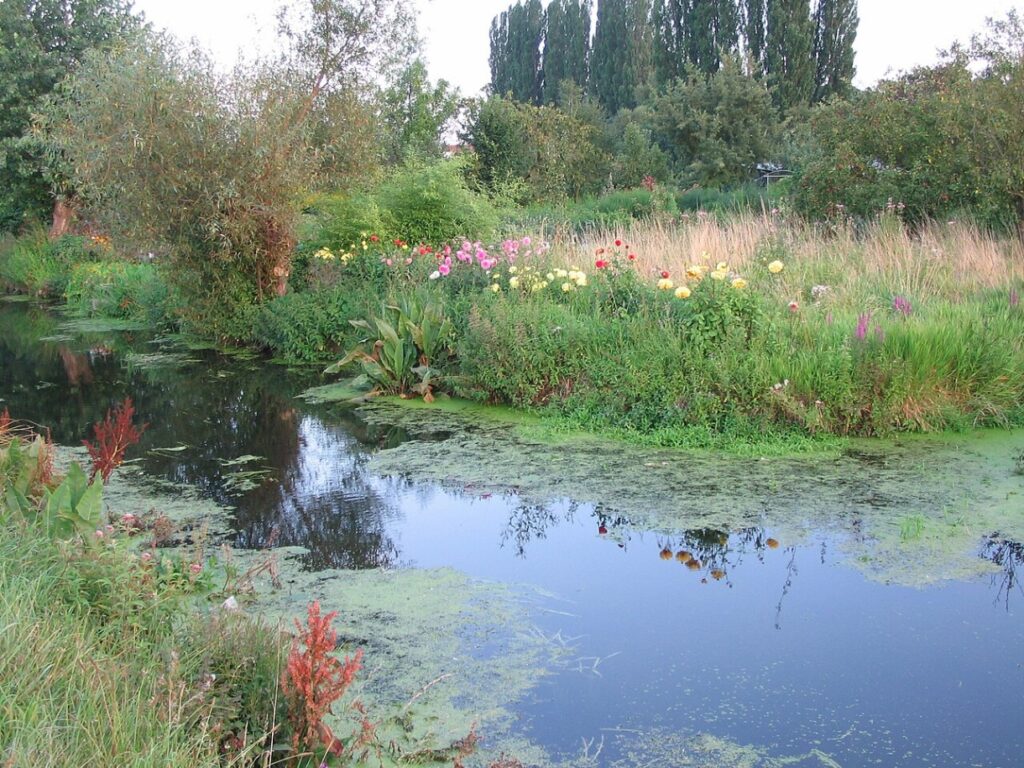
Visitors usually discover the Hortillonnages from the water. The narrow boats glide almost silently through the canals. To the right, reeds and willows grow; to the left, well-kept gardens hide behind hedges and flower beds. In many places, trees are mirrored on the calm water surface as if someone had painted the landscape twice.
And this is exactly where the magic of this place lies.
Every curve opens up a new view. Around the next bend, perhaps a small wooden bridge appears. A few meters further, fruit trees, colorful flowers, or a tiny garden house come into sight. Some islands are still used for vegetable cultivation, others serve as private retreats. Some can only be reached by boat.
Those who travel early in the morning experience the Hortillonnages at their most beautiful. Mist drifts over the water. Birds greet the day with their concert. Dragonflies flutter among the plants. The atmosphere has something timeless about it.
It almost feels as if someone has stopped the clock.
In a time when many travel destinations suffer from crowds, the Hortillonnages offer a soothing calm. No one pushes through overcrowded streets. No one waits in long lines just for a photo. Instead, serenity and nature set the pace.
Perhaps that is the secret of their success.
More and more travelers today search for places with character rather than sights to merely tick off. They desire genuine experiences, encounters with history, and moments away from the hustle and bustle. The Hortillonnages fulfill all these wishes almost effortlessly.
The region also received an additional boost through an exceptional art project. For several years now, artists, landscape architects, and designers have transformed individual islands into creative open-air galleries. Between trees, waterways, and flower beds, installations have emerged that blend harmoniously into the surroundings.
What is exciting is that art and nature do not compete with each other. Instead, a dialogue arises. Sometimes a sculpture seems to hover above the water; other times, an installation surprises in the middle of the greenery. Visitors often discover the works casually during their boat ride.
Thus, centuries-old cultural landscape connects with modern creativity.
For Amiens itself, the Hortillonnages are also a stroke of luck. The city already boasts one of France’s most important buildings with its imposing cathedral. Many visitors now combine both attractions. In the morning, they marvel at the Gothic masterpieces in the city center; a few minutes later, they are already gliding through a tranquil water landscape.
This proximity of city and nature almost seems unusual.
Where else can you switch from medieval architecture to a world of canals and floating gardens within a very short time?
It is precisely for this reason that Amiens increasingly attracts guests from Belgium, the Netherlands, Germany, and of course France itself. Especially for weekend travelers, the city offers an appealing alternative to the well-known tourist routes.
And honestly: who doesn’t appreciate a place that not everyone has already checked off their travel list?
The Hortillonnages impressively demonstrate that France offers far more than its famous classics. Here, history, nature, agriculture, and culture come together in a very compact area. Nothing seems artificially staged. Everything developed over centuries and found its own distinct rhythm.
That is exactly what makes the charm of this landscape.
While many travel destinations compete for attention with increasingly spectacular attractions, the Hortillonnages enchant with their simplicity. The water flows leisurely. The gardens bloom with the changing seasons. The boats follow their paths as they did generations ago.
Sometimes, you don’t need great sensations.
Sometimes, a quiet boat ride through a landscape that feels like a hidden painting in the middle of Northern France is enough. Those who visit the Hortillonnages take home not only beautiful photos but also the rare feeling of having discovered a place that has preserved its soul.
An article by M. Legrand