
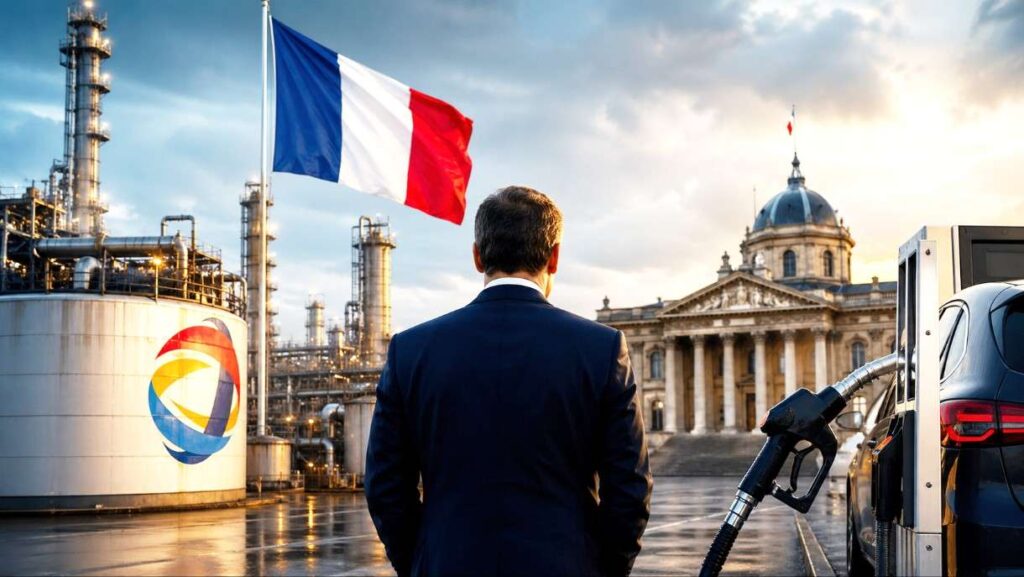
The recent record profits of the French energy company TotalEnergies have reignited an old, politically sensitive question in Paris: How much profit is legitimate in times of geopolitical crises – and when does economic success become a social obligation? Prime Minister Sébastien Lecornu is trying to find an answer that considers both economic reason and social sensitivity.
The situation is tense. In the first quarter of 2026, TotalEnergies increased its profit by over 50 percent to around 5.8 billion dollars. The main driver was the sharply rising oil prices due to tensions in the Middle East – a classic example of how geopolitical uncertainty immediately impacts corporate balance sheets. For French consumers, however, these developments mean above all one thing: persistently high prices at the pump.
Political Tightrope Walk at the Élysée
Against this backdrop, Lecornu has publicly called on the company to return “extraordinary profits” to the population in some form. The choice of words is deliberately vague – a sign of the political balancing act the government under Emmanuel Macron is currently performing.
On the one hand, Macron is under increasing pressure to protect the purchasing power of households. Energy prices directly affect inflation and disproportionately impact lower-income households. On the other hand, the government has committed itself to a business-friendly policy for years, aiming at investment incentives, location attractiveness, and international competitiveness. A harsh taxation of corporate profits could potentially jeopardize this balance.
Lecornus’ approach can therefore be interpreted as an attempt to avoid state intervention without appearing politically inactive. By demanding voluntary measures from the corporation, he signals willingness to act without regulatory escalation.
TotalEnergies and the Logic of Self-Regulation
TotalEnergies responded immediately and referred to measures already in place. Since 2023, the corporation has been limiting fuel prices in France – a tool that is interpreted from the company’s perspective as an indirect redistribution. This argument follows a clear logic: price caps reduce margins and directly benefit consumers without the detour via state redistribution.
From an economic perspective, this model is not without problems. Price caps can provide short-term relief but distort market mechanisms and investment incentives in the long term. Nevertheless, they have a political tradition in France, especially in times of crisis. They allow governments to achieve visible effects quickly without having to use complex fiscal instruments.
For TotalEnergies, the voluntary price limitation also offers a strategic advantage: it strengthens the company’s social acceptance and reduces the risk of regulatory interventions. In an environment where energy companies are increasingly in the focus of political debates, this is a factor not to be underestimated.
Pressure from the Left – and from Europe
Despite these measures, political pressure is growing, especially from left-wing parties. They have long called for a so-called windfall tax – an instrument that has already been temporarily introduced in several European countries. The basic idea is simple: profits that are not based on entrepreneurial performance but on external shocks such as wars or supply shortages should be taxed more heavily.
The debate is by no means purely national. At the European level, the discussion about taxing energy profits has gained momentum since the energy crisis of 2022. The European Union had already adopted temporary measures to tap so-called “windfall profits.” France is thus operating in a tension field between national industrial policy and European regulation.
Economically, the issue remains controversial. Supporters argue that excess profit taxes promote social justice and secure state revenues in times of crisis. Critics, on the other hand, warn of negative investment effects and the politicization of corporate profits. Especially in the energy sector, which requires enormous capital investments – for example in renewable energies – overly aggressive taxation could slow down long-term transformation processes.
Energy prices as a political minefield
The urgency of the debate is explained not least by the central role of energy prices in France’s political system. The protests of the “Yellow Vests” in 2018 vividly demonstrated how sensitive the population is to rising fuel prices. At that time, it was a planned increase of the CO₂ tax that triggered a nationwide protest movement.
This experience significantly shapes current policy. The government is striving to avoid renewed social tensions without abandoning its climate policy goals. In this context, measures such as price caps or voluntary corporate contributions are gaining importance – they appear as a politically expedient middle ground.
At the same time, a structural dilemma becomes apparent: France wants to accelerate the transition to a climate-neutral economy, but remains heavily dependent on fossil fuels in the short term. High oil prices are a potential accelerator of the energy transition from a climate policy perspective, but a risk from a social policy perspective.
Strategic Industrial Policy in the Background
The reluctance towards a direct tax on TotalEnergies also has a strategic dimension. The corporation is one of the most important multinational companies in France and a central player in the global energy market. Its investment decisions – such as in liquefied gas, renewable energies, or hydrogen – have significant impacts on the country’s economic and geopolitical position.
An aggressive tax policy could strain the relationship between the state and companies and impair France’s attractiveness as a business location. At a time when energy supply is increasingly regarded as a matter of national security, this aspect gains additional importance.
Lecornu explicitly emphasized this in the Senate by warning against a blanket “Total bashing.” This choice of words highlights the concern that a politically charged debate could cause long-term damage – not only to the company but to the entire French industrial policy.
Between Pragmatism and Principles
The current course of the government can be described as a pragmatic approach that aims to combine short-term relief with long-term stability. Whether this approach is viable, however, depends on several factors: the further development of energy prices, the geopolitical situation in the Middle East, and not least the domestic political pressure.
If TotalEnergies’ profits continue to rise, the demand for more binding measures is likely to become louder. Voluntary contributions have political limits – especially when they are perceived as insufficient. In this case, the government could be forced to reconsider its position and turn to regulatory instruments after all.
At the same time, the question remains whether the debate about “extraordinary profits” should not be conducted on a more fundamental level. In a globalized economy where companies increasingly benefit from or suffer due to external shocks, the question of fair distribution of risks and profits arises anew. France thus serves as an example of a broader European discussion that goes far beyond the energy sector.
Author: P. Tiko