
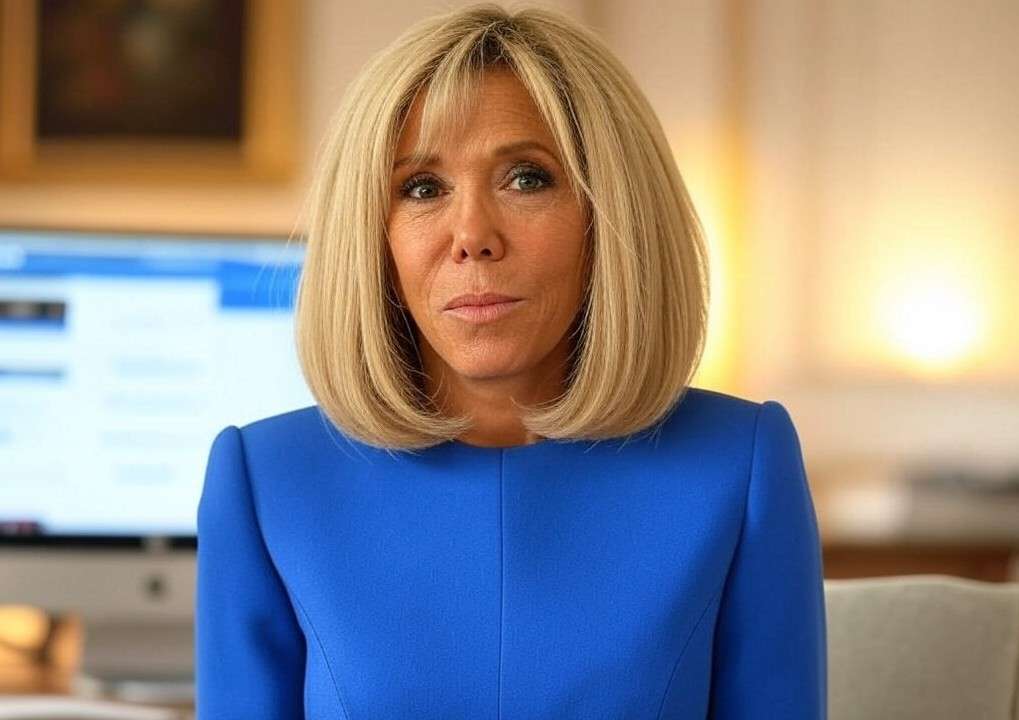
Sometimes a single sentence is enough to trigger a debate that grows far beyond its original cause. In early December, a casually filmed moment, an unthoughtful word, a mobile phone video at the edge of a theater evening sufficed. A few seconds later, the First Lady of France was at the center of a public dispute that raised questions about temperament, responsibility, and the boundaries of privacy anew.
Brigitte Macron, wife of the French president, apologized on Sunday evening, January 4, 2026, in the news program “20 Heures” on the channel TF1 for her choice of words. “I regret having hurt women who might have felt attacked or shocked. That was exactly not my intention,” she said, visibly striving for clarity. And added a sentence that stuck: “I am not a woman of quiet tones.”
The starting point was a video that was circulated on December 8. In it, Brigitte Macron can be heard branding feminist activists who had disrupted a performance by the comedian Ary Abittan with the expression “sales connes” – a coarse, derogatory insult. The activists protested against Abittan’s appearance because he was accused of rape, but the proceedings ended with a dismissal order. Legally acquitted, socially controversial – a powder keg that went off again that evening.
The outrage followed promptly. Not only because of the wording, but because of the speaker. A First Lady insulting feminist activists? For many, the image did not fit. For others, however, it did, because Brigitte Macron has never claimed to be a polished representative figure. “I am not the president’s wife around the clock. There are moments when Brigitte takes over,” she explained on television. A sentence like a shrug, human, perhaps too human for an office without an official job description, but with enormous symbolic weight.
That she apologized again was not the first step of this kind. Already on December 22, she had spoken to the online medium Brut. At that time, she emphasized that the statement was never meant for the public, that she had addressed four people. Her thoughts, she said, were with the women who were actually victims of sexualized violence. Again here: regret, contextualization, distancing. And yet a residue of unease remained.
Because the core of the debate runs deeper. It touches on the question of how much spontaneity a person in a prominent position is allowed. Brigitte Macron is not an elected politician, not a government member, and yet a projection surface. As the wife of Emmanuel Macron, she constantly moves between the private person and the public role. Every exclamation, every gesture, every frown can be read politically—whether intended or not.
Your reference to one’s own temperament acts like a double-edged sword. On the one hand, it makes her relatable. You can almost hear the quiet “That’s just how I am,” that typically French shrug that says: I’m not playing a role, I’m living. On the other hand, the question arises whether that alone is enough. Anyone constantly in the spotlight is measured, whether they want it or not. Moderation is not seen as lack of character, but as a protective mechanism.
The French public is familiar with these debates. They regularly flare up when closeness and distance, emotion and office collide. In this case, another sensitive aspect comes into play: the relationship to the feminist movement. The insult did not target just anyone, but women who—regardless of how their form of protest is judged—represent a social cause. That it is precisely the Première dame who expresses herself in this way intensifies the symbolic rupture.
At the same time, it would be too simple to reduce the affair to a moral black-and-white. Those who have observed Brigitte Macron over the years know about her direct manner, her sometimes blunt humor, her aversion to calculated phrases. She speaks before others have even found the right tone. That makes her popular—and vulnerable. Sometimes something slips out. Some say: that was unfortunate. Others say: that’s exactly where character shows.
The apology on “20 Heures” was certainly more than a formal gesture. It was an attempt to regain interpretive authority without denying oneself. Not a polished statement, but a personal declaration. Whether that is enough remains to be seen. On social networks the criticism is slowly ebbing, it will not completely disappear. The sentence is too harsh, the context too sensitive, the speaker too prominent for that.
In the end, it remains a lesson about publicity in the digital age. Private words hardly exist anymore. A mobile phone is enough, and a moment becomes a political issue. Brigitte Macron has experienced this – not for the first time, but perhaps more impressively than before. Her words were sharp, her remorse audible, her temperament undisputed. In between lies the expectation of a country that demands humanity from its public figures but only tolerates mistakes to a limited extent. Well. Welcome to real life, one might say. Or to the very public one.
By C. Hatty