
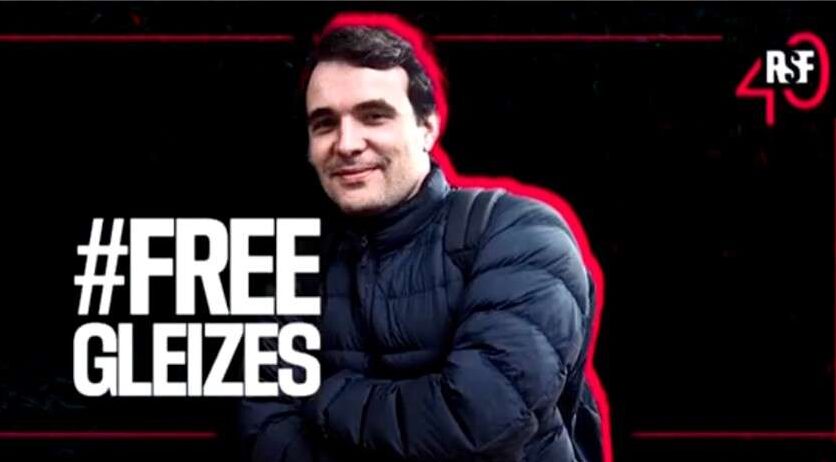
The French journalist Christophe Gleizes has been detained in Algeria for nearly two years. Now the contributor to the magazines So Foot and Society has withdrawn his cassation appeal against the seven-year prison sentence for alleged “support of terrorism.” Legally, this step means the final recognition of a verdict. Politically, however, it could pave the way for a presidential pardon by the Algerian head of state Abdelmadjid Tebboune.
The decision marks a remarkable turn in a case that has long become a symbol of the tense relations between France and Algeria. At the same time, it reveals the limits of legal defense in politically charged proceedings within authoritarian systems – and unveils the central role of the president as the ultimate power factor in the Algerian state.
A journalist between sports reporting and state security
Christophe Gleizes traveled to Algeria in May 2024 to report on Jeunesse Sportive de Kabylie (JSK), a traditional football club from Kabylia. The region has long been considered a sensitive terrain of Algerian domestic politics. Kabylia, predominantly inhabited by Berbers, has repeatedly been the scene of autonomist and opposition movements.
At the center of the accusation are Gleizes’ contacts with a representative of the “Mouvement pour l’autodétermination de la Kabylie” (MAK). The Algerian authorities accuse him of having communicated with an official of the movement between 2015 and 2017. However, problematic from the perspective of many observers is the chronological sequence: the MAK was officially classified as a terrorist organization by Algeria only in 2021.
From a legal point of view, this raises the question of the prohibition of retroactive effect of criminal law provisions – a fundamental principle of modern rule of law. Human rights organizations and numerous French media therefore argue that the conviction is based on a politically motivated interpretation of the concept of terrorism. The accusations against Gleizes are ultimately part of a broader repression strategy against critical voices and the Kabyle question.
The Logic of Renunciation
The withdrawal of the cassation appeal appears paradoxical at first glance. A defendant voluntarily waives the last legal possibility to challenge his conviction. In fact, however, this step follows a clear political calculation.
According to Algerian law, a presidential pardon can only take place once a judgment is final. As long as a procedure remains pending before the Court of Cassation, the legal processing is considered incomplete. By waiving the appeal, the defense therefore consciously removes the last formal obstacle to a pardon decision.
Lawyer Emmanuel Daoud spoke of a necessary “change of course” in order to “preserve all chances of release.” This is based on the assessment that the legal level in this case hardly promises any more success. Instead, hope is placed on a political solution.
Historically, this approach is by no means unusual. In numerous authoritarian or semi-authoritarian systems, pardons serve as instruments of political flexibility. The state formally maintains the authority of its judiciary, while the political leadership can simultaneously defuse international tensions.
Kabylia as a Nervous Point of Algeria
To understand the severity of the approach against Gleizes, the importance of Kabylia for the Algerian state must be taken into account. Since independence in 1962, Algiers has pursued a strongly centralized state doctrine. Regionalist or ethnically defined movements have traditionally been viewed with suspicion.
The MAK originally developed as a political movement for greater autonomy of Kabylia. After the mass protests of the Hirak from 2019 onwards, however, the government significantly tightened its security policy course. In 2021, the MAK was officially classified as a terrorist organization. Since then, the state increasingly uses anti-terror laws also against opponents, activists, and journalists.
International observers see this as a deliberate expansion of the terrorism concept for political control. Amnesty International and Reporters Without Borders have repeatedly accused Algeria of using anti-terror laws to restrict press freedom.
The Gleizes case therefore strikes a sensitive nerve. For Algeria, it is not just about a foreign journalist, but about the demonstration of state sovereignty in a politically highly sensitive region.
Tense relations between Paris and Algiers
The case also falls into a phase of exceptionally tense French-Algerian relations. Although the two countries are closely linked economically and socially, the political relationship remains shaped by historical traumas.
Three areas are particularly conflict-ridden.
First, the memory politics surrounding the Algerian War. Despite repeated rapprochements under Emmanuel Macron, the colonial past remains a permanent point of contention between the two states.
Second, the Western Sahara issue causes significant tensions. France has recently moved closer to Morocco, which is perceived in Algiers as a strategic provocation.
Third, cases of imprisoned French or Franco-Algerian personalities are increasing. Besides Christophe Gleizes, especially the writer Boualem Sansal attracted international attention. His arrest intensified the perception in France of increasing repression in Algeria.
In this context, each individual case takes on a diplomatic dimension. The French government is under pressure to secure the release of its citizens without at the same time provoking an open escalation with Algiers.
Why a pardon could be attractive for Tebboune
For President Abdelmadjid Tebboune, a pardon could offer several advantages. Domestically, he would not have to publicly correct the judiciary. The conviction would formally remain in place, allowing the state to maintain its hard line against the MAK.
In foreign policy terms, however, a signal of détente could be sent. Algeria has been striving for years to attract international investments, energy policy partnerships, and diplomatic stability – especially since Europe has been increasingly seeking alternative gas suppliers following Russia’s attack on Ukraine.
The case of an imprisoned French sports journalist significantly damages this image. The mobilization of over 300 French media outlets as well as international press freedom organizations has increased the pressure on Algiers.
A presidential pardon would therefore open a face-saving way out. It corresponds to a well-known pattern in Algerian power politics: the judiciary formally maintains its authority, while the president presents himself as a pragmatic arbitrator.
Between the rule of law and political reality
The case of Christophe Gleizes exemplifies the tension between legal formality and political power in Algeria. The withdrawal of the cassation appeal is less an expression of resignation than a recognition of a political reality: In sensitive cases, it is ultimately not only the legal system that decides, but political expediency.
Whether Tebboune will actually take the opportunity to grant a pardon remains open. Traditionally, such measures often take place on national holidays or diplomatically significant moments. Observers therefore speculate about possible steps in the coming months.
For Christophe Gleizes, foregoing the last legal recourse is a risky decision: the definitive acceptance of a controversial verdict against the hope of political mercy. This makes his personal fate ultimately part of a larger power game between state security, international pressure, and the fragile relationship between France and Algeria.
Author: P. Tiko