
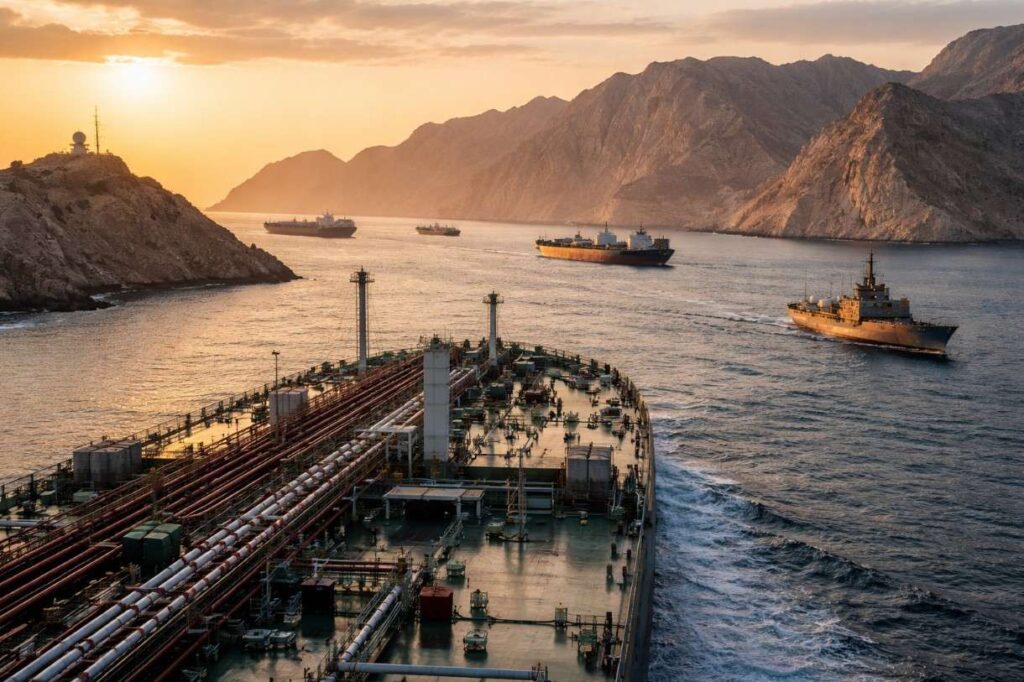
The decision by French President Emmanuel Macron not to participate initially in the military securing of the Strait of Hormuz goes beyond mere tactical restraint. It reflects a strategic mindset deeply rooted in France’s diplomatic tradition, signifying influence through distance, mediation, and deliberate non-involvement in a chain of military escalation.
At a time when tensions around Iran are rising and uncertainty in the global energy system is increasing, this decision appears as a balancing act between geopolitical responsibility and political self-assertion.
Bottleneck of the Global Economy
The Strait of Hormuz is one of the world’s most sensitive bottlenecks in infrastructure. Millions of barrels of crude oil pass daily through the narrow strait between Iran and Oman, accounting for nearly one-third of the world’s maritime oil trade.
Since the military escalation surrounding Iran, the situation has markedly worsened. Attacks on commercial vessels, threats of a full blockade, and obvious regional military build-up characterize this situation. For the international community, a classical security policy issue arises: should stability be enforced by military presence, or should it be maintained through political de-escalation?
France’s Strategic Restraint
Paris has chosen the latter option for the time being. The official justification refers to the “current situation,” which is intentionally ambiguous yet politically accurate. This indicates a willingness to act while not fully committing to it, leaving room for diplomatic maneuvering.
In this way, France continues the course of its Middle East policy that has lasted for decades. In other words, maintaining the possibility of dialogue even with difficult counterparts. Particularly with Tehran, Paris has always sought to keep channels of communication open, including within the framework of negotiations regarding Iran’s nuclear program.
Participation in Western-led security missions complicates this role significantly. In Iran’s eyes, France risks shifting from a potential mediator to an open participant in the conflict.
Differences within the Western Alliance
This decision also reveals structural tensions within the Western alliance. While the United States traditionally emphasizes military deterrence, France pursues a more diplomatic strategy.
This difference is not new. It recalls previous lines of conflict such as the Iraq War in 2003 and the intervention in Libya in 2011, but with reversed roles. France asserts an independent foreign policy judgment that does not automatically align with Washington’s priorities.
The concept of “strategic autonomy,” which has gained significant importance in recent European debates, is taking on concrete political contours. Paris is demonstrating that this autonomy is not merely rhetorical but can lead to different decisions even in critical situations.
Risk assessment between security and escalation
However, restraint carries risks. Although sources have diversified since the Ukraine crisis, Europe still heavily depends on a stable flow of energy. Continued disruption of the Strait of Hormuz would immediately cause economic impacts—rising energy prices, burdens on industry and consumers, and possibly new inflationary shocks.
Nevertheless, the French government seems to have concluded that the risks of military intervention outweigh these. An enhanced Western presence would be perceived as provocation by Iran, potentially leading to direct confrontation, the outcomes of which are largely unpredictable.
Diplomacy as a means of power
Instead, France is relying on diplomatic mediation, a traditional strength of its foreign policy. This strategy is not detached from the pursuit of interests. Those accepted as dialogue partners gain political influence—especially in regions where trust is scarce.
Paris deliberately takes a position standing between both camps. It avoids a clear military stance while simultaneously leaving open the option to act as a mediator in the event of further escalation.
However, whether this calculation will succeed depends on factors beyond France’s control. Namely, the domestic political developments in Iran, the strategic direction of the United States, and above all the stability of the entire Gulf region.
Therefore, France’s decision can be seen less as an expression of restraint and more as a calculated political signal. It highlights a fundamental question in European foreign policy: namely, how influence can be secured—whether through military presence or diplomatic agility—in an increasingly fragmented world order.
The answer Paris is currently showing is clear, but its effectiveness will be proven in the coming months.
Author: P. Tiko