
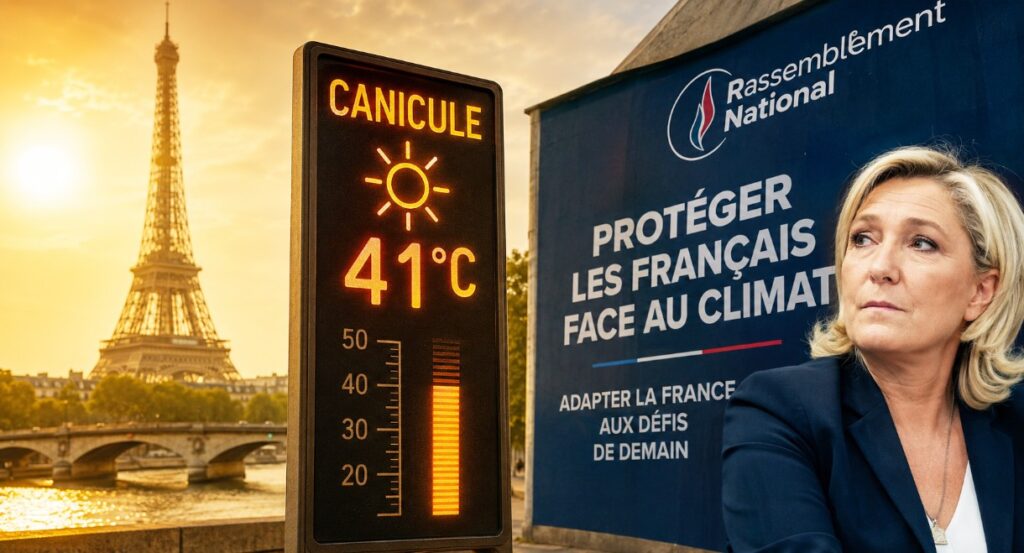
France is experiencing one of the most intense heatwaves of recent years. In numerous regions, temperatures soar well above 35 degrees Celsius, hospitals prepare for additional patients, schools adjust their operations, and municipalities set up air-conditioned refuges for particularly vulnerable people. The canicule not only dominates the news but also changes the political discourse. Even parties that long approached climate protection with great distance are suddenly finding new words. This change is particularly evident with the Rassemblement National.
For years, the party frequently criticized climate policy measures as excessive, ideologically motivated, or as burdens on the economy and consumers. Especially European climate regulations were regularly at the center of their criticism. Today, the tone sounds very different. Leading representatives of the RN speak openly about the consequences of climate change and call for measures to better protect France against extreme heat, droughts, and other weather events.
The change is noticeable. Instead of debating the causes of global warming, the party increasingly focuses on adapting to its consequences. More air conditioning in public buildings, better-insulated homes, additional water reserves, and investments in civil protection now count among the most important demands. The protection of older people as well as air-conditioned schools and care facilities also play a larger role in current statements.
This course is no coincidence. Surveys have shown for years that environmental and climate issues no longer concern only voters from the left or ecological camps. Even conservative citizens increasingly view climate change as one of the most important political problems. Therefore, a party aspiring to govern can hardly ignore this topic anymore.
Nevertheless, this is not a fundamental shift in climate policy. The RN clearly distinguishes between climate adaptation and classic climate protection. While measures to protect against the consequences of extreme weather events are supported, the party continues to reject numerous instruments for reducing greenhouse gas emissions.
It is particularly critical of the European Green Deal as well as additional environmental regulations for companies. Stricter rules for drivers or farmers also meet opposition from the RN. Instead, the party advocates for the further expansion of nuclear energy, stronger national control over energy policy, and limiting European interventions. From the party leadership’s perspective, climate protection can only s쳮d if economic competitiveness and national interests are prioritized.
This strategy allows the RN a political balancing act. On the one hand, the party now acknowledges the reality of climate change much more visibly than a few years ago. On the other hand, it avoids demands that its traditional electorate might perceive as restrictions on daily life or additional financial burdens. This is precisely the core of the new communication strategy.
The extraordinary heatwave, however, makes this balancing act more difficult. Record temperatures, forest fires, water shortages, and health risks ensure that many people experience the consequences of climate change directly. The topic suddenly has a completely different urgency than just a few years ago. Political responses must therefore appear credible and practicable for everyday life.
The RN tries to pick up on this development by linking climate issues more strongly with concrete life situations. The party talks about heat-resistant cities, more shaded areas, resilient infrastructure, and better precautions for particularly vulnerable population groups. This shifts the focus deliberately from long-term emission targets to short-term protective measures.
The political competition, however, views this new tone with great skepticism. Representatives of left-wing parties and numerous environmental organizations accuse the RN primarily of modernizing its language. The fundamental positions have changed little. Those who continue to reject central instruments for reducing emissions can hardly convey the impression that climate protection has become a political priority.
Many political scientists also differentiate between communication and actual programmatic content. While numerous parties understand climate protection and climate adaptation as two inseparable components of the same strategy, the Rassemblement National focuses almost exclusively on dealing with the already visible consequences of global warming. The causes themselves receive much less attention.
Whether this strategy will pay off in the long term remains open. However, it is clear that the political debate in France is changing. Extreme weather events ensure that climate policy is increasingly becoming an everyday topic. Questions about energy supply, health protection, infrastructure, and public safety can hardly be separated from the impacts of climate change anymore.
For the Rassemblement National, this means a challenging tightrope walk. The party tries to meet the expectations of a population that increasingly perceives climate change as a concrete threat without simultaneously abandoning its fundamental economic and European policy convictions. Whether this balancing act s쳮ds is likely to become apparent in the coming months. The current canicule has at least made it clear that climate change now affects all political camps—even those that for a long time focused mainly on other issues.
An article by M. Legrand