
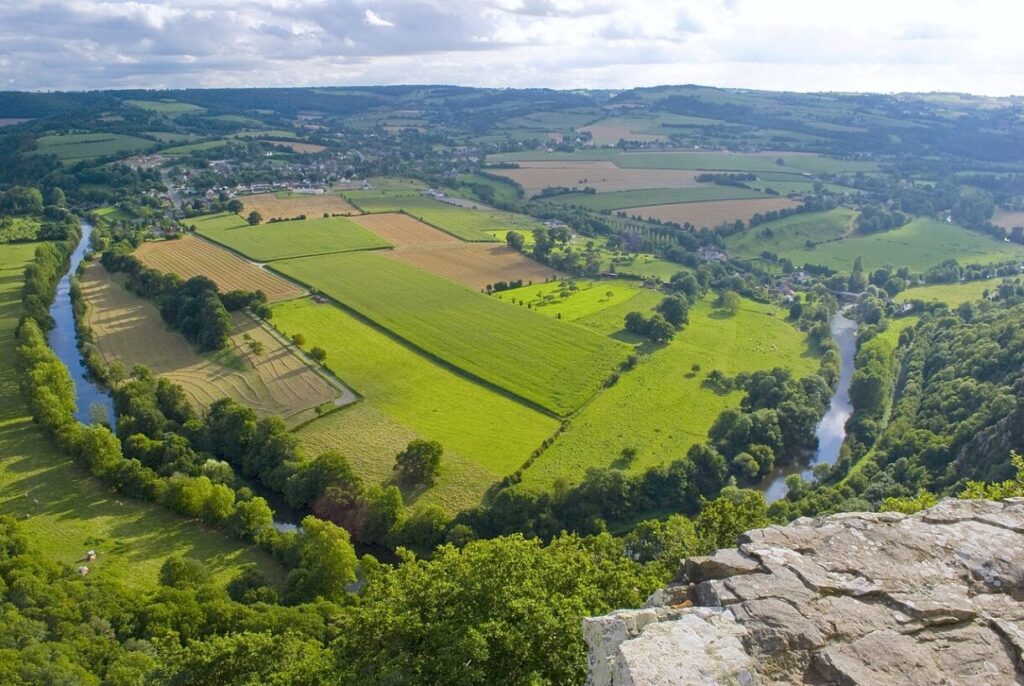
Those who immediately think of long sandy beaches, the chalk cliffs of Étretat, or Mont Saint Michel when hearing Normandy will discover a completely different world inland. The so-called Norman Switzerland surprises with deeply incised valleys, rugged cliffs, dense forests, and a landscape that in some places resembles more of a low mountain range than the gentle hills of northern France. The region received its name in the 19th century when travelers compared its distinctive ridges and river bends to the landscapes of Switzerland.
Located between the Départements of Calvados and Orne, the Suisse normande today is considered one of the most beautiful natural regions of Normandy. Hikers, cyclists, canoeists, and all those seeking peace in a varied landscape find ideal conditions here.
Just the journey makes it clear that this area breaks the mold. The roads wind through wooded hills, pass small villages, and repeatedly open wide views onto valleys and rivers. Instead of flat meadows, steep slopes and rocky heights shape the landscape. This very contrast is what gives the region its special appeal.
The river Orne is primarily responsible for the spectacular landscape. Over millennia, it carved deeply into the rock and formed gorges, cliffs, and numerous river bends. Elevation differences of more than 300 meters give the area a dynamism that many visitors to Normandy would hardly expect. Standing on one of the viewpoints, you look over a mosaic of forests, meadows, and winding river courses.
Among the best-known natural attractions are the Roches d’Oëtre. These imposing cliffs rise more than a hundred meters above the Rouvre valley and offer one of the most impressive views in all of Normandy. Especially in the early morning hours or just before sunset, the landscape appears almost magical. Mist drifts through the valleys while the light bathes the cliffs in warm colors. It’s easy to say: this almost looks like a mountainous region.
Just a few kilometers away lies Clécy, often called the capital of Norman Switzerland. This charming village clings to the banks of the Orne and serves many visitors as a starting point for their explorations. Cobblestone lanes, well-kept houses, and flower-adorned facades give the place a cozy atmosphere. Small cafés and restaurants invite you to take a break before the next adventure begins.
Clécy enjoys an excellent reputation especially among friends of active holidays. Canoe tours regularly start here on the Orne, suitable for both beginners and families. The boat gently glides through the river landscape, past steep slopes, meadows, and old stone bridges. Those who prefer to stand upright take up paddleboarding and discover the river from a completely new perspective.
Opportunities on land are plentiful as well. Hiking trails lead through forests, over ridges, and along former railway lines. Mountain bikers appreciate the varied routes with their climbs and rapid descents. The cliffs offer ideal conditions for climbers, while paragliders use the thermals to glide silently over the valleys. Even a via ferrata provides additional variety and opens spectacular views.
But not every visit has to be sporty. Often a leisurely walk along the Orne or through the small streets of Clécy is enough to leave everyday life far behind. The rustling of the water, bird songs, and the scent of the forests create an atmosphere that slows down the pace.
A dense network of marked hiking trails opens up almost the entire region. Several hundred kilometers run through diverse landscapes, connecting forests, river valleys, and traditional villages. Especially popular is the circular hike to the Roches d’Oëtre and the gorges of the Rouvre. Shady forest sections alternate with open viewpoints along the way. Around every bend, a new panorama awaits – and that is exactly what makes these tours so appealing.
Ambitious hikers often choose longer stages between Clécy, Pont d’Ouilly, and Thury Harcourt le Hom. Along the way, they encounter historic bridges, old churches, and small farms that still shape the rural character of the region today. Benches or picnic spots invite repeated pauses. Does every excursion have to lead from one sight to another?
Especially during the summer months, Norman Switzerland shows its most pleasant side. Forests and rivers provide a comparatively mild climate. Even on warm days, many places remain pleasantly cool. Families use the recreational opportunities along the Orne for canoe trips or relaxed afternoons by the water. Children discover dragonflies and small fish while adults enjoy the tranquility.
Of course, regional cuisine also plays an important role. Numerous producers sell their specialties directly at the farms or at small markets. Fresh Camembert, Livarot, spicy cider or Poiré belong to the region as much as the traditional Teurgoule, a slowly baked rice pudding with cinnamon. Homemade jams, honey, and other products authentically represent the taste of Normandy.
Besides Clécy, other places are worth a stop. Pont d’Ouilly impresses with its relaxed location right on the river and is a popular meeting point for water sports enthusiasts. Saint Philbert sur Orne forms the gateway to the Roches d’Oëtre and is an excellent starting point for hikes. Thury Harcourt le Hom, in turn, combines historic buildings with well-developed bike paths and a peaceful atmosphere.
Despite its scenic beauty, Norman Switzerland remains pleasantly unspoiled in many places. Large crowds of visitors are usually hard to find. Instead, nature, serenity, and small encounters shape the stay. Those who let their gaze wander often hear only the wind in the trees or the splashing of the Orne. Isn’t that sometimes the greatest luxury?
The region can be reached within a few hours from Paris or the coasts of Normandy. This makes it suitable both for a weekend trip and for a longer stay. Between impressive rock formations, idyllic river courses, and lively villages, a side of Normandy reveals itself that surprises even many France connoisseurs. Those who appreciate nature, activity, and authentic landscapes will discover here a region that stays long in the memory.
M. Legrand