
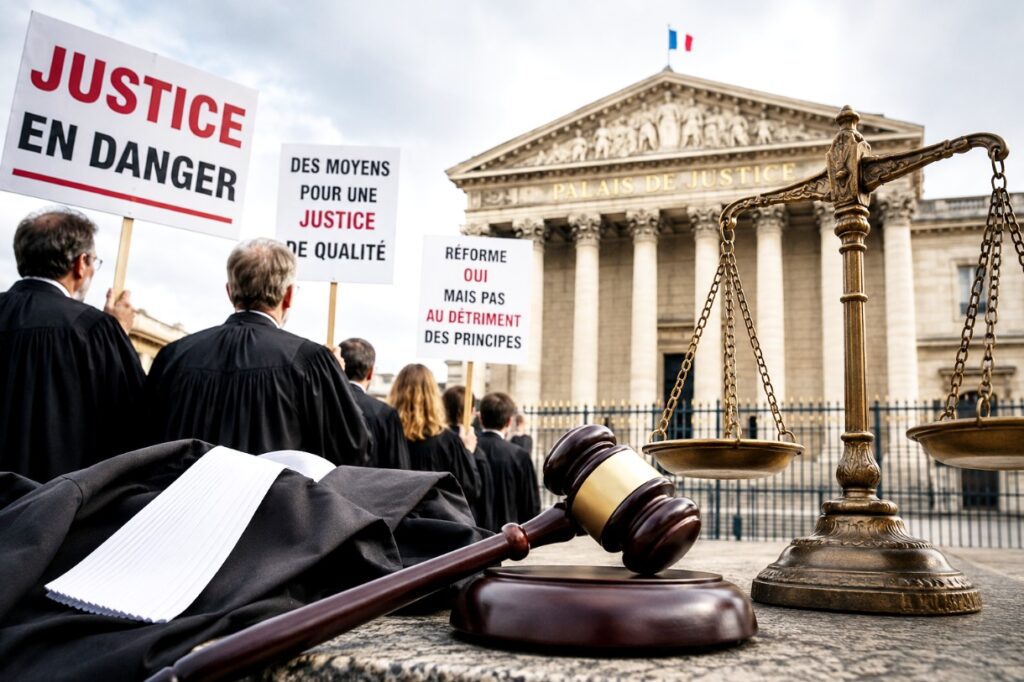
The French judiciary is witnessing a rare show of unity among its key professions. Judges, public prosecutors, lawyers, and court clerks have announced nationwide protests for Monday. They are opposing what they consider untenable working conditions and a reform of the criminal jurisdiction that, according to many legal experts, may speed up proceedings but at the same time weaken fundamental principles of the rule of law. Behind the current protests lies a deeper problem: for years, the judicial workload has been increasing while reforms are often perceived as insufficient and poorly coordinated.
A Judiciary at the Limit
Overburdening has long become routine in the country’s courts. The number of complex cases continues to rise steadily, while staff shortages and organizational deficiencies make the work even more difficult. Long durations of proceedings, overcrowded courtrooms, and increasing administrative burdens shape the daily professional life of many judges and court clerks.
The legal profession also deplores a trend toward an increasingly standardized mass justice system. There is less and less time available for the careful preparation and trial of individual cases. The claim to an individualized and thorough adjudication is therefore coming under growing pressure.
With the protest actions, the professional associations aim to draw attention to this situation. Court boycotts, postponed hearings, and demonstrations in front of judicial buildings are planned in numerous cities. The goal is to raise public awareness of the structural problems of the French judiciary.
The Reform of the Criminal Jurisdiction Sparks Fierce Criticism
At the center of the dispute is the reform of the French criminal jurisdiction. The government aims to introduce the so-called Cour criminelle départementale nationwide. These criminal courts decide on serious crimes solely with professional judges and replace the traditional jury courts in numerous cases, in which citizens serve as jurors.
From the government’s perspective, this reorganization is intended to solve several problems simultaneously. Proceedings should be completed more quickly, backlogs reduced, and courts organizationally relieved. Given years of overloading, a more efficient structure seems politically understandable.
However, many legal experts see significant risks. They are especially critical of the gradual withdrawal of jury courts. Citizen participation in the judiciary is considered an important expression of democratic legitimacy and social oversight. Its diminishing importance is therefore seen not only as an organizational change but also as an intrusion into the self-understanding of criminal justice.
Furthermore, defense attorneys fear that particularly serious crimes could in the future be tried in a less formal and less thorough setting. There are also doubts within the judiciary about whether a consistently high quality of adjudication can be guaranteed under the existing personnel conditions.
An Unusual Show of Unity
What is remarkable above all is the cohesion of the protest movement. Professions that often face different interests in everyday court life largely agree on the same analysis this time.
Judges criticize a judicial policy that, in their view, focuses too much on organizational reforms without addressing the actual causes of overburdening. Lawyers, on the other hand, point to increasingly tight time constraints, overcrowded schedules, and rising pressure on effective defense.
This unusual consensus gives the protests particular weight. It is no longer solely about professional-political demands of individual groups but about fundamental questions concerning the overall functionality of the French judiciary.
Chronic Staff Shortages Remain the Core Problem
At the heart of almost all demands is the judicial staffing level. Although budgetary resources have been increased several times over recent years, France still lags behind in Europe regarding the personnel of its courts. In particular, the number of judges and court clerks in many places is insufficient to handle the steadily growing number of cases promptly.
The protesters argue that organizational reforms alone cannot achieve a sustainable improvement. Without additional positions, modern infrastructure, and long-term investments, there is a risk that new structures will merely shift existing bottlenecks instead of actually solving them.
A Political Balancing Act for the Government
The protests come amid intense debates about the performance of state institutions. The judiciary increasingly stands at the crossroads of different societal expectations. Citizens demand quick decisions, consistent law enforcement, and at the same time rule-of-law diligence and comprehensive procedural guarantees.
This poses a difficult balancing act for the government. On one hand, there is considerable pressure to accelerate proceedings and reduce backlogs. On the other hand, modernization must not create the impression of compromising rule-of-law standards in favor of administrative efficiency.
Especially the reform of the criminal jurisdiction illustrates how closely organizational issues are linked with democratic principles. The discussion therefore goes far beyond legal circles and touches on central questions regarding the relationship between the state and its citizens.
Monday’s mobilization is therefore much more than a protest against difficult working conditions. It highlights a fundamental conflict: How can a modern judiciary operate efficiently, independently, and with high quality at the same time? The involved professional groups do not fundamentally question reforms but demand to be involved early in their design and that necessary personnel and financial prerequisites be created.
Because citizens’ trust in the judiciary does not rest solely on speedy proceedings. Crucial is the conviction that judgments are made carefully, independently, and under fair conditions. Many of today’s protesters increasingly see this trust endangered.
Author: P. Tiko