
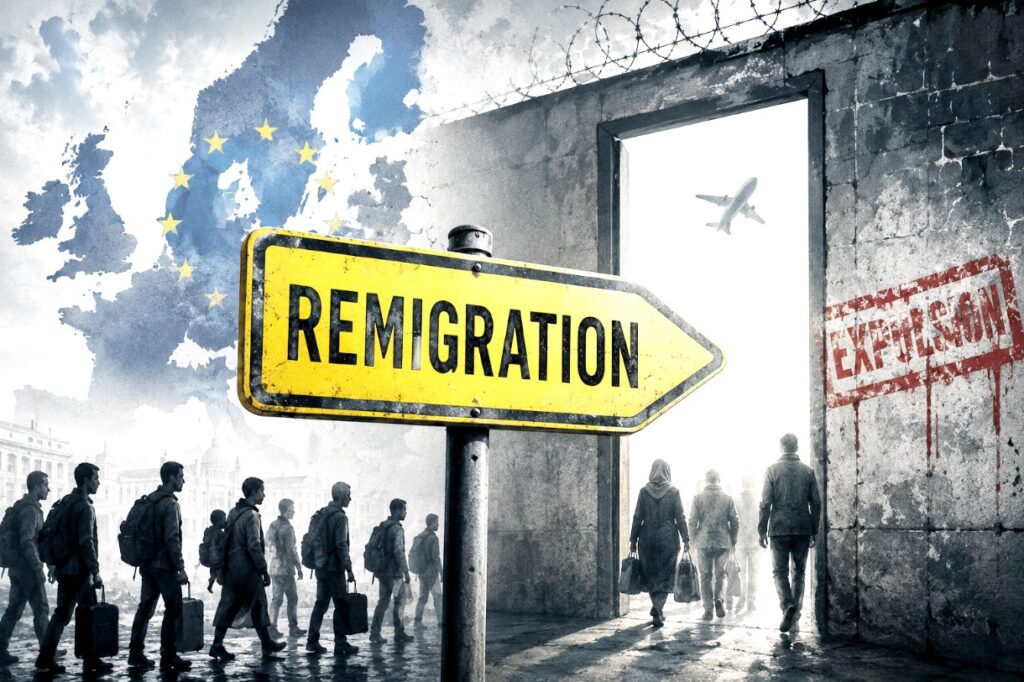
Few terms have polarized the European migration debate in recent years as much as “remigration.” What originally was a slogan of small identitarian groups has now become part of the political vocabulary of various right-wing populist and far-right parties. While supporters understand it to mean the consistent return of rejected asylum seekers, critics see it as a political concept that extends far beyond existing migration law and calls fundamental principles of the democratic constitutional state into question. The debate exemplifies how political concepts from ideological fringe milieus can gradually enter public discourse.
Origins in the identitarian movement
The term “remigration” emerged in the early 2010s within the European identitarian movement. Particularly in France, Austria, and Germany, organizations such as the now-banned Génération Identitaire adopted the term and made it a central part of their political strategy. Ideologically, the concept is linked to the views of the so-called “New Right,” which since the 1970s has sought to place cultural identity and ethnic affiliation more firmly at the center of political debates.
Originally, remigration referred to the return of migrants to their countries of origin. Over time, however, the meaning has been increasingly broadened. In publications and policy proposals by various identitarian actors, it no longer includes only persons required to leave the country or rejected asylum seekers. Sometimes long-term resident foreigners, registered citizens, or even people born in Europe with a migration background are also included, provided that, according to the respective representatives, they are deemed insufficiently culturally integrated.
It is precisely this substantive expansion that explains why the term goes far beyond traditional demands for restrictive immigration policy.
A strategically chosen term
The political success of remigration is due in no small part to its linguistic effect. Unlike terms such as “mass expulsion” or “deportation,” remigration sounds relatively neutral and technical. The designation suggests an orderly return policy and is often associated with voluntary departure programmes or financial return assistance.
Communication scholars, however, point out that political terms are often deliberately chosen to linguistically soften controversial content. This is also why critics view the expression as a strategic euphemism. Numerous policy texts of identitarian movements contain ideas that extend far beyond voluntary return programmes and would require far-reaching changes to citizenship and residency law.
The differing meanings of the term also make an objective discussion more difficult, because different political actors understand very different concepts by the same word.
Germany as the center of the controversy
Especially at the beginning of 2024, remigration was intensely debated in Germany. The trigger was an investigation by the investigative media outlet Correctiv into a meeting in Potsdam, attended by representatives of the Identitarian movement, businesspeople, and individuals from circles around Alternative for Germany (AfD).
According to the investigation, concepts were presented there that envisaged, under the term remigration, the departure or deportation of a very large number of people—including German citizens with a migration background. The publication prompted significant political reactions nationwide. In numerous German cities, several million people demonstrated in the following weeks against right-wing extremism and against a possible radicalization of political positions.
The AfD, by contrast, stated that it primarily advocates for more consistent deportation of persons required to leave the country and rejected various accounts of the content and significance of the meeting. Nevertheless, the events led to an intense debate about the limits of legitimate migration policy and the influence of far-right ideologies on parliamentary parties.
Spread across Europe
The term has long been no longer limited to Germany. In Austria, too, remigration is used by some politicians of the Freedom Party of Austria (FPÖ). In Belgium and the Netherlands, the expression has been part of the vocabulary of various nationalist and identitarian groups for years.
In France, the term is found primarily in the milieu of identitarian movements and among some representatives of the nationalist right wing. The Rassemblement National party, by contrast, uses it much more cautiously. Instead, it mainly speaks of limiting migration, stricter control of external borders, national priority, or the deportation of foreigners who have become criminals.
These differences make it clear that even within right-wing parties there is no uniform definition of the term.
Why is the concept gaining support?
The increasing spread of the term coincides with a period in which migration is among Europe’s dominant political issues. Since the refugee crisis of 2015, immigration, integration, and asylum policy have remained the subject of intense social debates.
Several developments contribute to the appeal of such demands. These include increasing migration flows to Europe, integration problems in certain urban districts, Islamist terrorist attacks in recent years, discussions about national identity, and economic and social uncertainties. Added to this is the enormous reach of social networks, through which political keywords can spread across Europe within a short time.
For supporters, remigration represents a way to preserve national identity, social cohesion, and domestic security in the long term. Opponents, by contrast, see it as a concept that is difficult to reconcile with the fundamental principles of liberal democracies. They point in particular to the principle of equality, protection against discrimination, and the rights associated with citizenship.
A term without a legal definition
An important reason for the ongoing controversy is that remigration is not a legally defined term. Unlike expulsion, deportation, or voluntary return, there is no binding definition for it in either European or national law.
Depending on the political context, remigration can therefore have very different meanings. Some understand it exclusively as the deportation of persons residing illegally or the return of rejected asylum seekers. Others include voluntary return programmes with financial support. In the most radical interpretations, however, the term also encompasses people with a permanent right of residence or even citizens whose ties to society are called into question.
This conceptual vagueness contributes significantly to the fact that the debate often takes place at cross purposes. While some actors use the term as a synonym for the consistent application of existing law, others associate it with far-reaching social and political views.
Remigration has thus become less a clearly defined political programme than an ideological marker. Its development exemplifies how terms originating in initially small political milieus can gradually gain traction in public debates. At the same time, the controversy makes clear the importance of language in migration policy. Behind individual terms often lie very different views of citizenship, national identity, integration and the role of the state. It is precisely for this reason that the debate on remigration is expected to remain a central issue in European politics in the future.
Author: P. Tiko