
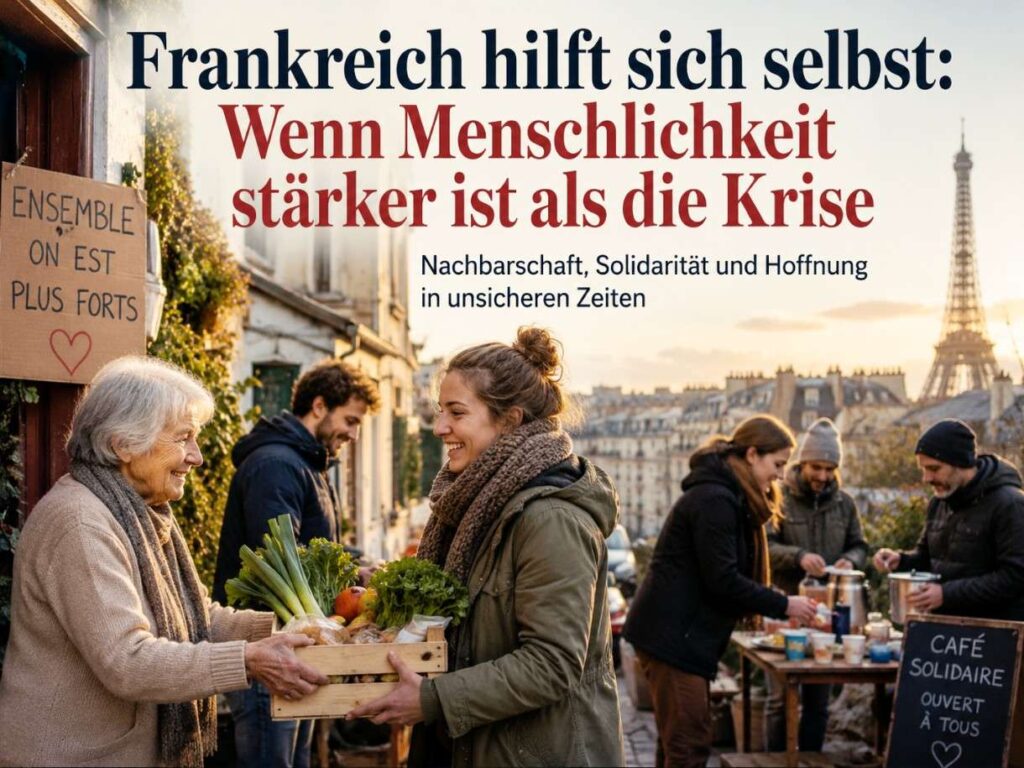
It is rare news in an era marked by crisis, war, and constant tension. For years, headlines about inflation, social tension, geopolitical conflicts, and economic uncertainty have dominated public discourse. Many people woke up in the morning to bad news and went to bed at night with new worries.
That is why a change quietly and almost unremarkably happening in France deserves even more attention — perhaps for that very reason, it holds great significance: people have started helping each other again. Not out of obligation, nor because the state organized it. Rather because they realized that no one can navigate these uncertain times alone.
This is the quiet recovery of humanity.
Small gestures suddenly feel large
They are barely noticeable in huge political debates: like taking a neighbor grocery shopping, providing free meals for students, caring for the elderly in the village, or looking after children so a single parent can work.
But it is precisely in these places that France’s hopeful side is currently revealed.
Carpooling (shared rides) is emerging in apartment complexes. Strangers share furniture, clothing, and household appliances with each other. Young families organize group purchases to save money. Students help the elderly with digital document preparation, and in return, the elderly provide warm meals. In many areas, neighbors have come to know each other’s names again.
These may seem like small scenes, but it is precisely because of that that they are moving.
They contradict the image that society is only individualistic, sensitive, and selfish.
Crises have changed people
France has gone through difficult times. The pandemic left deep marks. This was followed by inflation, rising energy prices, and fears of political tension and social decline. Many lost the belief that prosperity guarantees security.
But crises do not only change society for the worse. Sometimes they awaken people to what truly matters.
Suddenly, time became more important than consumption, closeness more than status, and help more than competition.
The past few years have shown many French people how vulnerable modern life has become. How quickly what once seemed stable can be shaken. Perhaps it is from this that something long lost has reemerged: true compassion.
Those who have experienced anxiety themselves recognize the anxiety of others more quickly.
A Society That Refuses to Harden
What is especially moving is that this solidarity often comes from people who themselves have almost nothing. In many places, it is not the wealthy who uphold social life, but those who know how difficult everyday life has become.
An elderly person sharing food on a small pension. A worker giving free rides to neighbors to their workplace. A student sharing the last plate of pasta. A baker distributing leftover bread for free in the evening.
These actions are not glamorous. But they say something fundamental about France.
Despite all political tensions, despite anger and anxiety, despite social fatigue, part of the nation seems to refuse to become cynical.
And it is right here that perhaps the most important news of our time lies.
The ‘We’ That Has Returned
For years, the feeling prevailed that everyone had to fight alone. Careers, competition, performance pressure, and soaring living costs fostered a daily routine that left little room for community.
Now, something new is slowly emerging — or perhaps something very old is being revived.
People are rediscovering the value of the collective. Not as a political theory, but as a practical reality of life. People help each other because they have understood that social warmth in times of crisis can be more important than economic success.
This development cannot be measured by growth figures. It does not appear in any statistics of the European Central Bank. Nevertheless, in the long term, it may be more important than many economic reform programs.
Society does not first break apart because of inflation or crisis. It only breaks apart when people stop caring about each other.
Currently, France is showing the opposite.
Perhaps hope begins exactly like this
Of course, mutual aid does not solve the big problems of the state. It cannot replace properly functioning social policies, fair wages, or affordable housing. Many people are still fighting economic insecurity.
However, in this anxiety, something that seemed impossible for a long time is happening: people are rediscovering trust in each other.
Perhaps that is the real good news.
It is not that everything suddenly got better. Instead, it is important that many French people have not lost the ability to show solidarity despite all difficulties.
In a world full of aggressiveness, social coldness, and persistent anger, that almost seems revolutionary.
Perhaps hope does not begin with a grand political speech. Perhaps it begins with a warm meal for a neighbor. It begins with small gestures like bringing groceries together. It begins with open ears. It begins with people telling each other, “You are not alone.”
And maybe, in the end, that might be stronger than any crisis.