
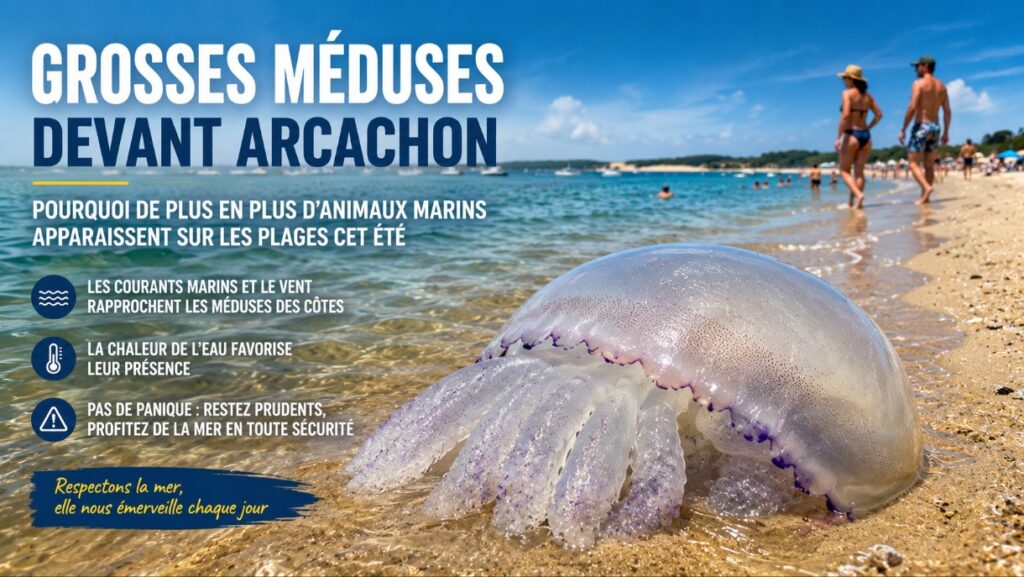
Anyone wishing to enter the water at the beaches of the Bassin d’Arcachon or on the Atlantic coast of Gironde often first looks carefully out to sea. In recent days, reports of unusually large jellyfish close to the coast have been piling up. Some holidaymakers therefore decide not to swim, while others prefer to observe the fascinating creatures from the beach. The sight is impressive, but in most cases it is a completely natural phenomenon.
During the summer months, jellyfish regularly drift from the open Atlantic Ocean toward the coast. The combination of wind, tides and sea currents is responsible for this. Especially after longer periods of westerly winds, the animals drift toward the beach and gather in sheltered bays or shallow coastal areas. Around Arcachon, this spectacle can be seen almost every year – sometimes more intensely, sometimes less so.
The current weather situation further intensifies this effect. Calm water and relatively warm surface waters ensure that the jellyfish remain near the coast for longer. Instead of quickly drifting back out to the open sea, they often stay very close to the beach for several days. This is precisely why they are currently being noticed especially often by holidaymakers.
The high temperatures of recent weeks probably also contribute to this. Many jellyfish species grow faster in warmer water, and favorable conditions promote their reproduction. Nevertheless, marine biologists see no reason to attribute every year with many jellyfish solely to climate change. Populations naturally fluctuate greatly. Currents, food availability, and reproductive success also play a decisive role.
Why do jellyfish still cause so much discomfort? Above all, their size is impressive. Some specimens reach a bell diameter of several dozen centimeters, with long tentacles that seem to trail endlessly through the water. Anyone who encounters such an animal while swimming quickly gains respect for it – and that is completely understandable.
But large does not automatically mean dangerous. Some common species cause only mild skin irritation, while others sting considerably more painfully. Rescue workers therefore generally advise against touching jellyfish – neither in the water nor on the beach. Even washed-up animals often still have active stinging cells and can cause painful injuries. The rule here is clear: hands off.
Despite the numerous sightings, there are no swimming bans on most beaches. Local lifeguard services are closely monitoring the situation and informing visitors when larger patches of jellyfish are drifting near the coast. Anyone wishing to swim should nevertheless remain cautious. Jellyfish are usually easy to swim around, children deserve special attention, and after a sting it is advisable to rinse the affected area with seawater. If symptoms persist or are more severe, a medical check-up provides reassurance.
Jellyfish blooms have long been part of the natural rhythm of the Atlantic Ocean and occur regularly, especially between June and August. Perhaps they are more noticeable this summer because there are also particularly many people on the beaches and sightings are shared via social networks within minutes. Who does not know that?
For holidaymakers, there is therefore no reason to cut their beach holiday short. With a little attention and a respectful distance from the sea creatures, there is usually nothing standing in the way of a day on the Atlantic coast. Often the wind direction changes after just a few days—and with it, the jellyfish disappear from the swimming areas again.