
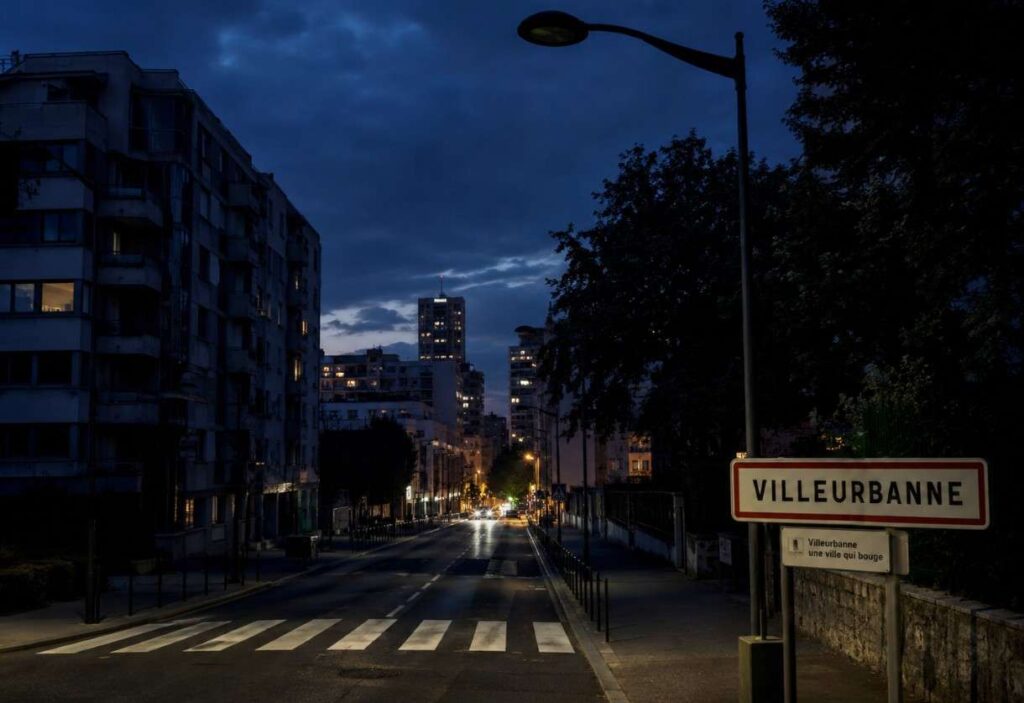
It often begins very suddenly. One street is left in the dark, and a few hours later the next section of street. In Villeurbanne, Lyon’s immediate neighboring city, a series of copper thefts is currently causing growing concern. Entire residential neighborhoods lose their street lighting at night — with consequences that go far beyond a technical malfunction.
“If you are out on foot, you have to be careful,” many residents now say. The sentence sounds banal, but it strikes a sensitive chord. A lack of light directly changes everyday life. Parents prefer to pick up their children by car, elderly people avoid nighttime walks, and cyclists try to navigate intersections more cautiously. Where streetlights would otherwise provide guidance, dark gaps suddenly appear. And darkness does something to a city.
According to the municipality, around ten kilometers of copper cables have already been stolen. Around fifty streets were temporarily affected. The perpetrators appear to act with purpose: they open manholes, cut underground lines, and disappear with the valuable metal. Copper has fetched high prices on the world market for years — and that is precisely what increasingly makes public infrastructure the target of organized thefts.
Particularly risky: the method appears both professional and dangerous. Some interventions take place in the middle of the night, in some cases even on lines that are still live. Employees of the lighting service speak of damage that cannot simply be repaired. New cables are often unavailable at short notice, and replacement parts are delivered too late. As a result, some streets remain dark for days.
The municipal authorities are trying to take countermeasures. Inspection rounds are intended to detect new damage more quickly, and citizens now report failed streetlights directly to the authorities. At the beginning of May, police caught a 46-year-old man in the act. But no one is reassured. The cases occur too frequently.
The Villeurbanne case shows a problem that has concerned many French cities for a long time. Copper theft no longer affects only construction sites or industrial facilities. Increasingly, power grids, railway installations, and public lighting are being targeted. The material value seems almost secondary—the consequential costs are exploding. Above all, there is a growing sense that even basic infrastructure has suddenly become vulnerable.
In Villeurbanne, this development is particularly striking against a sensitive backdrop. The city has repeatedly made headlines lately due to drug-related crime, violence, and growing insecurity. When entire streets are now also left in darkness, it reinforces among many residents a vague feeling of losing control. As if the motto were: first the cables disappear, then the sense of security.
Because light serves far more than just a practical purpose in modern cities. Illuminated streets convey presence, order, and reassurance. Where brightness is lacking, people’s behavior changes almost automatically. Squares empty more quickly, routes seem more threatening, and the city withdraws further into itself at night.
And that is precisely where the real seriousness of these thefts lies. A streetlamp seems ordinary—until it suddenly disappears.