
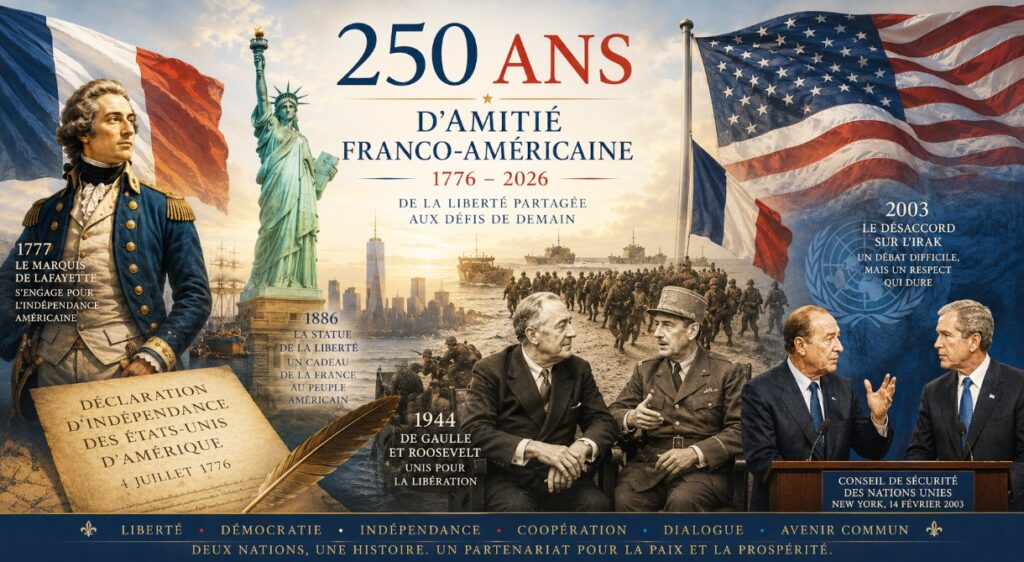
On July 4, 2026, the United States will celebrate the 250th anniversary of its independence—a jubilee that goes far beyond the national holiday calendar. The history of the American republic is inextricably linked to Europe, and no European state has influenced its emergence as enduringly as France. At the same time, few transatlantic relationships are as contradictory: shaped by shared ideals, strategic cooperation, and recurring phases of open estrangement. It is precisely this tension between affinity and autonomy that has kept the relationship remarkably stable for more than two and a half centuries.
La Fayette: The French Aristocrat as Architect of American Freedom
When the young Gilbert du Motier, Marquis de La Fayette, secretly set off for North America in 1777, he acted against the express wishes of the French court. At just 19 years old, he was guided not by dynastic loyalties, but by the ideas of the Enlightenment. For him, the American colonists’ struggle against the British Crown was more than a military conflict: it presented itself as a political experiment intended to put the idea of individual liberty and republican self-determination into practice.
La Fayette quickly gained the trust of George Washington, who treated him like a son. Militarily, the Frenchman played an important role especially during the decisive phase of the War of Independence. But even more relevant was his diplomatic function. He convinced Paris to provide the American insurgents with substantial military and financial support. French soldiers, the fleet under Admiral de Grasse, and extensive loans created the balance of power without which victory at Yorktown in 1781 would hardly have been possible.
American independence was therefore not exclusively the result of colonial determination. It was also an expression of French power politics against Great Britain—and, at the same time, a triumph of shared political ideals. La Fayette embodies this dual dimension to this day: the idealistic fighter for freedom and the mediator between two political worlds.
The Statue of Liberty: A Monument to Shared Values
A hundred years after independence, the transatlantic friendship received its most enduring symbol. The Statue of Liberty, designed by the French sculptor Frédéric Auguste Bartholdi and engineered by Gustave Eiffel, was far more than a diplomatic gift.
It recalled the shared history of two nations that based their political legitimacy on the ideals of the Enlightenment. Freedom, popular sovereignty, and the rule of law were to form the core of a modern democratic order. France’s gift of this monument to the young American republic was also an expression of political self-understanding: despite different historical developments, both states saw themselves as bearers of universal ideas of freedom.
For millions of immigrants who later arrived in the United States via Ellis Island, the statue became the first visible sign of a new life. The monumental figure thus evolved far beyond its original symbolic meaning. To this day, it represents hope, political freedom, and the United States’ aspiration to be a country of immigration.
Allies in war – rivals in politics
The Second World War brought France and the United States together again. Following the German occupation of France, Free France under General Charles de Gaulle emerged as a political alternative to the Vichy regime. Yet it was precisely during this phase that it became clear that having a common enemy does not automatically lead to political harmony.
U.S. President Franklin D. Roosevelt viewed de Gaulle with great distrust for a long time. Washington sometimes preferred other French interlocutors and doubted the political legitimacy of the inflexible general. De Gaulle, for his part, was convinced that France had to preserve its national sovereignty even in the most difficult circumstances.
After the Allied landing in Normandy in 1944, cooperation intensified, but the fundamental differences never disappeared. De Gaulle understood France as an autonomous power with global ambitions and rejected any lasting political dependence on Washington.
This stance also shaped his presidency. France’s withdrawal from NATO’s integrated military structure in 1966 was less an anti-American policy than a demonstration of strategic independence. Paris remained a member of the alliance, but wanted to place its armed forces under exclusively national command. This principle continues to shape French foreign policy to this day and is the origin of the concept of European strategic autonomy, often invoked later.
The Iraq War: The Most Serious Transatlantic Conflict of the Contemporary Era
Few events strained relations between Paris and Washington after the end of the Cold War as much as the Iraq War in 2003. While President George W. Bush’s administration pushed for the military overthrow of Saddam Hussein, France under President Jacques Chirac refused to support the intervention.
Particularly memorable was the intervention by French Foreign Minister Dominique de Villepin before the United Nations Security Council. His speech strongly warned of the long-term consequences of a war without clear international legitimacy and without conclusive evidence of weapons of mass destruction in Iraq. France not only questioned Washington’s military strategy, but also defended the primacy of international law and multilateral decision-making processes.
Reactions in the United States were unusually harsh. Calls to boycott French products circulated, and in some sectors of American politics the famous “French Fries” were demonstratively renamed “Freedom Fries.” The relationship between the two governments reached a low point not seen in decades.
With the benefit of hindsight, however, that episode appears in a different light. The subsequent failure to find the alleged weapons of mass destruction and the long-term destabilization of the Middle East have led many historians and security experts today to assess the French warnings of the time much more nuancedly. The controversy is now seen less as an expression of anti-American sentiment than as an example of independent foreign policy analysis.
Partners despite recurring differences
The history of Franco-American relations disproves the widespread idea that stable alliances must be free of conflict. In reality, the two countries have often maintained their closest ties precisely because they openly resolved their disagreements without calling their fundamental common interests into question.
France and the United States work closely together in NATO today, coordinate their security and intelligence policies, maintain intensive economic relations, and share the basic conviction that democratic institutions and individual rights must be defended. At the same time, there are considerable differences—whether in trade policy, digital regulation, industrial policy, or relations with China.
Paris consistently pursues the goal of greater European capacity to act. Washington, for its part, expects stronger security contributions from its allies. These differing priorities periodically generate tensions, without permanently eroding the foundations of the partnership.
This is precisely where the uniqueness of this relationship lies. Since the days of La Fayette, France and the United States have shared more than an alliance of convenience. Both countries invoke similar political ideals, although they often interpret their application differently. From this tension has emerged, to this day, a partnership that is neither uncritical submission nor permanent confrontation.
The 250th anniversary of American independence recalls not only the birth of a nation. It also evokes one of the most extraordinary bilateral relationships of the modern era: a friendship that has endured wars, political crises, and diplomatic ruptures because it has always rested on a foundation deeper than the shifting configurations of interests of the moment. Freedom, national sovereignty, and the search for the right political order have united France and the United States since their beginnings. That they repeatedly argued over these matters was never a sign of weakness, but often an expression of a partnership between equal allies.
Andreas M. Brucker