
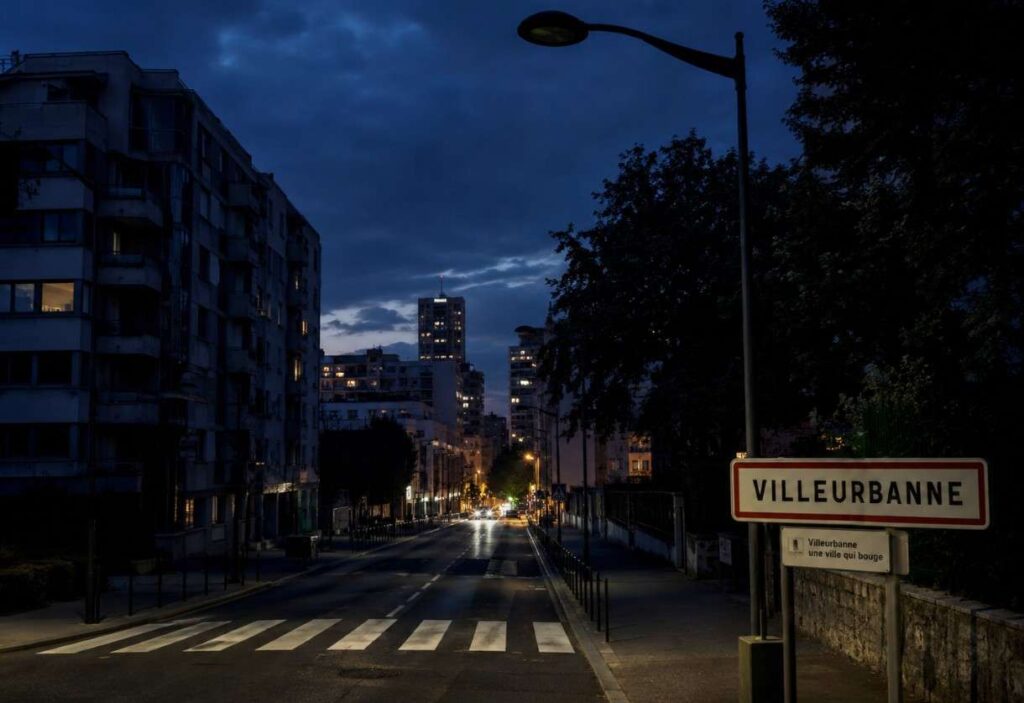
It often starts suddenly. One street goes dark, and a few hours later the neighboring street follows. In Villeurbanne, a suburb of Lyon, the ongoing series of copper wire thefts is currently causing increasing concern. Entire residential neighborhoods lose their street lighting at night, and the impact goes beyond mere technical failure.
“You have to be careful when walking,” many residents say. This statement may sound obvious, but it hits the core. Because the lack of light instantly changes everyday life. Parents start picking up their children by car, elderly people avoid going out at night, and cyclists pass intersections more cautiously. Places that once served as landmarks with streetlights suddenly become engulfed in darkness, and the darkness affects the character of the neighborhood.
According to the city’s announcement, about 10 kilometers of copper wire have already been stolen. Up to around 50 streets have been affected. The perpetrators act methodically, opening inspection ports, cutting underground wiring, and taking away valuable metal. Copper has maintained high prices on the global market for many years, which is why public infrastructure has become a target for organized theft.
What is particularly troublesome is that the methods are professional yet come with risks. Sometimes work is conducted right in the middle of the night, including cases where wires that are still live are cut. The street lighting officials say that there is damage that cannot be easily repaired. Since new cables cannot be arranged immediately and parts are delayed in arriving, the streets can remain dark for several days.
The city authorities are taking measures. They have intensified patrols to detect new damage early, and citizens report malfunctioning streetlights directly to the municipality. In early May, the police arrested a 46-year-old man in the act. However, since incidents occur frequently, it cannot be said that the issue has been resolved.
The example of Villeurbanne illustrates a problem that many French cities face. Copper wire theft is no longer only a problem for construction sites and industrial facilities, but also targets power networks, railway facilities, and public lighting. The value as a material is secondary, and the resulting costs escalate. Above all, there is a growing sense that even basic infrastructure has suddenly become vulnerable.
In Villeurbanne, this situation is a particularly sensitive topic. The city has long been noted for reports of drug crime, violence, and increasing anxiety. Furthermore, with the streets cloaked in darkness, many residents experience a vague sense of losing control. In other words, “first the copper wires disappear, and next the feeling of safety vanishes.”
Lighting in a modern city has significance beyond a practical role. Bright streets convey presence, order, and landmarks. When the light is missing, people’s behavior changes almost automatically. Squares become deserted more quickly, passageways feel frightening, and the city shuts down on its own at night.
This is precisely where the major problem of such theft lies. Streetlights are something seen every day, but only when they suddenly disappear do we realize their importance.