
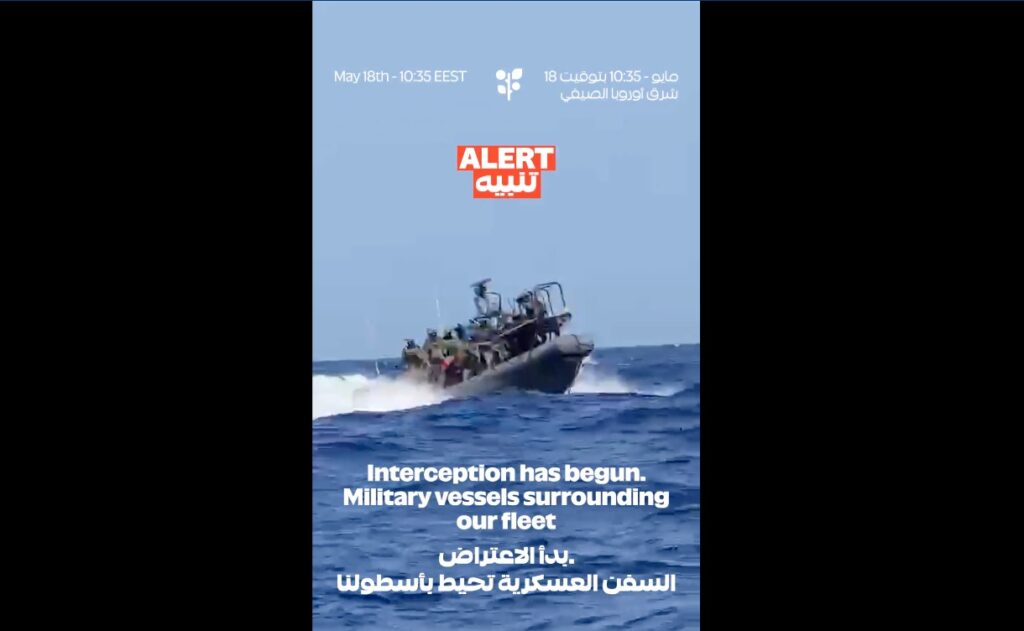
A new international “Fleet for Gaza” was intercepted off the coast of Cyprus by Israeli forces on Monday. According to the organizers, the convoy consisted of about fifty boats that had departed from Turkey last week. The action illustrates the increasing international polarization around the Gaza war and the long-contested Israeli naval blockade of the coastal strip.
The organizers of the initiative “Global Sumud” stated on the X platform that Israeli naval vessels had stopped the fleet and begun boarding some ships. The activists described their mission as “legal, humanitarian, and nonviolent” and demanded safe passage towards the Gaza Strip.
Israel responded as expected with sharp rejection. The Ministry of Foreign Affairs declared shortly before the interception operation that the Jewish state “will not allow any violation of the legitimate naval blockade of the Gaza Strip.” All participants in the action were urged to change course and turn back.
Symbolism with international impact
Fleet actions have held high symbolic significance in the Middle East conflict for years. As early as 2010, the storming of the “Mavi Marmara” by Israeli special forces caused an international crisis. Ten Turkish activists lost their lives then, and relations between Ankara and Jerusalem deteriorated permanently.
Also, the current campaign deliberately aligns with this tradition. The organizers are trying to increase pressure on Israel through international attention while simultaneously raising awareness of the humanitarian situation in the Gaza Strip. Since the beginning of the war following the Hamas attack of October 7, 2023, the supply situation in Gaza has become a central point of contention in international diplomacy.
Relief organizations have been warning for months about a dramatic deterioration in living conditions. The availability of medicines, fuel, and food is considered especially critical. Israel counters that control over the sea routes is necessary to prevent arms deliveries to Hamas and other militant groups.
The legal controversy surrounding the blockade
A central question in the debate is the international legality of the Israeli naval blockade. Israel cites international maritime law and states that the blockade is part of legitimate security measures within the armed conflict with Hamas.
Critical voices, however, accuse Israel of effectively imposing collective punishment on the civilian population by means of the blockade. International human rights organizations and various UN representatives have repeatedly criticized the restrictions. Legally, the situation remains complex: although states are allowed to impose naval blockades in the context of armed conflicts, these must be proportionate and allow for humanitarian aid.
The fleet movement has been trying for years to make this legal grey area politically visible. Their activists see themselves as civil actors of international protests. Israel, on the other hand, considers the actions calculated provocations with significant escalation potential.
Ankara between solidarity and geopolitical calculation
The fact that the fleet again departed from Turkey carries significant political symbolism. President Recep Tayyip Erdoğan has been one of the sharpest critics of Israeli Gaza policy for years and presents himself in domestic and foreign politics as a defender of the Palestinian cause.
At the same time, Ankara pursues an increasingly pragmatic foreign policy. Despite harsh rhetoric, diplomatic relations with Israel have gradually normalized over recent years. Economic interests, energy issues in the eastern Mediterranean region, and the strategic role of the US compel both states to a cautious balancing act.
The new fleet action could strain this fragile rapprochement again, especially if it leads to violence or arrests of international activists.
European limited influence
The European Union follows the developments with increasing concern but remains politically divided. While some member states call for stronger pressure on Israel, others emphasize Israel’s right to self-defense.
Cyprus is increasingly finding itself in a geopolitically sensitive position. The island is only a few hundred kilometers from Gaza and has been serving more and more frequently as a logistical hub for evacuations and humanitarian aid initiatives since the beginning of the conflict.
The fact that the fleet was intercepted off the Cypriot coast illustrates the operational reach of the Israeli navy as well as Jerusalem’s determination to prevent any symbolic breakthrough of the blockade at an early stage.
The incident shows how much the Gaza war long ago transcended the immediate conflict zone. The military confrontation between Israel and Hamas has become a global political flashpoint in which humanitarian issues, international law, and geopolitical power interests are increasingly intertwined. Actions like the new Gaza fleet hardly change the strategic reality on the ground but do contribute to keeping international diplomatic pressure on Israel visible—and at the same time make it clear how difficult a political resolution of the conflict currently seems.