
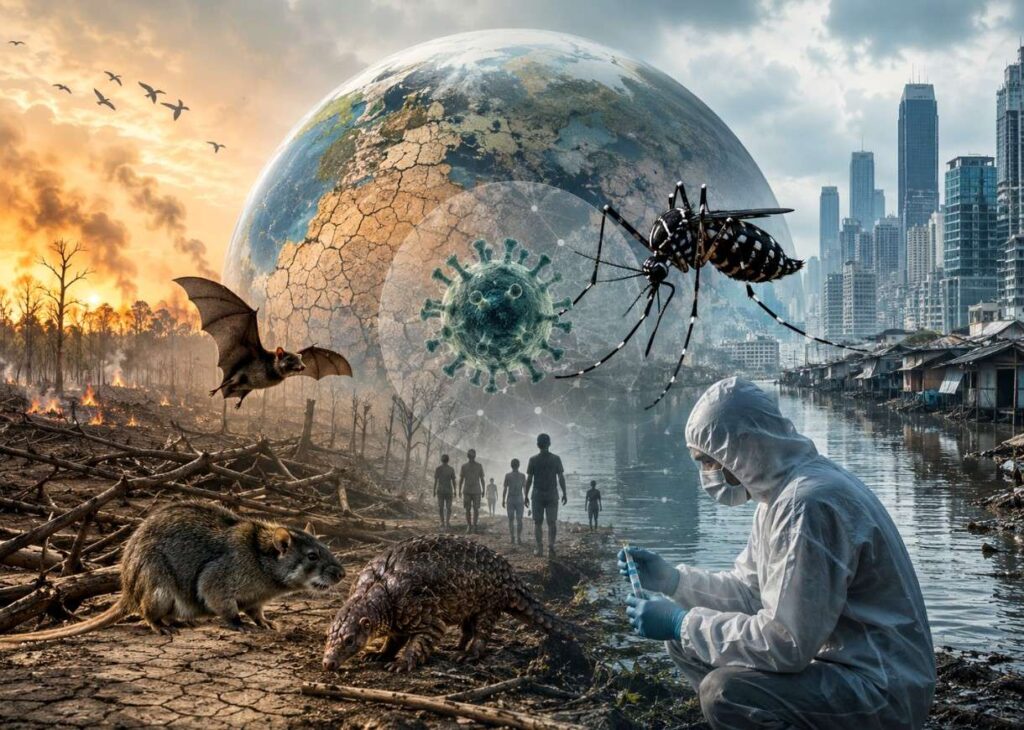
The political debate about climate change is usually conducted along temperature curves, emission targets, or energy prices. Far less visible, but possibly more consequential, is another connection: the interaction between ecological destabilization and the spread of infectious diseases. For a long time, this was considered a niche topic among epidemiologists and environmental researchers. Today, it is one of the central security policy issues of the 21st century.
The statement that climate change favors new diseases is often exaggerated or polemically simplified in political discourse. But behind this formula lies a scientifically well-supported finding. It is not the climate itself that creates viruses. However, it changes the ecological conditions under which pathogens, animals, and humans come into contact. This is where the real urgency lies.
Shifting Habitats, New Risks
The rise in global average temperatures is changing the distribution ranges of numerous animal and insect species worldwide. What initially seems like an abstract ecological shift has immediate health policy consequences.
This is particularly visible with so-called vectors — organisms that transmit pathogens. Mosquito species such as the Asian tiger mosquito are now spreading as far as Central Europe. Ticks that transmit Lyme disease or tick-borne encephalitis find increasingly suitable living conditions at higher altitudes and in more northern regions. Areas that previously acted as natural climatic barriers are losing this protective function.
As a result, the geographic map of infectious diseases is changing. Diseases once considered tropical are moving closer to European metropolitan areas. The health infrastructure of Western countries is only partially prepared for this development. The challenge lies less in isolated spectacular epidemics and more in the gradual normalization of new risks.
The Disrupted Order of Ecosystems
At least as significant as temperature trends is the destruction of natural habitats. Deforestation, soil degradation, wildfires, and extreme droughts push wildlife closer to human settlements. This increases the likelihood of so-called spillover events — the transmission of pathogens from animals to humans.
Approximately three-quarters of all newly emerging infectious diseases in humans are estimated by international health organizations to have originally come from the animal kingdom. Ebola, SARS, MERS, and Covid-19 are prominent examples of such zoonoses.
The crucial point is that ecological stability also creates a form of biological distance. Intact ecosystems act, so to speak, as a buffer between species. When these systems are destroyed, contacts between humans, livestock, and wildlife intensify. Statistically, this raises the likelihood of new disease jumps.
The modern global economy further amplifies this effect. Global supply chains, factory farming, urbanization, and international mobility generate an unprecedented speed of spread. A local outbreak can have global consequences within days.
Science Speaks in Terms of Probabilities
Political debates often suggest mechanical causality: climate change causes pandemics. Such simplifications do not hold up under scientific scrutiny.
Pandemics never arise from a single cause. They result from complex interactions between biological, social, and economic factors. Population density, healthcare, international transport networks, food systems, and government crisis responses play as central a role as ecological changes.
Covid-19, for example, is not considered a direct consequence of climate change. Most research focuses instead on the close contact between humans and wildlife, possibly in markets with live animals. Nevertheless, numerous scientists argue that global environmental changes increase the overall likelihood of such spillovers.
This is exactly where the crucial difference between science and politics lies. Science works with increased risks, statistical probabilities, and multifactorial models. Politics, in contrast, tends towards clear attributions of blame and simple narratives.
This also explains why some politicians’ statements, while grounded in real research findings at their core, rhetorically often go beyond the actual scientific consensus.
“One Health” as a Geopolitical Concept
For this reason, a new guiding concept called “One Health” has been established in international organizations in recent years. It is based on the insight that human health, animal health, and ecological stability cannot be considered separately.
This perspective marks a profound paradigm shift. Health policy is no longer understood solely as the responsibility of hospitals or pharmaceutical systems but as part of comprehensive environmental and security policy.
The consequences reach far beyond medical issues. States must increasingly perceive biodiversity, agriculture, urban planning, and climate policy as elements of preventive health security. Pandemic preparedness thus becomes a question of strategic resilience.
Developing countries, in particular, are under pressure. Many regions in Africa, Southeast Asia, or Latin America experience rapid population growth, ecological destruction, and weak health systems simultaneously. There, the consequences of climate-related disease dynamics could unfold especially dramatically.
For Europe, this means a new form of global vulnerability. Infectious diseases know no national borders. Health policy thereby inevitably becomes foreign and security policy.
Between Alarmism and Denial
The real danger in the debate today lies less in scientific dissent than in political overreaction on both sides. On one hand, there is an alarmist discourse that immediately attributes every new epidemic to climate change. On the other, there are still voices denying any connection and completely ignoring ecological factors.
Both positions fail to recognize the complexity of modern crisis dynamics.
The current state of research supports neither apocalyptic certainties nor false reassurances. Rather, it points to a structural shift in risks. A warmer and ecologically less stable world increases the likelihood of new infectious diseases — not automatically, but measurably.
This also changes the nature of state responsibility. Climate policy no longer appears solely as a long-term environmental issue but increasingly as part of preventive health policy. Those discussing emission reduction, biodiversity, or land use today are indirectly debating the stability of future health systems.
The next pandemic will likely not originate solely from climate factors. But a world in ecological imbalance creates conditions under which such crises become more probable. This is the real political challenge: not simplistic cause-and-effect narratives, but the ability of modern societies to recognize complex risks early and respond institutionally.
Andreas M. Brucker