
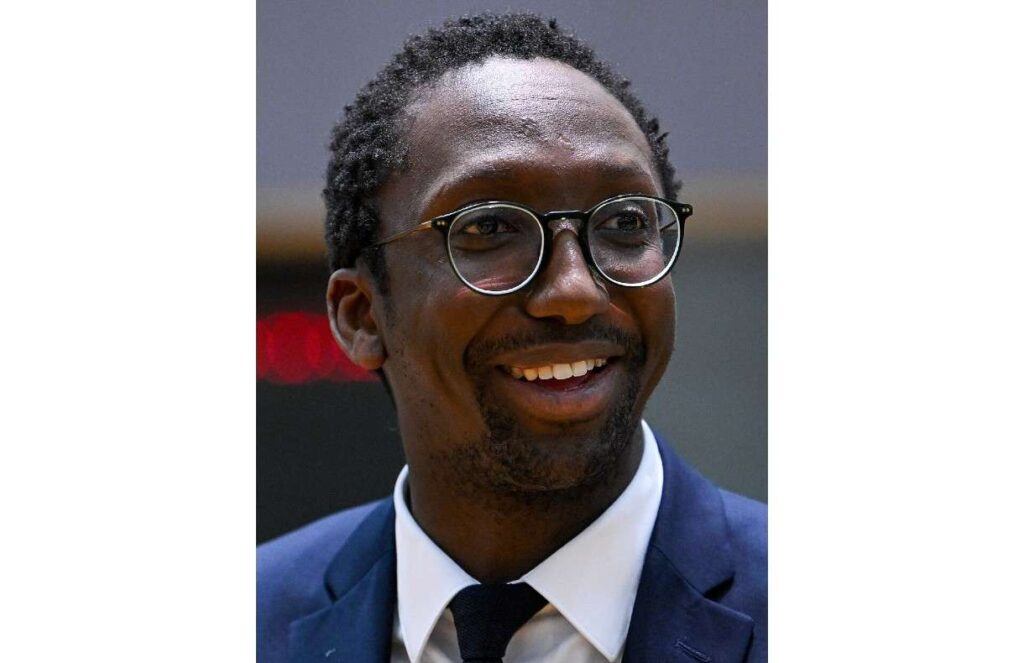
There are political careers that follow a familiar pattern: youth party, ministerial cabinet, constituency work. And there are life paths that only in retrospect can be understood as a political symbol. The member of parliament from Finistère and former Secretary of State for the Sea, Hervé Berville, embodies such an exceptional biography. It leads from genocide-scarred Kigali to the wind-swept roadstead of Brest — and tells a great deal about France, its memory politics, and a Brittany in transition.
A life shaped by the rupture of history
Berville was born in Kigali in 1990. Four years later the genocide against the Tutsi shook Rwanda; within a hundred days over 800,000 people were murdered. The civil war, the systematic violence, the collapse of state order — all of this forms the historical background of his early childhood. Berville survived, was adopted by a French couple and grew up in Breton Plougastel-Daoulas, opposite the bay of Brest.
This biographical rupture is more than a personal fate. It points to a phase in which France’s role in Central Africa was increasingly questioned. For decades Paris was regarded as the protector of the then Rwandan regime. Only the 2021 report of the historians’ commission chaired by Vincent Duclert brought a new official assessment: it attested to France a “serious and overwhelming responsibility,” without finding direct complicity in the genocide.
For Berville this debate is not abstract memory politics. It touches his own origins and at the same time his political identity as a French parliamentarian. His interventions in the National Assembly were sober, analytical, and geared toward compromise – a tone that is not a given in the heated politics of memory.
Formation of elites and political rise
Berville’s educational path corresponds to the republican ideal of social mobility. After his Abitur he studied at Sciences Po in Paris and at the London School of Economics – two institutions that have shaped leaders in administration, business, and politics for decades. He worked as an economist, dealt with development issues and Africa policy, before entering the National Assembly in 2017 with Emmanuel Macron’s rise.
The 2017 parliamentary election marked a tectonic shift in the French party system. With the movement La République en marche Macron achieved a breakthrough beyond the traditional camps of socialists and Gaullists. Berville, then 27 years old, won in the second constituency of Finistère. In a region historically marked by Catholic influence, strong regional identity, and economic peripherality, a young deputy born in Rwanda suddenly represented the new political center.
The symbolic significance of this election was considerable. Brittany was an emigration region for centuries; hundreds of thousands left their homeland for Paris or overseas in the 19th and 20th centuries. Now an adoptive son from East Africa represented an area long shaped by migration.
Brest as a strategic space
Berville’s constituency includes Brest – a city that, like few others, stands for the maritime dimension of France. Its military port is one of the most important bases of the French navy. At the same time, Brest has established itself as a center for marine research, with renowned institutes such as Ifremer and the French oceanography center.
When Berville was appointed Secretary of State for the Sea in 2022, this seemed logical. The portfolio is politically sensitive: France has the second-largest exclusive economic zone in the world, spread across all oceans. Questions of fisheries, coastal protection, offshore wind power, and maritime security affect ecological, economic, and geostrategic interests alike.
This conflict of interests is particularly tangible in Brittany. Fisheries suffer from stricter EU quotas, rising fuel costs, and environmental regulations. At the same time, pressure is growing to expand marine protected areas and reduce CO₂ emissions. Berville was obliged to implement European environmental requirements while safeguarding the livelihoods of traditional businesses.
His critics from the fishing industry sometimes accused him of being closer to Paris and Brussels than to local actors. Supporters, on the other hand, emphasized his detailed knowledge and ability to mediate between administration, business and EU institutions. The tensions are structural in nature: the ecological transformation is politically desired, yet its social costs are distributed unevenly.
Memory politics and diplomatic bridges
Alongside the maritime agenda, the Rwanda question remained a latent component of his public profile. the Duclert report of 2021 and Macron’s subsequent trip to Kigali marked a turning point in bilateral relations. Paris acknowledged historical mistakes without admitting legal guilt. Kigali, in turn, opened up to a cautious rapprochement.
In this context, Berville assumed a special role — less formal than symbolic. As a deputy with Rwandan roots and as a member of the majority faction, he embodied a connection between both political spheres. His statements avoided moral extremes; they aimed at institutional responsibility and long-term reconciliation. Especially in France, where colonial history and Africa policy are emotionally charged, such restraint carries political weight.
A Brittany in change
Berville’s biography also points to a profound structural transformation of Brittany. The region has caught up considerably in recent decades: universities, research centers and technology clusters now shape cities like Rennes or Brest. The expansion of renewable energies – especially offshore wind farms – is changing the economic structure.
At the same time, the sense of identity remains strongly regionally shaped. The Breton language, movements for cultural autonomy and local identity continue to play a role in the political discourse. That a member of parliament born in Kigali speaks Breton and demonstratively refers to regional traditions is an expression of an identity defined not by descent but by belonging.
This development is not without conflict. In a political landscape where issues of migration, integration and national identity are increasingly polarizing, Berville’s life path is at times instrumentalized – as evidence of republican success or as a projection surface for ideological disputes. But beyond partisan attributions, the fact remains that his career would scarcely have been conceivable without the openness of local structures.
In the end this biography tells less of an extraordinary individual than of the malleability of political spaces. France’s republican ideal – equality before the law, advancement through education, integration through institutions – becomes concrete in such life paths. At the same time the ruptures of history are revealed: colonial entanglements, foreign-policy missteps, economic transformation processes.
Brest, with its view of the Atlantic, symbolises this ambivalence. The city is simultaneously a military outpost, a scientific laboratory and an economic zone of risk. It is within this mixture that Hervé Berville moves – as a deputy, as a former government representative, as a citizen with a dual historical anchoring. His career is therefore less a “folle histoire” than a condensed narrative of contemporary France: shaped by global entanglements, regional identity and the claim to derive political responsibility from history.
P.T.