
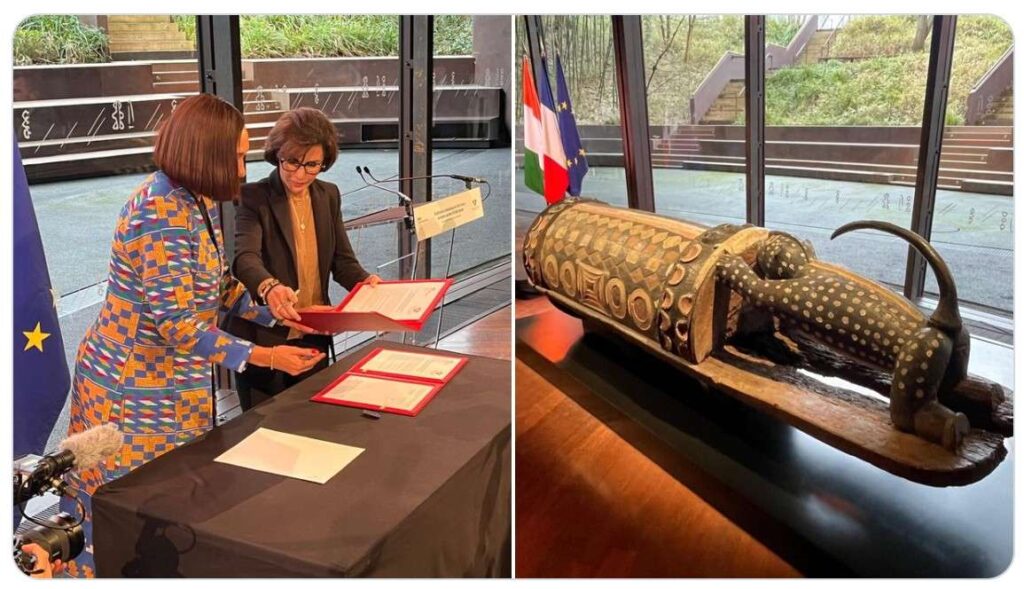
More than a century after its violent seizure, a central symbol of West African culture is returning to its place of origin. France has officially restituted the so-called “talking drum” to Côte d’Ivoire (Ivory Coast). What may at first glance appear to be the return of a single museum object is, in fact, the expression of a profound shift in European remembrance policy and part of a reassessment of relations between former colonial powers and African states.
Colonial Loot
The history of the drum dates back to 1916. During the First World War, what was then French West Africa was under strict colonial control. During this period, there were repeated military punitive expeditions against local resistance groups that opposed forced recruitment and the imposition of taxes. In the course of one such operation, the “talking drum” was confiscated and taken to France.
These seizures were not isolated cases, but a systematic component of the exercise of colonial power. Cultural objects were regarded as trophies, evidence of imperial superiority, or scientific collection pieces for ethnological museums. The Ivorian drum eventually entered French state collections and was most recently kept at the Musée du quai Branly – Jacques Chirac in Paris, an institution that houses tens of thousands of objects from Africa, Asia, Oceania, and the Americas.
For decades, the instrument was presented as a museum piece, detached from its political and social context. Its original function as a means of communication receded into the background; what remained was an aestheticized artifact in a display case.
The talking drum as a political instrument
The “talking drum,” however, is much more than a musical instrument. In many West African societies, the talking drum serves as a means of political communication. By varying the tension of the drumheads, different pitches can be produced that correspond to the tonal patterns of local languages. In this way, complex messages can be transmitted over long distances: from calling an assembly to warning of dangers.
The example now returned comes from the Abidjan region and is attributed to the Ébrié (Atchan) ethnic group. In the precolonial order, it had a central function on official occasions. The drumbeat proclaimed the decisions of traditional authorities and symbolized political legitimacy. Its violent appropriation was not merely a material loss, but a deliberate intervention in the symbolic order of the community.
That the drum is now returning is understood in Abidjan as an act of historical recognition. The Ivorian government speaks of a restoration of cultural dignity. In a country that has repeatedly experienced political crises, military interventions and civil wars since independence in 1960, such symbolic acts are attributed identity-forming significance.
France’s policy shift on restitution
The return of the drum is not an isolated event, but part of a broader reorientation of France’s cultural policy. A decisive impetus came in 2017 from a speech by President Emmanuel Macron in Ouagadougou. There, he declared that African heritage should not remain permanently in European collections if it had been acquired under colonial conditions. Within five years, the conditions should be created for temporary or permanent restitutions.
As a result, a seminal report was produced, written by art historian Bénédicte Savoy and Senegalese economist Felwine Sarr. The so-called 2018 Sarr-Savoy report recommended far-reaching returns wherever it could be demonstrated that objects had been taken through coercion or violence. The publication sparked an intense debate—not only in France, but across Europe.
Legally, however, implementation is complex. French state collections are traditionally considered “inalienable,” meaning they cannot be alienated. Therefore, each return requires a special law. As early as 2021, Parliament passed a corresponding law for the restitution of 26 works of art to Benin. A legislative step was also necessary in the case of the Ivorian drum.
Symbolism and structural issues
Critics argue that French restitution practice has so far remained selective. Given that there are around 70,000 objects from sub-Saharan Africa in the Musée du quai Branly alone, the return of individual pieces appears more symbolic than systemic. Indeed, the administrative obstacles are considerable, as are diplomatic coordination efforts with the countries of origin.
Supporters counter that each individual case sets a precedent. Restitution is not a purely logistical act, but touches on questions of property law, historical responsibility, and international cooperation. Moreover, it is not exclusively about physical returns, but about a new form of collaboration: joint provenance research, training programs for conservators, and long-term loan agreements.
For Côte d’Ivoire, the “Talking Drum” could be a starting point. Other objects with an Ivorian context can be found in French collections. Abidjan has indicated that systematic research is desired: a process that requires diplomatic skill and institutional capacities.
A new institutional framework in Abidjan
The question of the future place of preservation is not trivial. The plan is to exhibit the drum in the national museum in Abidjan, possibly at the Musée des Civilisations de Côte d’Ivoire. There, it should not simply be presented as a historical artifact, but as part of a living culture of remembrance.
The challenge is to avoid a new decontextualization. Some voices advocate involving traditional authorities and local communities more closely in curatorial decisions. Restitution does not end with physical return; it also requires examining the question of whom cultural heritage belongs to and who may dispose of it.
In this sense, the “Tambour parleur” becomes a touchstone for a partnership-based cultural policy. It compels us to think beyond ownership and consider responsibility.
The symbolic significance of this return transcends bilateral relations. It encompasses the fundamental question of how European societies wish to deal with their colonial legacy. The debate is by no means closed. It ranges between detailed legal questions and moral considerations of principle. But with each restitution, the normative framework shifts: what was long regarded as a legitimate part of national collections is being reassessed.
The beat of the drum, which once announced political decisions in an Ivorian village, now resonates on the international stage. It reminds us that historical violence does not disappear into the archives, but continues to have an effect: in institutions, legal systems, and cultural self-perceptions. The restitution of the “Tambour parleur” is not an endpoint to the colonial past. Rather, it is a sign that history remains negotiable—and that political responsibility can still be effective more than a hundred years later.
P.T.