
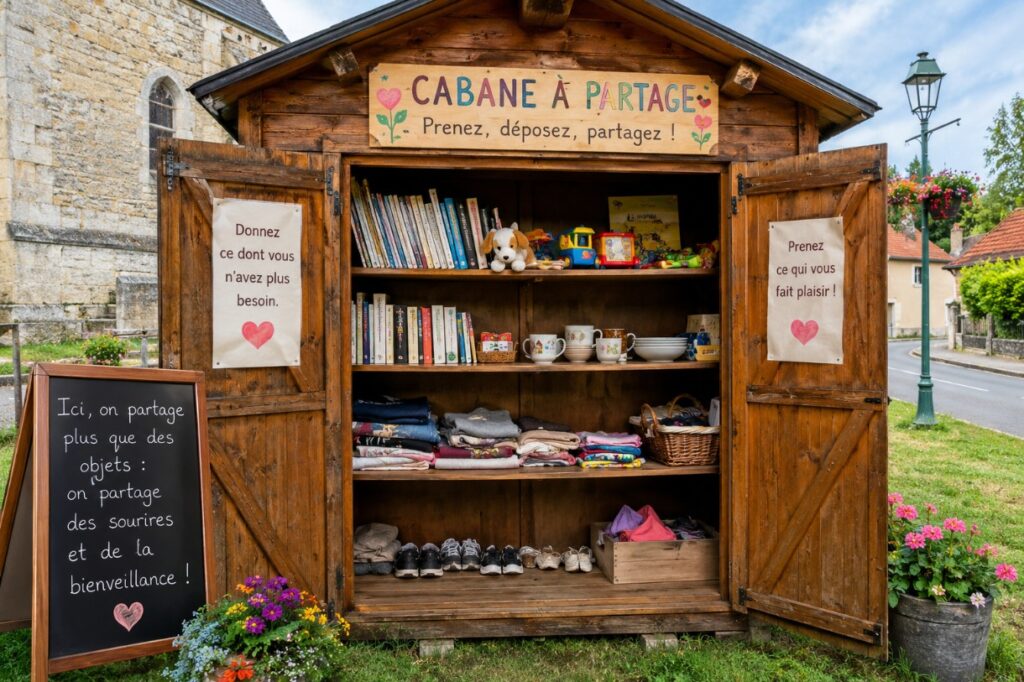
In many towns in France a quiet little revolution is currently taking place. It is not a major political debate, nor a multimillion-euro support program, but simply a little wooden shed by the roadside. In the small Somme village of Canaples, with about 700 inhabitants, they have been showing for two years just how powerful an old idea can be: share rather than throw away.
The so-called “Cabane à partage” looks ordinary at first glance. Open the door and you will find books, toys, crockery, clothes, small pieces of furniture. Items that no longer fit in the owner’s house, cellar or attic, but which suddenly become precious to others. Anyone can leave something, and anyone can take something. It is free, with no registration and no checks.
It is precisely this simple approach that is the appeal of the project.
While many regions are debating reduced purchasing power, rising prices and consumer stress, Canaples has long been putting a very practical solution into practice. This little shed functions like a promise of the village: to trust one another. No guards, no paperwork, no bureaucratic procedures. It may sound a little strange, but it works remarkably well.
You can tell quickly after visiting a place like this once or twice: it’s not just about old things here.
One day an old man stands in front of a box of children’s books and says those exact stories from his daughter’s room are in those books. Two young parents are delighted to find a baby chair they almost had to buy at full price. A neighbor laughs at a lamp and says, “It fits perfectly in my kitchen—looks like it was custom made.”
Conversations start like this, and such conversations are becoming rarer in many villages.
In particular, meeting places have been disappearing for years in rural France. Small shops have closed, cafés struggle to survive, and post office branches are shrinking. Social life is moving more and more into private spaces. So the “Cabane à partage” takes on a new, incidental role: becoming a meeting place.
And perhaps that is exactly this place’s real strength.
France has recently been experiencing a cultural shift in consumer culture. Concepts like “anti-gaspillage” (anti-waste) have become part of everyday social life. Flea markets, repair cafés, and second-hand platforms are booming. These little exchange huts fit perfectly with this trend. They combine sustainability and solidarity without trying to preach morally.
The reason this model works particularly well is that it is pragmatic. No one gives long speeches about climate protection or social change. People simply see that many items are still usable. So why throw them away?
Of course there are problems. In some towns there are reports of broken items or unclean spaces. Wherever there is trust there is always a risk of abuse. But surprisingly, in many places positive experiences overwhelmingly prevail. Perhaps most people respect these places because they are based on voluntariness.
This principle seems to work particularly well in rural areas. People know each other, meet regularly, and feel a certain responsibility toward one another. Social control comes from the community rather than from rules. That is a clear distinction.
Perhaps the little cabin in Canaples now tells a larger story about our time.
As digital platforms dominate everyday life and many things become increasingly fast, expensive, and anonymous, some villages are suddenly rediscovering the value of very simple things: trust, neighbors, recycling, human-scale distance.
Often all that is actually needed is a small wooden hut on the edge of town.
Andreas M. B.