
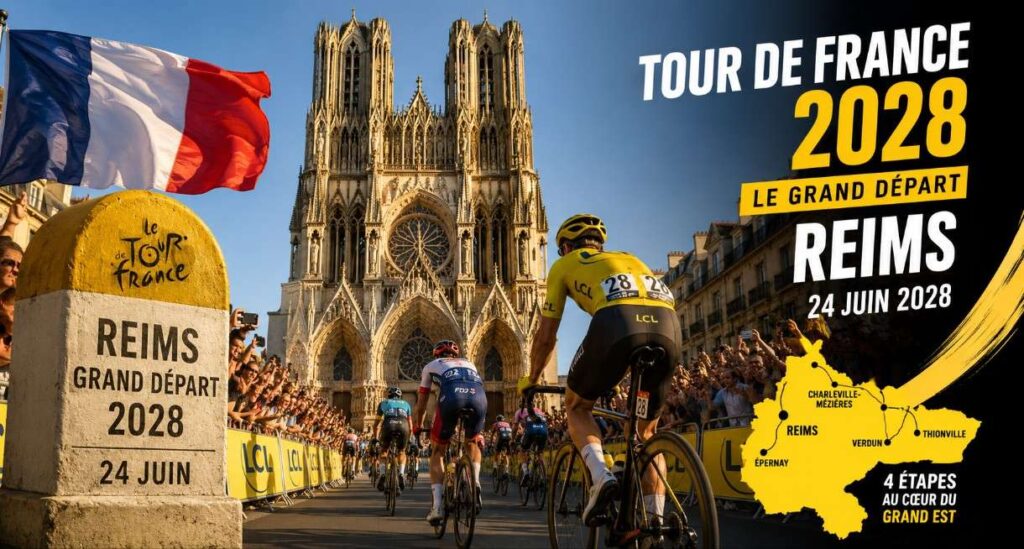
The city has been preparing for this for a long time and it has now been officially announced: Reims will host the Grand Départ of the 2028 Tour de France. On June 24, the 115th Tour de France will begin in Champagne, marking a start much earlier than usual. The reason behind this decision is the Olympic Games being held in Los Angeles, located across the Atlantic: because of the Olympics, the Tour schedule has been moved forward. For Reims, this decision means more than just a sports event. It signifies that the city is returning to the center of a national narrative beyond bicycle racing within France.
Since 1956, Reims has not hosted the start of the Tour. Therefore, the symbolic significance of this selection is even greater. Mayor Arnaud Robinet has actively promoted this application for years, emphasizing that Reims has all the conditions for a “French-style Grand Départ”: international reputation, historical background, the power of culinary culture, and efficient infrastructure. In fact, there are few places that can best embody the combination of sporting spectacle and national cultural heritage that the Tour seeks.
The Return of the French Start
The decision for Reims simultaneously symbolizes a return to French soil. The 2026 Tour starts in Barcelona, and in 2027 it begins in the United Kingdom, but Amaury Sport Organisation (ASO) chose the classic domestic scenario again in 2028. This also signifies a strategic balance: the international Grand Départ plays a marketing role for globalization, while the Tour remains deeply rooted in France.
Reims, in particular, is very suitable for this role. The city connects several layers of French identity: the cathedral where the king’s coronation took place, the world-famous Champagne, and a symbol remembering the destruction of World War I. Additionally, the most prominent active French female cyclist, Pauline Ferrand-Prévot, hails from this region, strengthening the international status of French women’s cycling.
This is why the start scene in front of the cathedral was not chosen by chance. The Tour de France has been staged for decades like a postcard moving through historical and cultural France. Reims provides a stage that successfully combines historical grandeur and tourism marketing potential.
Four stages in the Grand Est region
The Grand Depart does not end in just one day. The first four stages cross the Grand Est region, which has been a relatively rare focus in recent Tour history. The planned route passes through Marne, Ardennes, Meuse, and Moselle, with cities like Épernay, Charleville-Mézières, Verdun, Metz, and Thionville scheduled in the departure itinerary.
ASO also pursues regional political goals with this. The Tour has always been a means to enhance the visibility of the region. Regions invest large sums to promote themselves through global TV broadcasts. According to estimates by French economists, the Tour attracts millions of viewers in more than 180 countries. For structurally heterogeneous regions like Grand Est, this is a rare opportunity to show that they are a unified economic and cultural space.
In particular, Verdun is likely to add a historical dimension. This city is a representative place symbolizing the memory of World War I, and the Tour often combines sports drama with national memory. In the past, the Tour has used memorial sites to reinforce republican or historical narratives.
An event with tremendous economic significance
For Reims, the real challenge now begins. The Grand Départ is comparable to a visit to a small country in terms of organization. Thousands of journalists, team members, security personnel, and visitors have to be coordinated. Hotels, transportation, and security systems reach their limits.
At the same time, this event generates significant economic effects. After the tour stages, cities in France see a sharp increase in accommodation bookings, alongside international media exposure and long-term tourism benefits. In particular, the Champagne industry will greatly profit as a global promotional opportunity. The marketing effect combining sports and regional luxury goods is almost ideal on the international stage.
However, the balance is not always positive. Hosting costs have steadily increased over the years. Safety requirements, infrastructure development, and logistics costs place a heavy burden on local finances. Therefore, the key issue is whether Reims can use this event not only symbolically but also economically in a sustainable way.
There is another factor. The Tour de France has become a global media product beyond a simple sports event. Cities are now competing not just over the route but also in social networks, streaming formats, and attracting attention in international markets. Reims will need to present a modern and sophisticated city image, rather than a nostalgic city image relying only on historical heritage.
The Tour Between Tradition and Global Competition
A fast start date demonstrates how much the international sports calendar has changed. The Los Angeles Olympics have moved the Tour forward by an unprecedented time difference. This indicates intensified competition among global sports events over attention, sponsors, and media rights.
Nevertheless, for ASO the Tour is one of the most stable sports products in Europe. While many traditional events suffer from declining audiences, cycling is gaining a new international audience through platforms like Netflix. The “Tour de France: Unchained” series has especially increased interest in the Tour outside Europe.
For this reason, the strategic importance of the Grand Départ grows even greater. This event has become part of a global brand architecture beyond a simple local festival. Reims in 2028 will be a stage not just for hosting a sports event but for showcasing French culture and lifestyle to the world.
Whether the city can convert this into a long-term benefit will only be known years later, but what is already certain is that with the Tour start, Reims will stand at the center of international attention for several days, connecting to traditions deeply rooted in French identity.