
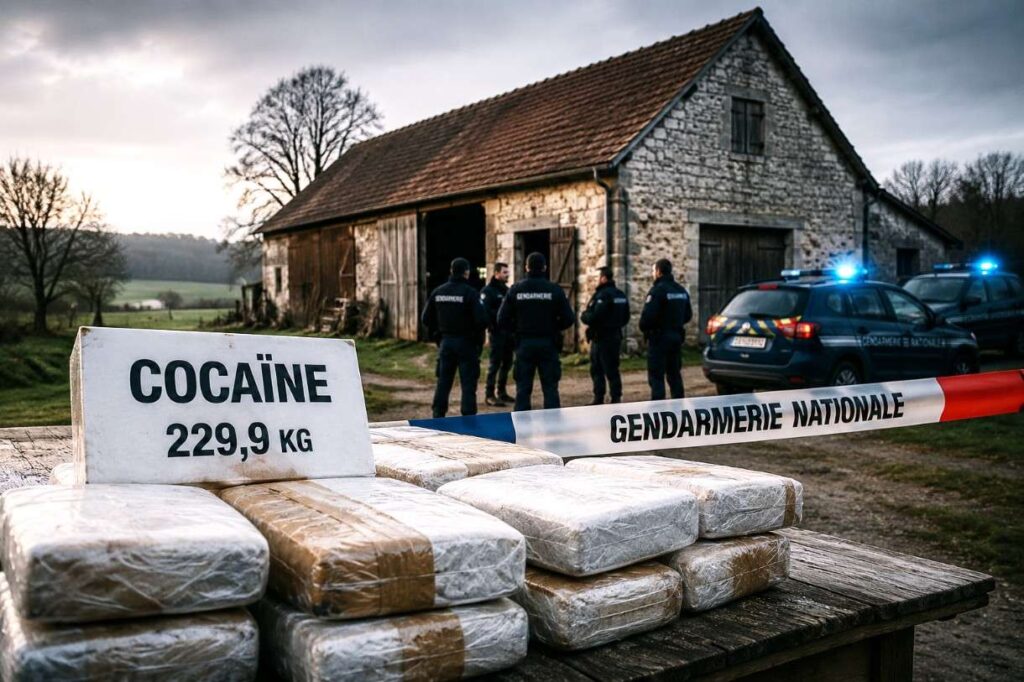
An old farm, a quiet country road, fields as far as the eye can see – and in the middle, nearly 230 kilos of cocaine. What looks like the plot of a detective novel has occupied investigators in France, Germany, and Mexico for several weeks. In the small town of Montmirey-le-Château in the French Jura, investigators came across one of the largest quantities of drugs in recent years in eastern France. Four suspects are now in provisional detention.
This case strikingly illustrates how modern drug networks now operate professionally and internationally. The cocaine delivery is said to have followed its route from Cancún in Mexico via Frankfurt Airport to France. German customs officers first discovered the merchandise at Frankfurt Airport. Nearly 230 kilos of cocaine, divided into 192 packages – a retail value of several million euros. Then the French investigation took center stage.
The trail finally led to the Jura.
Far away from the big cities and the traditional hotspots of drug-related crime, the suspects seemed to have found an ideal storage location. The old farm appeared harmless. A few storage units, an isolated area, little traffic. It is precisely these kinds of places that are increasingly attracting the attention of international networks. Little attention, almost no neighbors, no curious passers-by – perfect conditions for illegal intermediate warehouses.
What is particularly cruel: the farm owners seem to have become involved without knowing the real extent of the matter. According to their statements, a man had rented the buildings explaining that he wanted to store fiber optic technology there. At first, this seemed harmless. Perhaps a bit strange in the countryside – but not suspicious enough.
Then the situation escalated.
After the investigators’ intervention, armed and masked men were said to have appeared. The owners report having suffered severe threats, weapons brandished, and scenes more worthy of mafia movies than a village in the Jura. “They pressed three pistols to our heads,” they later told regional media. Such testimonies illustrate the brutality with which organized drug-related crime now expresses itself – even in regions long considered quiet and isolated.
For French investigative authorities, this discovery is further proof that the European cocaine routes have changed profoundly. In the past, many shipments passed directly through major port cities like Antwerp or Marseille. Today, the networks distribute their supply chains across several countries, multiple airports, and discreet intermediate warehouses. Germany, France, Spain, Netherlands – everything fits together like gears.
And that is precisely what makes the fight so difficult.
Because the cartels now think beyond borders. Flexible, well-organized, and often terribly professional. The Jura farm was ultimately just a small link in an international chain. But these places show how much this global parallel economy has come closer to everyday life in Europe. Not somewhere far away. But just next door.