
France loves grand words.
Liberté. République. Résistance.
Heavy terms, polished like a philosopher on the Boulevard Saint-Germain, accompanied by the scent of cold espresso and decades of moral superiority.
And of course: freedom of speech.
Few countries celebrate their intellectual independence with greater passion. In France, people don’t just discuss—they “hold debates.” As loud as possible, as dramatic as possible, often with crossed arms in a TV studio whose lighting looks like an interrogation room for existentialists.
Yet it is precisely in a place where freedom is supposedly sacred, that an astonishingly sensitive nervousness is showing itself.
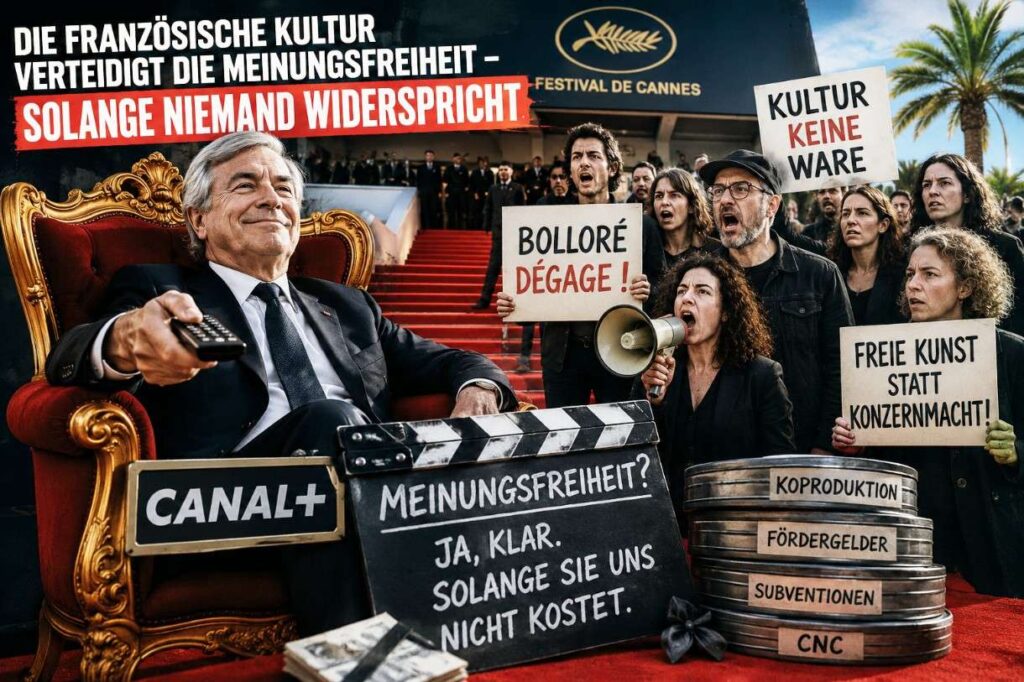
The dispute surrounding Canal+, Vincent Bolloré, and the Festival de Cannes seems like a case study on the modern French cultural industry—and its panicked fear of real independence.
Hundreds of filmmakers publicly warn of Bolloré’s influence on cinema. People sign manifestos, speak of threats, cultural control, and political interference. The usual grand opera, then. France without pathos would be like red wine without a hangover.
Then Canal+ responds.
And suddenly, the message is essentially: Those who sign against us might no longer collaborate with us in the future.
There it stands, the proud film industry—groomed for the red carpet, but with slightly trembling knees before the accounting department.
Because, of course, the French cinema rebels against the system.
However, the prerequisite remains that the system first covers production costs.
This is the true comedy of this affair.
The French cultural world likes to see itself as the last bastion of moral integrity. It fights against capitalism, power concentration, right-wing media moguls—but is often financed by exactly the same corporations accused in panels in the evening.
Revolution, please. But with funding approval.
There is something tragically comic about this: In the past, people barricaded streets. Today, people fear the cancellation of co-production funds. The Nouvelle Vague has definitively arrived in the boardroom.
And of course, it is far from just cinema.
The affair reveals a much larger problem: France constantly talks about cultural independence but organizes this culture in a structure of extreme economic dependence. A few large groups control broadcasters, production budgets, publishers, distribution paths, and public attention.
The result sometimes resembles a feudal system with intellectual polish.
The artists act as the rebels.
The corporations play the patrons.
And both need each other more than they want to admit.
Especially fascinating is the moral self-staging. The French cultural scene loves the impression of permanent dissent. Everyone imagines themselves a bit like Jean-Paul Sartre in the resistance—although the most dangerous opponent today is often not a censor anymore, but an Excel sheet in a media corporation.
Nowadays, rebellion comes with catering.
And yet France acts as if every cultural-political conflict were immediately a fight for the soul of democracy. That sounds heroic but conceals a simple fact: Those who are economically dependent have only limited freedom. This used to apply to workers. Now it evidently also applies to auteur filmmakers with festival accreditation.
The real irony is that precisely the industry that constantly speaks of freedom of speech now reacts strikingly sensitively to dissent.
As soon as power relations become concrete—budgets, broadcasters, contracts, market shares—the romantic part of the debate ends quite abruptly. Then it becomes clear that cultural freedom in France often acts like a luxurious old building window: beautiful to look at but please don’t open it too wide.
And Vincent Bolloré?
The man now almost fulfills a national function. He is less of an entrepreneur than a projection surface. For some, a conservative cultural fighter with media power. For others, the perfect villain the French literary and cultural commentary desperately needs in order to continue feeling like a resistance movement themselves.
Without Bolloré, the cultural scene would be almost without a dramatic element.
Because let’s be honest: The French elite often loves its opponents just as much as its ideals. Without the big conflict, without the moral alarm sound, without daily republican self-dramatization, a significant part of public discourse would collapse like a soufflé in a draft.
Perhaps that precisely explains the hysteria around Cannes.
After all, everything that France wants to tell about itself meets there: art, power, morality, money, politics, glamour, and the eternal claim that one naturally stands on the right side of history.
The current dispute above all shows one thing: Freedom of speech is great in France—as long as everyone roughly shares the same opinion.
The moment of real dissent only begins where financial consequences threaten.
And it is precisely there that it suddenly goes quiet in arthouse cinema.