
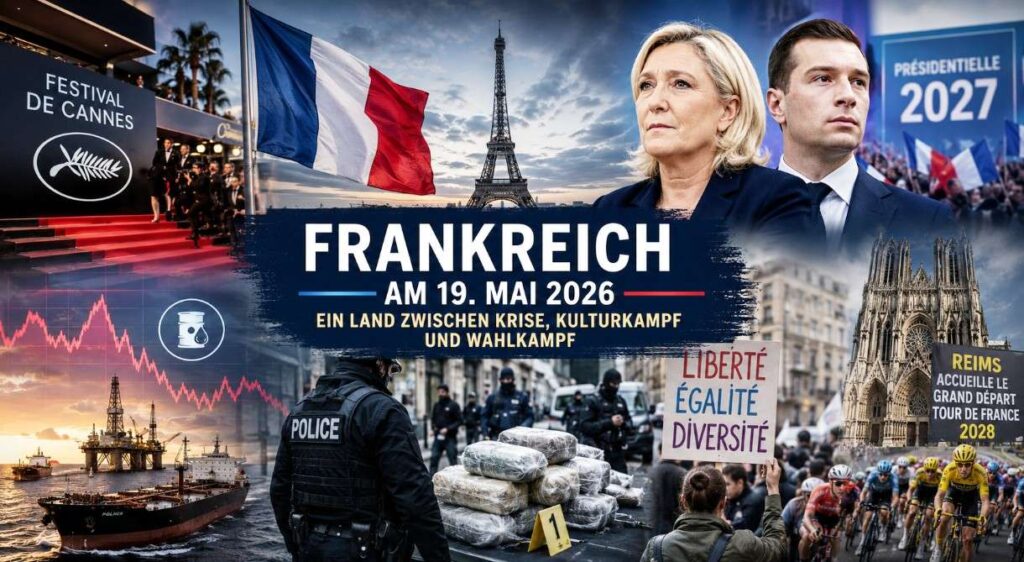
France is experiencing a peculiar intensification of political and social tensions these May days. The topics dominating the French press today range from the glamorous stage of the Cannes Film Festival to concerns about energy prices, drug violence, and the strategic realignment of political parties ahead of the 2027 presidential election. Behind the headlines emerges a country seeking orientation — and at the same time appearing increasingly polarized.
Cannes: From Film Festival to Ideological Arena
The Cannes Festival remains France’s cultural showcase, but the actual debates have long been taking place behind the scenes. French leading media now view Cannes less as a celebration of cinema and more as a symbol of a deep conflict within the media and cultural world.
At the center is the dispute over the media company Canal+ and indirectly over the influence of entrepreneur Vincent Bolloré. The discussion is ignited by allegations of political interference and questions about how independent France’s cultural sector really still is. Especially left-liberal newspapers warn against a concentration of journalistic power in the hands of a few billionaire owners.
This debate touches a sensitive nerve of the French Republic. France traditionally understands culture as part of state sovereignty. When filmmakers today speak of economic pressure and ideological selection, it is therefore not just about artistic freedom but about the republican self-description of the country.
It is also striking how much the lines of conflict have shifted. Only a few years ago, debates were dominated by streaming platforms or Hollywood competition. Today, political loyalties, media power centers, and societal factionalization are at the forefront.
Rassemblement National on the Path to Power Option
At the same time, the political press is increasingly focused on the year 2027. Emmanuel Macron is barred from running for a third term after two terms. This creates a power vacuum fundamentally changing France’s party landscape.
Particular attention goes to the Rassemblement National. The party is visibly working to finally shed its image as a protest movement and to present itself as a government-capable force. French commentators note that the RN now appears organizationally more professional than many traditional parties.
The open question is less whether the party will again reach the second round of the presidential election but who will run. Marine Le Pen remains the dominant figure of the camp, yet Jordan Bardella embodies for many younger voters a modernized and less confrontational variant of right-wing nationalism.
The actual weakness currently lies less with the RN than with the state of the political center. Macron’s coalition appears ideologically exhausted, while the conservative Républicains continue to suffer from internal conflicts. Meanwhile, the Socialists have not yet regained their previous social foothold.
France is thus experiencing a development observable in many European countries: the traditional opposition between moderate left and conservative right is losing stability, while populist or system-critical forces are institutionally appearing increasingly professional.
Hormuz Crisis and Fear of New Inflation
Internationally, the situation around the Strait of Hormuz dominates economic policy reporting. France reacts particularly sensitively to potential energy price shocks. The memory of the Yellow Vests protests runs deep — hardly any other European country responds politically as explosively to rising fuel prices.
Economists now warn of several parallel risks. Besides higher oil prices, supply chain issues and rising fertilizer costs could also drive inflation again. Particularly France’s agriculture sector watches the development with concern, as many production chains remain highly dependent on global energy and raw materials markets.
The French government therefore visibly tries to avoid nervousness. President Macron knows that purchasing power issues often have a more immediate impact on political mood than foreign policy conflicts themselves. Hence, the government faces a dilemma: on the one hand, France wants to assert itself geopolitically as a strategic power; on the other hand, the country remains highly dependent on social stability domestically.
It is remarkable how much economic debates have now become security-politically charged. Energy supply, supply chains, and industrial sovereignty are no longer seen only as economic issues but increasingly as components of national resilience.
The Debate About “Mexicanization”
The internal political reporting on drug trafficking and organized crime is currently particularly alarmist. Terms like “narco-banditisme” or even “mexicanisation” have become firmly established in the media discourse.
Triggers are several spectacular violent incidents and large cocaine seizures that reinforce the impression that France is losing control over criminal networks in certain regions. Conservative commentators openly speak of parallel economies and territorial power structures in some suburbs.
Sociologists and crime researchers, however, warn against exaggerated comparisons with Latin America. France still possesses functioning state institutions and a significantly different violence structure. Nevertheless, even cautious analysts recognize a qualitative change in the problem: drug trafficking is becoming more professional, international, and financially powerful.
Politically, this is developing into a central conflict area for the coming years. Security policy could become as dominant in the 2027 election campaign as migration or purchasing power. The RN in particular is already trying to link these issues together and form a comprehensive narrative of state loss of control.
Societal Polarization
Societal policy questions also remain highly emotional. The case of the green mayor of Arcueil, who filed a complaint after homophobic attacks, is being discussed far beyond the local context.
The French public traditionally tends to explain cultural conflicts immediately as national fundamental issues. Debates about religion, laïcité, gender roles, or LGBTQ rights are rarely treated as purely social topics. Almost always, these also involve republican identity and the question of what culturally holds France together.
A paradoxical climate is increasingly emerging: On the one hand, France still internationally is considered a country of universal freedoms and republican values. On the other hand, domestic debates often appear more sharply polarized than in many neighboring countries.
This tension also shapes the media landscape itself. Newspapers and TV stations position themselves increasingly along ideological lines. The line between journalistic analysis and political factionalization is blurring more and more.
The Desire for National Narratives
Precisely for this reason, symbolic topics like the Grand Départ of the Tour de France 2028 in Reims receive unusually great attention. The Tour remains one of the last events that generates positive national identification across all social camps.
Many commentators see more than just sports enthusiasm in this. In a politically fragmented country, shared rituals and historical symbols gain importance. Reims is not accidentally at the center: the city embodies like hardly any other place the historical depth of the French nation — from the coronations of kings to post-war European history.
The strong resonance to such news points to a deeper need. France is searching for binding narratives in a time of growing social fragmentation. Culture, sport, and historical remembrance increasingly take on functions that were formerly carried more strongly by political institutions.
On May 19, 2026, the French press therefore reflects not only current events. It shows a country that, between republican self-understanding, social nervousness, and geopolitical pressure, is seeking new stability. Especially the simultaneity of culture wars, security debates, and economic worries makes clear how closely nearly all political questions are now intertwined. France appears neither paralyzed nor resigned — but noticeably tense.
Author: P. Tiko