
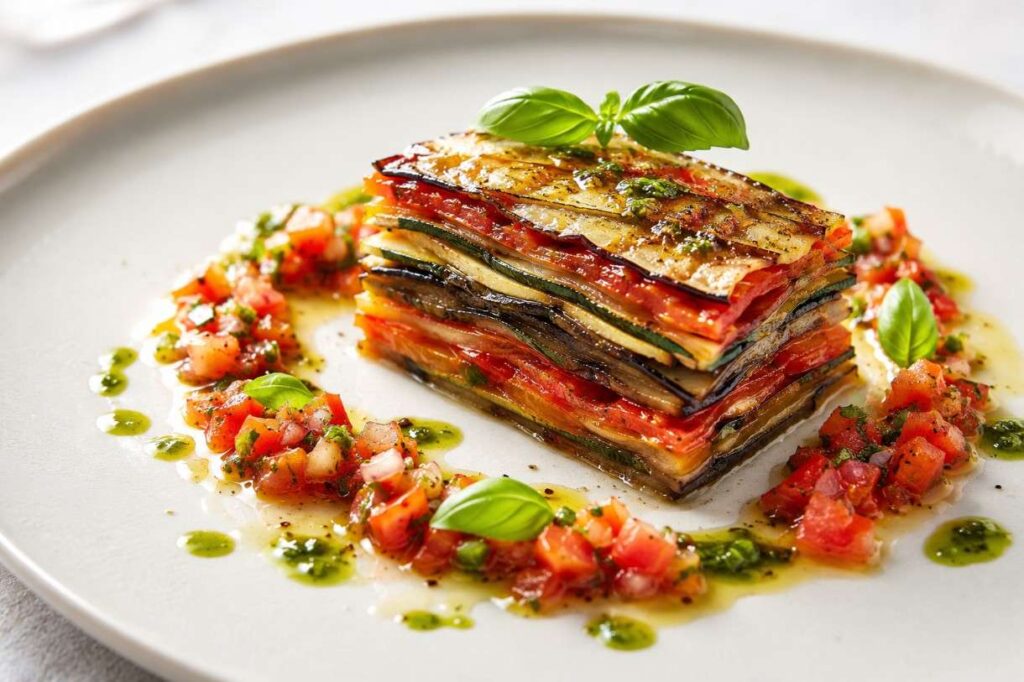
French cuisine draws its strength from its ability to create great elegance from simple ingredients. Few dishes embody this philosophy as much as ratatouille. Originally known as a rustic vegetable dish from Provence, the classic is given a refined reinterpretation in modern French cuisine: ratatouille in millefeuille style.
Instead of serving the vegetables traditionally braised, very thin slices of eggplant, zucchini, and tomato are artfully layered. The result visually resembles a pastry millefeuille – delicate, precise, and elegant. The dish is completed with a fresh tomato vinaigrette and an intensely green basil oil that bring lightness and aromatic depth.
This dish is perfectly suited as a summer starter, a vegetarian main course, or part of a festive menu for Pentecost. It combines Mediterranean freshness with a modern French presentation and showcases the versatility of vegetables.
The idea behind modern ratatouille
Classic ratatouille comes from Nice and was traditionally prepared as a peasant dish. Vegetables such as eggplants, zucchinis, peppers, and tomatoes were slowly simmered together until forming a harmonious flavor unity.
In modern cuisine, the flavor is preserved, but the textures are worked on more consciously. Each type of vegetable retains its own character. Separate cooking develops finer aromas and a more elegant mouthfeel. The millefeuille layering adds structure and visual sophistication to the dish.
The tomato vinaigrette brings freshness and acidity, while the basil oil offers a herbaceous intensity and brings the colors of Provence to the plate.
Recipe: Ratatouille Millefeuille with Tomato Vinaigrette and Basil Oil
Ingredients for 4 people
For the ratatouille millefeuille
- 2 small eggplants
- 2 zucchinis
- 4 large aromatic tomatoes
- 2 pointed red peppers
- 2 shallots
- 2 garlic cloves
- 4 tbsp olive oil
- 1 tsp fresh thyme leaves
- 1 tsp finely chopped rosemary
- Salt
- Black pepper
For the tomato vinaigrette
- 3 ripe tomatoes
- 1 small shallot
- 2 tbsp white wine vinegar
- 5 tbsp olive oil
- 1 tsp Dijon mustard
- 1 pinch of sugar
- Salt
- Black pepper
For the basil oil
- 1 bunch of fresh basil
- 100 ml mild olive oil
- 1 small pinch of salt
For the garnish
- Small basil leaves
- A few drops of good olive oil
- Fleur de sel
Preparation of the vegetables
Cut the eggplants and zucchinis into slices about 2 to 3 millimeters thick. Also slice the tomatoes into thin rounds and lightly salt them to draw out excess water.
Cut the pointed peppers in half, remove the seeds, and roast them skin-side up under the grill or in the oven until the skin blackens. Then cover, let rest briefly, and peel off the skin. Next, cut into thin strips.
Finely chop the shallots and garlic, then sauté them in a little olive oil until they become translucent.
Cooking the vegetables
Lightly brush the eggplant and zucchini slices with olive oil and then cook them briefly in a hot grill pan or on a baking sheet in the oven. They should become tender but retain their structure.
Season with salt, pepper, thyme, and rosemary.
Assembling the millefeuille
Use a small rectangular mold or ring molds. Alternate layers of eggplant, zucchini, tomato, and pepper. Distribute some of the sautéed shallots and garlic between the layers.
Press the layers lightly to form a stable structure.
Reheat the vegetable millefeuille in the oven at 180 degrees for about 15 minutes so the flavors meld slightly.
Preparing the tomato vinaigrette
Peel, deseed, and cut the tomatoes into very small cubes.
Finely chop the shallot and mix it with white wine vinegar, mustard, salt, pepper, and a small pinch of sugar. Then slowly incorporate the olive oil.
Finally, fold in the diced tomatoes. The vinaigrette should be fresh and light.
Preparation of the basil oil
Quickly blanch the basil and then immediately plunge it into ice water. This helps preserve an intense green color.
Then drain well and finely blend with olive oil and a small pinch of salt. Pass through a fine sieve.
The result is an aromatic oil, intensely green with a fresh basil fragrance.
Presentation
Place the hot ratatouille millefeuille in the center of preheated plates.
Loosely spread the tomato vinaigrette around. Drizzle a few drops of basil oil onto the plate and vegetables.
Finish with small basil leaves and a bit of fleur de sel.
Flavors and textures
This dish plays on the contrast of different elements:
- the delicate texture of layered vegetables
- the fresh acidity of the vinaigrette
- the herbaceous depth of the basil oil
- the slight sweetness of sun-ripened tomatoes
- the grilled flavors of eggplant and bell pepper
Unlike classic ratatouille, the modern version feels clearly lighter and more precise. Each ingredient remains identifiable and contributes to the overall flavor palette.
Serving ideas
The ratatouille millefeuille lends itself to many combinations:
- as a starter with fresh goat cheese
- as a vegetarian main course with a crispy baguette
- with grilled lamb or veal
- with pan-fried sea bass or bream
- as part of a summer menu
Dry white wines from the south of France pair particularly well, such as a Vermentino or a mineral rosé from Provence.
This dish clearly illustrates how French cuisine has evolved. Vegetables no longer play just a secondary role. Modern French chefs treat seasonal vegetables with the same care as fish or meat.
The ratatouille millefeuille combines tradition and contemporary aesthetics. It remains deeply rooted in Provence while being light, elegant, and modern – ideal for refined spring and summer cuisine around Pentecost.
Tips for perfect preparation
Even slices
The thinner and more even the vegetables are sliced, the more elegant the millefeuille will be. A mandoline is particularly suitable for this.
Reduce water content
Tomatoes and eggplants contain a lot of water. A light salting before cooking greatly improves the texture.
Use quality olive oil
Since the dish contains few ingredients, the quality of the olive oil greatly influences the flavor.
Preparation in advance
The millefeuille can be prepared a few hours in advance. Just reheat it briefly before serving and plate fresh.
Modern French Vegetable Cuisine
This dish illustrates well how French cuisine has evolved. Vegetables no longer play a simple secondary role. Modern French chefs treat seasonal vegetables with the same care as fish or meat.
The ratatouille millefeuille combines tradition and contemporary aesthetics. It remains deeply rooted in Provence while being light, elegant, and modern – ideal for the refined spring and summer cuisine around Pentecost.