
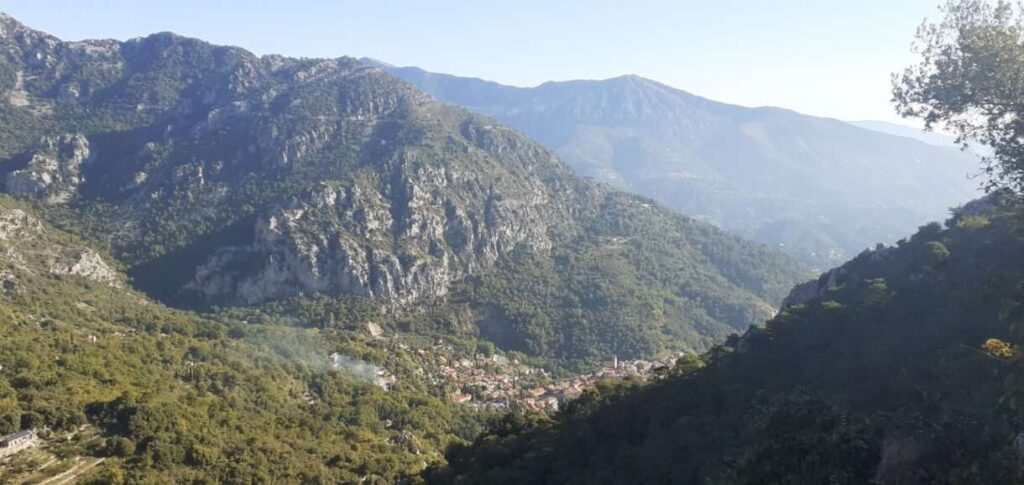
Anyone who associates the Côte d’Azur only with promenades, yachts, and glittering coastal towns will experience a surprise in Gorbio. Perched high above Menton and Roquebrune-Cap-Martin, this medieval village clings to the slopes of the Maritime Alps like a forgotten eagle’s nest. Only about 2,100 inhabitants live here, spread across narrow alleys, old stone houses, and hidden squares. But Gorbio only appears small on the map. On-site, an atmosphere unfolds that lingers long after.
The approach itself winds through the mountains like a little test of courage. Around every bend, the view over the Mediterranean Sea opens wider. Then suddenly: natural stone facades, terracotta roofs, quiet staircases, and a village center that looks as if someone has stopped time.
And exactly therein lies the charm.
A Village Like from a Historical Novel
The ideal starting point is the Place de la République, which many locals still call Place de l’Orme. There stands Gorbio’s famous elm tree — planted in 1713 and today one of the most remarkable trees in France. Its massive trunk seems almost unreal. Beneath its gnarled branches, elderly gentlemen play cards while water trickles from a small fountain. Children run across the square, somewhere dishes clatter in a restaurant.
Life here feels pleasantly slow.
Those ordering an espresso quickly notice: no one is in a hurry. Why should they be?
Directly from the square, Rue Gambetta leads deeper into the village. Cobblestones replace asphalt, the houses draw closer together. Covered passages provide shade, flowers hang from windows, somewhere it smells of rosemary and lavender. Some walls date back to the 14th century. Others tell stories from the Renaissance or Baroque periods. Every step reveals new details — a weathered door sign, old wooden beams, or tiny pastel-colored shutters.
And suddenly, one wonders: How many generations may have already walked these paths?
After a few minutes, the Église Saint-Barthélemy appears. The Baroque church from 1663 rises simply and elegantly between the narrow houses. Inside, it surprises with ornate altars, 17th-century paintings, and an impressive statue of Christ. The light falls softly through small windows and bathes the space in an almost meditative atmosphere.
Even visitors without great interest in sacred buildings usually linger longer than planned.
Between Fortress, Art, and Medieval Walls
From the church, the route continues toward the Tour Lascaris. The path leads through especially winding parts of the old town. Some alleys seem barely wider than outstretched arms. Small stone arches connect houses overhead. It’s details like these that give Gorbio its almost cinematic character.
The tower itself once belonged to the fortress of Château Lascaris. Parts of the complex date back to the 12th century. Particularly striking are the Gothic window openings from the 13th century, which have been preserved to this day. Inside the castle museum, art exhibitions are held regularly. Works by the Indian painter Sayed Haider Raza especially shape the village’s cultural identity. The artist lived and worked here for decades.
That fits surprisingly well.
Because Gorbio possesses exactly that blend of tranquility, light, and authenticity that many artists seek. One immediately understands why painters, photographers, or writers love this place.
A few steps further await more small treasures: the Chapelle des Pénitents Blancs from 1445, the Chapelle Saint Lazare with its medieval and Roman-Byzantine influences, as well as the Chapelle Saint Roch from the 17th and 18th centuries. None of these chapels seem ostentatious. That’s exactly what makes them special. They quietly tell stories — of faith, plagues, patron saints, and hard mountain life.
To conclude a tour, the descent to the Fontaine de la Place de la Mairie is worthwhile. In earlier times, pack animals quenched their thirst here. Today, the fountain mainly serves as a popular photo motif. The water sparkles in the sun while voices and laughter echo across the square.
A moment like from a French movie.
When Snail Shells Glow
Culturally, Gorbio has far more than mere historic walls. Especially legendary is the Procession des Limaces — the snail procession. It sounds curious at first but develops an almost magical effect. During the olive harvest, residents adorn snail shells with small lights. When dusk falls, the glowing spirals move through the alleys.
No flashy effects. No modern spectacle.
Only warm light, old stone houses, and an atmosphere hovering somewhere between fairy tale and tradition.
In summer, the village additionally transforms into an open-air stage. Musical evenings, art exhibitions, and small markets enliven the squares. Especially in July and August, a relaxed mix of vacation, village life, and Mediterranean joie de vivre emerges. Street musicians perform beneath old arches, children dance across squares, and late into the evening, meals are enjoyed in small courtyards.
With a bit of luck, one stumbles into a village festival — and suddenly you’re sitting among locals with wine and olives.
Hiking with Sea View
But Gorbio thrives not only on history and culture. The surrounding nature has an almost raw beauty. Directly behind the village, hiking trails begin through the Maritime Alps. One of the best known leads to Col de la Madone. Other routes climb to the Cime des Cabanelles or Mont Agel.
The long-distance hiking trail GR51, also called the “Balcony of the Côte d’Azur,” remains especially popular. The name doesn’t exaggerate at all. Spectacular views of the Mediterranean open repeatedly. Below, the coast glistens, above, rugged mountains tower into the sky. This combination feels almost surreal.
Within minutes, the landscape changes from Mediterranean olive groves to alpine rock formations.
However, sturdy footwear is advisable. The paths can be challenging at times. Loose stones, steep sections, and old stairs require some attention. But this is exactly what creates the feeling of genuine discovery.
Not polished. Not dazzled for tourists.
But authentic.
Cuisine Without Frills
After a stroll through the alleys, hunger eventually sets in. And that’s when Gorbio reveals its next strength. The cuisine here focuses on regional ingredients, honest dishes, and a cozy atmosphere.
At Le Beau Séjour, Mediterranean home cooking lands on the plate — fresh, uncomplicated, and full of flavor. Many ingredients come directly from the surroundings. A regional wine from the Alpes-Maritimes pairs excellently.
Also popular is the Auberge du Village on Rue Gambetta. Here, traditional specialties like lamb, rabbit, or freshly caught fish dominate. The ambiance feels pleasantly familiar. No stiff gourmet cuisine, but honest food with soul.
In between, small cafés around Place de la République invite for a break. A coffee, a piece of lemon cake, and the quiet village life all around — sometimes that’s all you need.
Street food? None.
Gorbio prefers to savor slowly.
Tips for a Successful Visit
The best time for an outing is between late spring days and early autumn. Especially in summer, the village pulses with festivals, exhibitions, and events. Early mornings or late afternoons, however, show Gorbio at its most beautiful. Then warm light bathes the facades in golden colors and temperatures remain pleasant.
Photographers experience a little paradise at these times of day.
About two to three hours suffice to visit the main sights. But honestly, time here passes surprisingly fast. Many visitors stay longer than planned — simply because behind every corner awaits yet another beautiful view.
Water in the backpack never hurts. Nor does a bit of curiosity. Because the most beautiful moments often arise off the main paths. Perhaps on a quiet staircase with a sea view. Perhaps in front of an old door full of flowers. Or during a spontaneous conversation with a resident who tells stories from earlier times.
That is exactly what makes Gorbio so special.
Not spectacular in a loud sense. But real.
And sometimes, it is precisely such places that touch the most deeply.
A travel report by V.O.Yager