
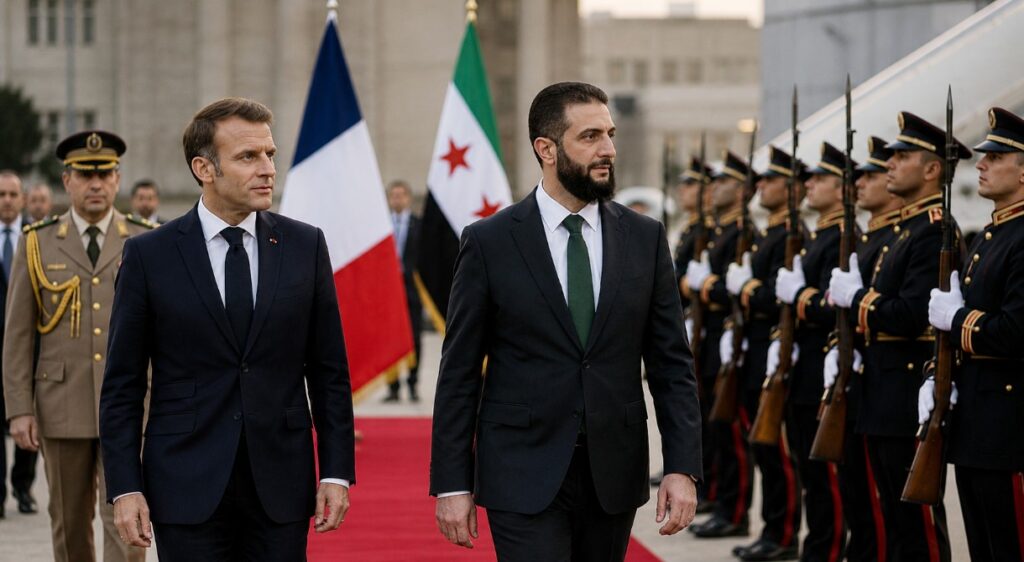
The visit of Emmanuel Macron to Damascus is far more than an ordinary diplomatic trip. As the first head of state of a major Western power to travel to Syria since the overthrow of Bashar al-Assad at the end of 2024 and the takeover by transitional president Ahmed al-Chareh, the French president is sending a politically significant signal.
The visit marks the end of a chapter that began in 2011, when France severed all relations with the Assad regime after the bloody suppression of the popular uprising. For more than a decade Paris was among the most determined Western capitals in its dealings with Damascus. Today, the geopolitical framework has fundamentally changed.
A Deliberately Chosen French Strategy
In fact, Emmanuel Macron has been preparing this rapprochement for several months. Already in May 2025 he surprised many European partners when he received Ahmed al-Chareh at the Élysée-Palast, thereby enabling the new Syrian head of state to make his first official visit to a Western capital.
At the time, the decision provoked considerable criticism, particularly because of the jihadist past of the new Syrian president. Macron defended his course, however, with a pragmatic argument: France wants to accompany the political transition rather than leave the field to regional powers or Russia. With the trip to Damascus, Paris is now following this strategy consistently.
France is pursuing several objectives at once.
First and foremost are security interests. Paris wants to ensure that the new Syrian authorities continue their fight against remaining cells of the terrorist organization “Islamic State” and maintain cooperation in the field of intelligence services.
Second, it is about diplomatic influence. By officially resuming relations with Damascus, France wants to secure its role in a region whose balance of power is currently being reordered.
Finally, the economic dimension also plays an important role.
Reconstruction at the Center
According to the Syrian presidency, Emmanuel Macron is being accompanied by a delegation of investors and representatives of large French companies. The aim is to expand economic cooperation between the two countries.
After fifteen years of war, Syria faces a massive reconstruction task. Investments are needed in almost all areas – from infrastructure and transport to energy supply and telecommunications, as well as health care. French authorities are aware that the competition will be intense. Companies from Turkey, China and the Gulf states have already positioned themselves early.
This economic perspective also explains why several Western states have been reassessing their Syria policy since the gradual easing of European and American sanctions.
A Still Fragile Normalization
However, the visit takes place under difficult conditions.
Just days before the official announcement of the trip, a bomb attack on a café in central Damascus caused numerous fatalities. The attack underscores that the security situation in the country remains extremely fragile. For security reasons, several originally planned public events, including a walk through the Old City of Damascus, were therefore canceled.
In addition, the new Syrian rulers continue to face considerable criticism regarding the protection of religious and ethnic minorities. Acts of violence against Alawite and later Druze communities have raised doubts in numerous Western capitals as to whether the new leadership is truly capable of building an inclusive state.
France is therefore pursuing a cautious course: dialogue yes – but without an unconditional vote of confidence.
A Message to Several Capitals
The visit also has a pronounced international dimension.
First, the signal is directed at Washington. Although the United States also support the political transition in Syria, Paris wants to emphasize that it will retain a leading role in the Syrian file and will not leave the country’s political future solely to the U.S.
The message is also aimed at Ankara, which is seen as a central actor in Syria and where Emmanuel Macron will subsequently participate in the NATO summit. France wants to make clear that it remains an important interlocutor on the security and geopolitical issues of the Middle East.
Last but not least, the initiative is addressed to European partners. By taking the lead, the French government hopes to gradually move the European Union toward a controlled normalization of its relations with Damascus.
A Political Gamble
However, this strategy is not without risks.
Ahmed al-Chareh is trying to present himself as a reform-minded statesman capable of stabilizing a country devastated by war. His past and the continuing difficulties of his government, however, continue to fuel significant reservations among many observers.
By traveling to Damascus, Emmanuel Macron is also staking part of his own political credibility. If the Syrian transition process actually leads to lasting stabilization and better protection for all population groups, France could claim to have supported this change early on. If the situation deteriorates again, however, France’s policy of opening up is likely to come under increased criticism.
One thing is already clear today: this visit marks a significant diplomatic turning point. Fifteen years after the severing of relations between Paris and Damascus, France officially returns to the Syrian stage. The trip once again underlines a constant of international politics: when geopolitical power relations change, strategic interests often prevail over former principled positions.
Andreas M. Brucker