
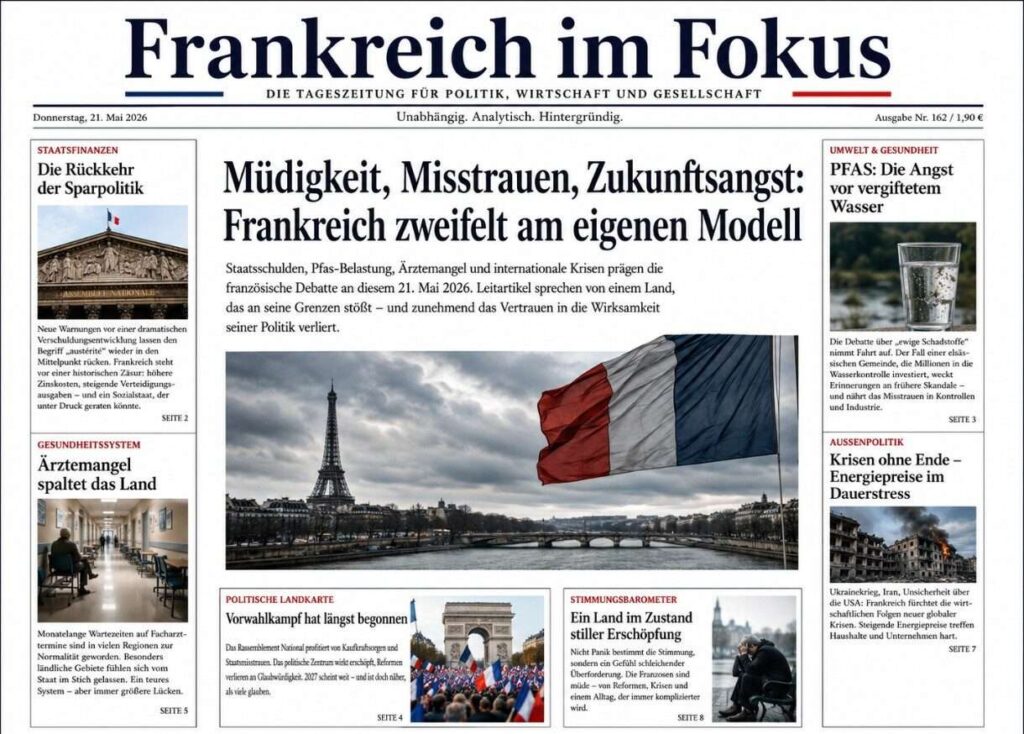
The French press conveys an unusually consistent mood on this May 21, 2026. Although the topics range from public finances to pollutants to foreign policy, they focus on one central concern: France is gradually losing confidence in the sustainability of its model.
What strikes is not so much panic but tiredness. The political and social debate appears less explosive and more exhausted. Many editorials describe a country that has been in a permanent reform situation for years, without daily life improving for many citizens.
The Return of Austerity Politics
At the center today is the debate on public debt. After new alarms from government circles and the financial world, there is open discussion of an upcoming phase of strict budget consolidation. The word “austerity” — for a long time a political taboo — has returned to being an integral part of public discourse.
The nervousness stems from a structural contradiction:
France wants simultaneously to strengthen its military role in Europe, maintain its social state, and finance high public spending — while facing rising interest costs and weak growth.
Many commentators now speak of a historic turning point. For decades France has been able to mitigate its economic problems through debt. But now the perception is growing that the room for maneuver is shrinking. In particular, the combination of high deficits and geopolitical pressures to increase armaments is causing concern.
The debate also has a symbolic dimension:
France traditionally considers itself a strong state with a broad social function. Any discussion about potential cuts therefore quickly becomes a confrontation about national identity.
PFAS: the fear of invisible pollution
At the same time, the discussion about PFAS chemicals is gaining a lot of attention. The so-called “forever pollutants” are today considered one of the most emotionally charged environmental issues in the country.
The case of an Alsatian municipality that invested millions of euros in monitoring its water supply is particularly heated, reigniting the debate. The issue touches a raw nerve because it represents a modern form of insecurity:
invisible, long-term, and almost uncontrollable.
Several media outlets have begun to compare this situation to previous French health scandals such as asbestos or certain pesticides. The difference is that PFAS could potentially affect entire regions and that pollution often only manifests after years.
Added to this is a growing distrust of state control mechanisms. Many citizens wonder whether politics and industry will again react too late.
An expensive healthcare system but with increasingly wide gaps
Almost daily reports on the so-called “medical deserts” dominate the regional press. In particular, in rural areas, the shortage of doctors is visibly worsening.
Waiting months for specialist appointments is now considered normal in many areas. Ophthalmologists, pediatricians, and gynecologists are particularly affected. For many French people, this creates a paradoxical feeling:
The state invests enormous sums in the healthcare system — yet the actual care deteriorates.
The political crisis concerns above all the territorial divide. While Paris debates defense policy, European strategies, and international crises, many people in smaller towns witness a withdrawal of essential services.
It is precisely this perception of a “forgotten France” that has been important fertile ground for populist movements for years.
Foreign policy as a factor of additional pressure
The international situation also heightens general uncertainty. The war in Ukraine remains a central topic, as do tensions with Iran and uncertainty about the foreign role of the United States under Donald Trump.
In France these crises are increasingly seen through an economic lens. The concern is not only about the military escalation, but also its financial consequences:
rising energy prices, higher defense spending, and new burdens on the state budget.
France thus finds itself in a difficult strategic situation. On one hand, President Emmanuel Macron wants to position France as a leading geopolitical power in Europe. On the other hand, at home there is a growing perception that the international ambition is increasingly disconnected from social reality.
The long shadow of the 2027 presidential elections
Although the next presidential elections are still far off, they are already influencing political dynamics. The Rassemblement National in particular is benefiting from the general mood made up of concerns about purchasing power, distrust of the state, and regional frustration.
Marine Le Pen’s political strategy remains remarkably consistent:
less ideological extremism, more focus on everyday problems.
The political center, on the other hand, appears increasingly on the defensive. Many reforms in recent years — for example in the pension system or the labor market — have pursued economic goals but at the same time have generated fatigue in society.
It is precisely this discrepancy that many commentators describe today:
France is constantly reforming, but fewer and fewer citizens believe in the effectiveness of these reforms.
A nation in a state of silent fatigue
Perhaps the most obvious feature of today’s French debate is the underlying emotional tone. The press does not portray a country on the brink of collapse. Institutions still function, the economy has not collapsed, and France remains one of the most important powers in Europe.
But beneath the surface, a feeling of growing overload is spreading.
Many French people perceive everyday life as more complicated, expensive, and unstable than a few years ago. At the same time, the feeling is growing that the state spends more and more without sustainably solving fundamental problems.
This mix of fatigue, skepticism, and a latent sense of loss of control characterizes large parts of the current public debate.
It is not panic that dominates the mood.
But the question of how much longer the French balance can hold.