
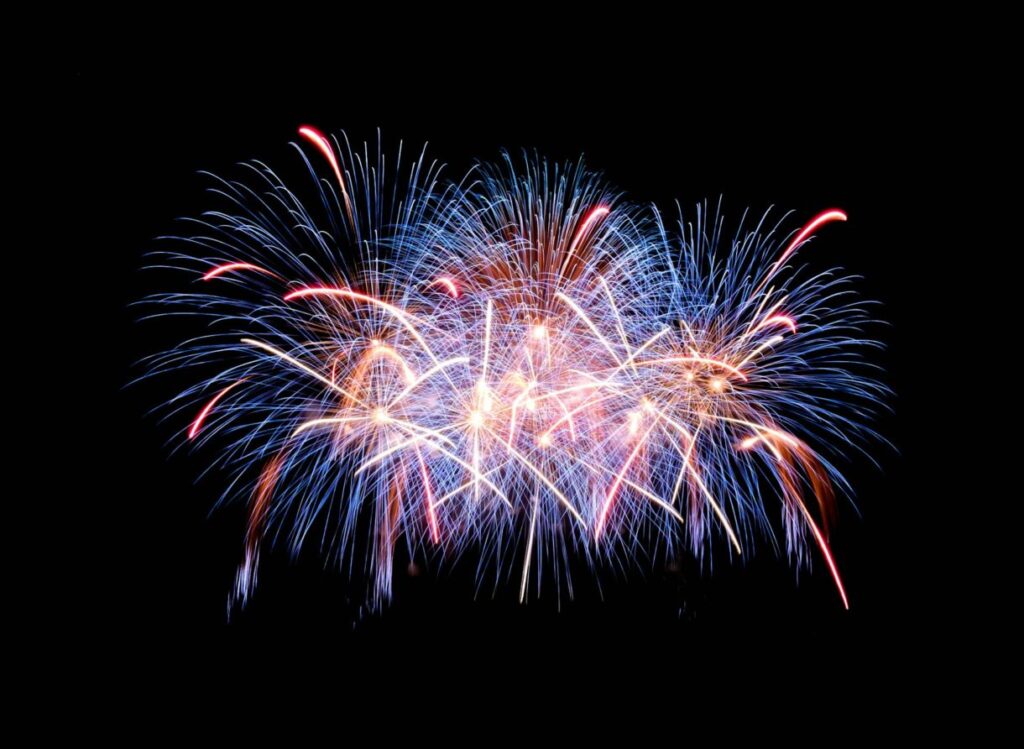
There are images that burn indelibly into a nation’s memory. In France the evening of July 14 is undoubtedly one of them. While elsewhere national holidays are observed with endless speeches, brass bands and stiff military ceremonies, France let the sky speak. Colour, thunder, light and wonder – for a few minutes the Republic seemed to hover above the rooftops.
Now the sky stays dark.
Not out of thrift. Not out of ideological asceticism. Not even out of security fanaticism.
But because nature has now taken over directing duties.
One needs to let that sentence sink in slowly. The country’s largest public celebration foregoes its emotional finale because a single spark could be enough to set whole regions on fire. Twenty years ago you’d probably have laughed at the screenwriter of a dystopian Netflix series for that.
Today it’s called the weather report.
Of course one could now conveniently complain about the municipalities. About mayors, prefects and civil servants whose favourite pastime supposedly is forbidding anything that gives people joy. That would be easy.
And wrong.
Because anyone who sets off fireworks in the face of parched forests acts about as responsibly as someone who lights a cigarette beside a petrol station and then wonders at the haste of the fire brigade.
The real bitterness lies elsewhere.
France is gradually losing those certainties that defined the country for decades. Summer was once a season full of lightness. Today it increasingly resembles crisis management with weather apps, water restrictions and wildfire maps. The colours of the national holiday give way to the colours of the danger levels.
Yellow.
Orange.
Red.
One almost wants to laugh. After all the celebration remains. There are concerts, music, dance and village fairs. Only without fireworks. Perhaps in future a drone show will replace the rockets. A thousand perfectly programmed points of light draw geometric figures in the sky, silent, low-emission and, of course, CO2-balanced.
Impressive.
Like a perfectly organised tax notice.
The problem with modern substitutes is that they can imitate almost everything – except emotions.
A firework lives precisely from its unpredictability. From the dull bang that arrives in your chest a second later. From the smell of gunpowder. From the collective “Oh!” of thousands of people who, for a brief moment, forget what they normally argue about every day.
A drone produces admiration.
A firework produces memories.
But memories seem to have a hard time in times of permanent crisis. First the certainty of snowy winters disappeared. Then heat waves became the norm. Rivers shrink, forests burn, fields wither. Now the change reaches precisely the ritual that has accompanied the summers of many French people for generations.
One could cynically ask which piece of the way of life will disappear next.
The picnic, because meadows are too dry?
The wine, because the vines burn?
The lavender fields of Provence as a historical footnote?
As exaggerated as these questions may sound – a few years ago no one would have believed that French municipalities would celebrate the national holiday without fireworks.
The real scandal, however, is not that the rockets remain in storage.
The scandal is that many have long since grown used to saying goodbye.
To landscapes.
To seasons.
To traditions.
To certainties.
Humans possess an astonishing capacity for adaptation. They get used to almost anything. Even to the idea that extraordinary heat suddenly appears ordinary. That water becomes scarce. That forests burn. That the year’s biggest fireworks display is cancelled.
Perhaps that is the most dangerous development.
Not the cancellation of the fireworks.
But the silent becoming accustomed to it.
Because a society rarely loses everything at once. Mostly its rituals disappear quietly, almost unnoticed – one after the other. Until one day someone asks how things used to be.
Then older French people tell of an evening in July when the sky above the Republic exploded in a thousand colours and no one imagined that even that spectacle could one day be too dangerous.
It then sounds like a story from another time.
Maybe it already is.