
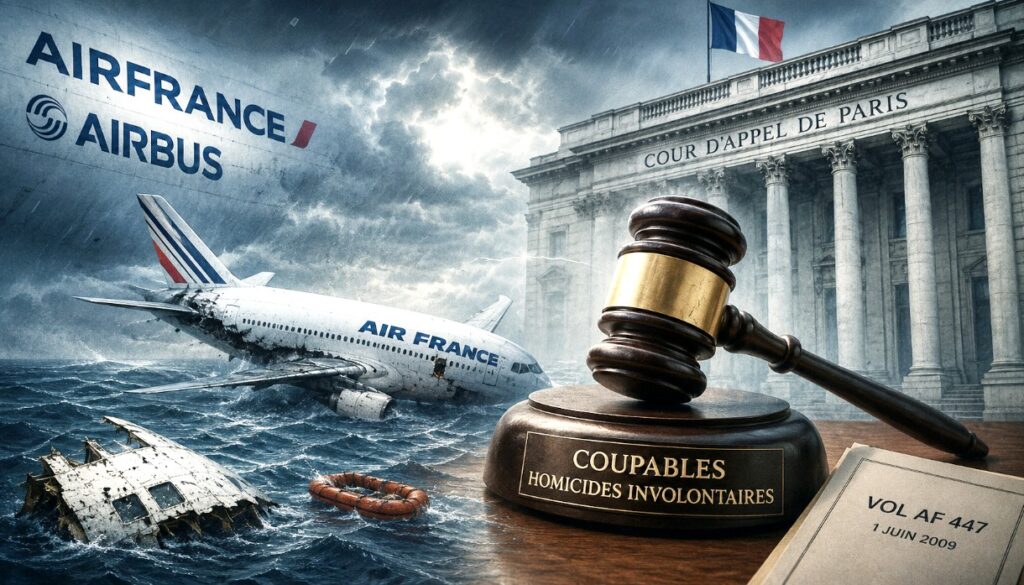
Some disasters never fully disappear from a nation’s collective memory. The crash of Air France Flight AF447, which was flying between Rio de Janeiro and Paris, remains an unhealed wound in France nearly 20 years later.
A recent ruling by the Paris Court of Appeal went beyond the aviation field. Airbus and Air France were found guilty of manslaughter. For the families of the 228 victims, this decision represents a long-awaited moment of recognition and marks the end of a legal marathon that seemed almost endless.
The crash on the night of June 1, 2009, is still considered one of the most mysterious and shocking accidents in modern aviation history. The aircraft disappeared from radar while flying over a thunderstorm area of the Atlantic. Only years later did investigators succeed in recovering the wreckage and flight recorders from thousands of meters deep. It may sound like a story from a novel, but tragically it was harsh reality.
At the center of the investigation were the pitot tube sensors mounted outside the Airbus A330. These small sensors measure airspeed. It may sound technical and mundane, but for pilots this data becomes a decisive rudder. When the sensors provided incorrect values, the cockpit plunged into extreme confusion in an instant.
An alarm sounded and automatic systems partially shut down. The pilots lost control of the aircraft in the darkness of the Atlantic.
It later emerged that both Airbus and Air France had warnings before the accident about problems with a specific pitot tube sensor. This point became the starting point for the court’s legal assessment. The judges concluded that the known risk was underestimated and that necessary measures were taken too late.
Thus the appeals court overturned the earlier 2022 judgment that had acquitted the two companies of criminal responsibility. This new ruling carries enormous symbolic significance, because within France Airbus and Air France have long been regarded as almost untouchable institutions, symbols of technical and national honor.
For many French people Air France is more than just an airline. It is part of the national self-image, like the SNCF high-speed trains or Toulouse’s aerospace industry. Meanwhile Airbus embodies Europe’s engineering prowess, industrial strength, and the dream of technological sovereignty vis-à-vis the United States.
For precisely these reasons the ruling is seen as a quiet breaking of a taboo.
This case is no longer simply about a single error in the cockpit. It reveals vulnerabilities in a highly complex system where technology, training, safety culture, and economic decisions are intertwined. Responsibility often spreads like fog, making it difficult to attribute clearly to any one individual.
This is precisely why the AF447 case continues to frustrate us to this day.
This crash was not caused by a single incorrect action. Small mistakes cascaded into disaster. Like a domino game, no one believed the first domino piece would ultimately bring everything down.
What matters most to the bereaved families now is that the state has officially recognized there were reasons beyond mere tragic fate. Many families have spent years fighting the feeling that they lost their loved ones amidst technical reports and legal disputes.
At least now a judgment has been made.
But the pain remains.