
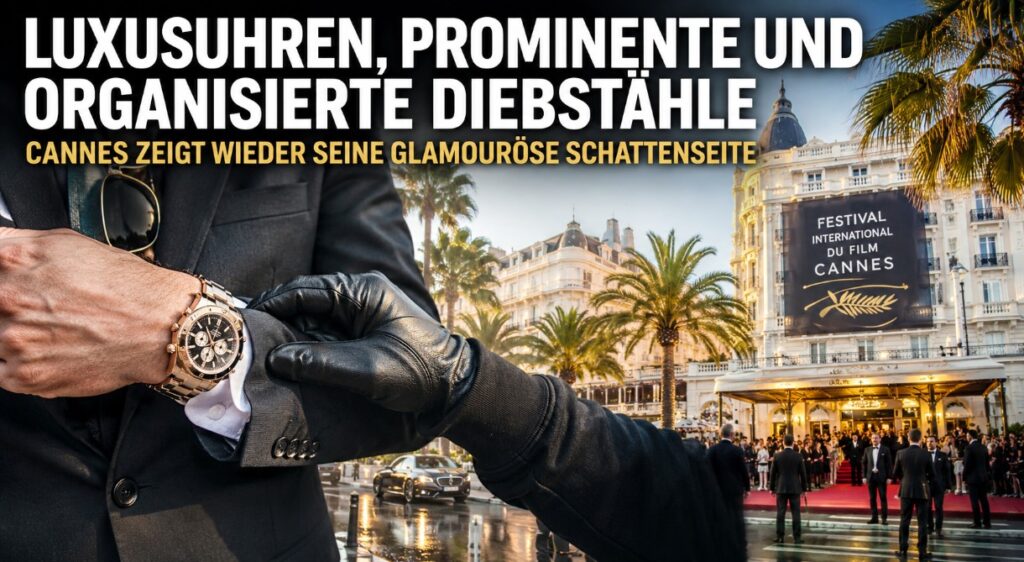
When cameras flash in Cannes, limousines slowly drive along the Croisette, and actors wearing sunglasses larger than their roles emerge from luxury hotels, the Côte d’Azur feels like a parallel world for several days. Everything shines, everything sparkles. And it is precisely this sparkle that now attracts not only photographers but many others as well.
This year’s film festival has been marked by a series of spectacular luxury watch thefts. Victims include millionaires, producers, influencers, entrepreneurs — in other words, people who clearly display their wealth on their wrists. Rolex, Patek Philippe, Richard Mille are no longer just watch brands. They function as small, portable assets, easy to carry, extremely valuable, and when sold on the market, traded as highly as gold bars.
French authorities now openly acknowledge the presence of professional, organized criminal groups. It’s not about opportunistic offenders or random assaults; rather, clearly defined teams come deliberately to Cannes during the festival period. Restaurants, beach clubs, hotel lobbies are under surveillance, and the target is often decided with just a glance at the wrist.
From there, everything moves swiftly.
Collision in front of the hotel entrance. A brief distracting maneuver. Sometimes they even grab directly as they pass by. In just a few seconds, a watch worth an entire apartment disappears. To outsiders, it looks like a scene from a 1970s French gangster film—except there’s no film music.
What is particularly striking is that the perpetrators are acting increasingly boldly. Previously, such thefts were carried out more discreetly, but now they occur right in the middle of the Croisette, right in front of luxury hotels, even in view of many passersby. Cannes is once again asserting itself as a stage for the extreme world. Here are luxurious yachts, champagne receptions, diamond jewelry, and on the other hand, organized crime specialized in this world is rampant.
Political debates quickly arose as well.
Conservative commentators see this incident as a symbol of the state’s declining control powers. Left-wing voices, on the other hand, argue that Cannes provocatively flaunts wealth almost every year, attracting criminals as a result. In fact, the film festival often appears to be a showcase of global luxury capitalism. It is not uncommon there for those seeking attention to proudly display on their arms what amounts to someone else’s income for an entire year.
And this is where the psychological peculiarity of this case lies.
Luxury watches are no longer just tools to tell time. They signify status, influence, and belonging to a special world. Influencers showcase their models like trophies on social networks, and entrepreneurs speak about limited editions with the same passion as they do about classic car or art collections. The problem is that visible wealth creates visible targets.
Many prominent guests now deliberately avoid conspicuous models or travel with additional security staff. Some hotels have strengthened security or started offering discreet transportation and private entrances. Even so, the constant sense of being on edge never disappears. Behind sunglasses and flashes, the atmosphere feels less like a film festival and more like a high-security zone.
In this sense, Cannes continues to embody a fascinating contradiction. It is both a stage for movies, glamour, and displays of power, and at the same time the place where the downside of excessive visibility is most clearly revealed. The more dazzling the luxury shines, the more those who seek to profit from it also become clearly visible.
It might be a little crazy.
Perhaps that is what speaks about modern France more than any political debate. Because between the red carpet and the police sirens, there are often only a few meters distance in Cannes.
Andreas M. Brucker