
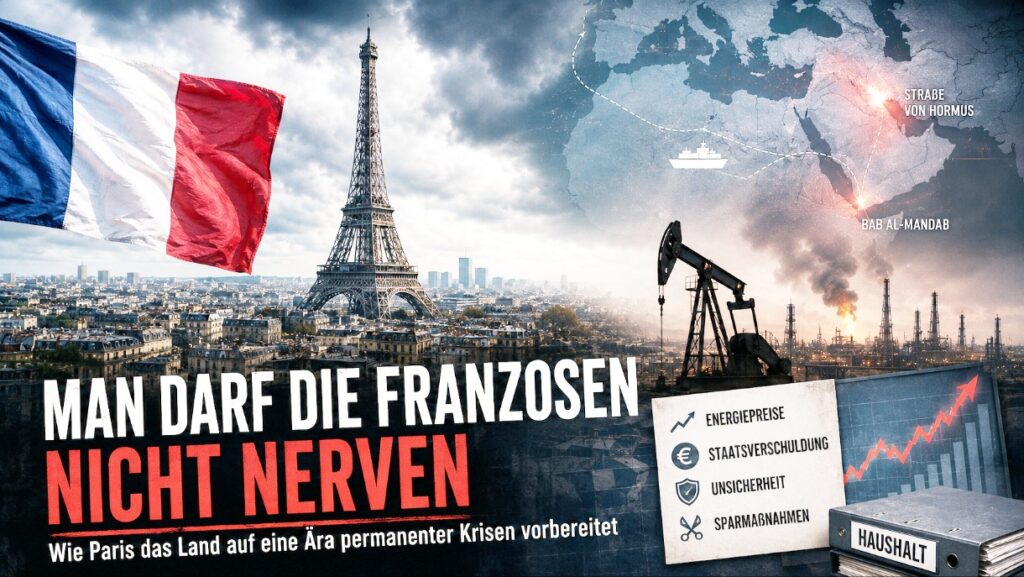
These words sound casual, almost popular. “Il ne faut pas emmerder les Français” — we must not make the French suffer any more. They were spoken by Prime Minister Sébastien Lecornu when announcing a new support package in response to rising energy prices linked to the escalation of the Middle East situation. Yet it is precisely in this plain clarity that a notable political shift in France can be seen.
In Paris, the posture has become clear: no longer aligning the public to temporary crises, but preparing for a permanent state of emergency.
The French government has begun to mention geopolitical risks in a calm tone that would have been rare a few years ago. Lecornu candidly stated that the Middle East conflict is “likely to continue in one form or another.” He explained that, even in favorable circumstances, stabilization can only be expected by autumn. At the same time, the government has warned about scenarios that until now were discussed only in security think tanks, such as attacks on oil infrastructure, interruptions to maritime trade routes, and the possibility of closures of the Strait of Hormuz or the Bab-el-Mandeb Strait.
Thus the political tone in France is fundamentally changing. The government no longer seeks to cleverly conceal uncertainty in words, but has begun to incorporate it into the nation’s public messaging.
A New Language of Persistent Crisis
The true meaning of Le Cornu’s words lies less in their content than in their political implications.
“Do not bother the French” is not mere social courtesy. It is an implicit recognition of political vulnerability. The French state knows well how quickly economic pressure can turn into unrest.
The memory of the 2018 Yellow Vests protests is central. Few events have unsettled France’s elites as much. What began as a relatively limited increase in fuel taxes ignited a nationwide protest movement within weeks, driven by declines in purchasing power, social inequality, and backlash against Emmanuel Macron’s technocratic leadership.
Since then, a strategic dogma has settled in the Élysée. Energy prices are not a purely economic issue but a matter of domestic stability.
That is why Le Cornu opposes a general reduction of fuel taxes. Such a measure would be popular in the short term but become fiscally unmanageable in the long term. Instead, the government focuses on targeted compensation measures aimed at groups particularly vulnerable, such as commuters, care workers, farmers, taxi companies, and logistics operators.
This is politically highly suggestive. The French state no longer seeks to absorb a crisis entirely but to limit its social explosive potential.
France Discovers the Logic of a Crisis Economy
Here a profound change in the philosophy of the French state is visible.
For decades, the French social model rested on an implicit promise. The state would comprehensively protect its citizens from the harshness of the global market. In moments such as financial crises, pandemics, or energy price shocks, Paris traditionally responded with large-scale interventions, price controls, subsidies, or state borrowing.
At the height of the energy crisis following Russia’s invasion of Ukraine, this logic reached its peak. France administratively capped electricity and gas prices and absorbed billions of euros in costs through the state budget. Public debt continued to rise, substantially exceeding 110% of GDP.
But fiscal leeway is shrinking. The combination of high interest rates, low growth, rising defense spending, and structural deficits forces Paris to set priorities. The government can no longer fully neutralize every crisis.
Hence a new French crisis policy is emerging: selective relief rather than universal protection.
This shift is not limited to France. Similar trends can be seen across Europe. States are trying to manage ongoing burdens administratively rather than fully compensating them. However, in France social expectations of the state are higher than in most European countries, making this strategy particularly politically sensitive.
The Return of Geopolitical Realism
It is also notable that French government officials have begun to speak more candidly about geopolitical risks.
Until a few years ago, it was believed in Europe that the interdependence of the global economy would ultimately have a stabilizing effect. Energy was seen primarily as a market issue, not a geopolitical vulnerability. But since the war in Ukraine, that assumption has begun to fall apart.
And now the Middle East conflict is further worsening uncertainty. France is indirectly communicating to its citizens that “the era of calculable globalization is over.”
Le Cornu’s remarks fit a larger strategic pattern. Europe is preparing for a world in which supply chains are more fragile, energy prices remain high, and geopolitical shocks occur more frequently.
There is one more factor. That is a security-driven strengthening of the armed forces. France plans massive investments in defence, weapons production and strategic infrastructure. President Macron has spoken for years about Europe’s “strategic autonomy,” and the current crisis gives further legitimacy to this policy.
But rearming, energy security and strengthening industrial resilience come with enormous costs. The most politically difficult challenge is to make this transformation socially acceptable.
The Psychology of Adaptation
This is exactly where Le Cornu’s words come into their own.
The government is walking a narrow tightrope. It must prepare the public for hard times while avoiding excessive alarm. It must convey seriousness without creating panic. And it must explain why the state will no longer be able to fully compensate all burdens in the future.
That is why the government’s communication takes on a very technocratic tone. The crisis is not narrated dramatically but managed. Targeted support, burden-sharing, resilience and adaptation are mentioned.
There is a quiet, educational message: that citizens should learn to accept uncertainty as the normal state.
This is also politically risky. France has a strong protest culture and deep distrust of elites. Perceptions of social injustice can quickly lead to an eruption. At the same time, the government seems convinced that a return to the illusion of former stability is no longer possible.
Therefore the essential message is not “the state will protect you from crises.”
Rather, “the state is trying to keep society controllable through an era of sustained crisis.”
This is a fundamental difference and probably the real political shift of the current moment.
P.T.