
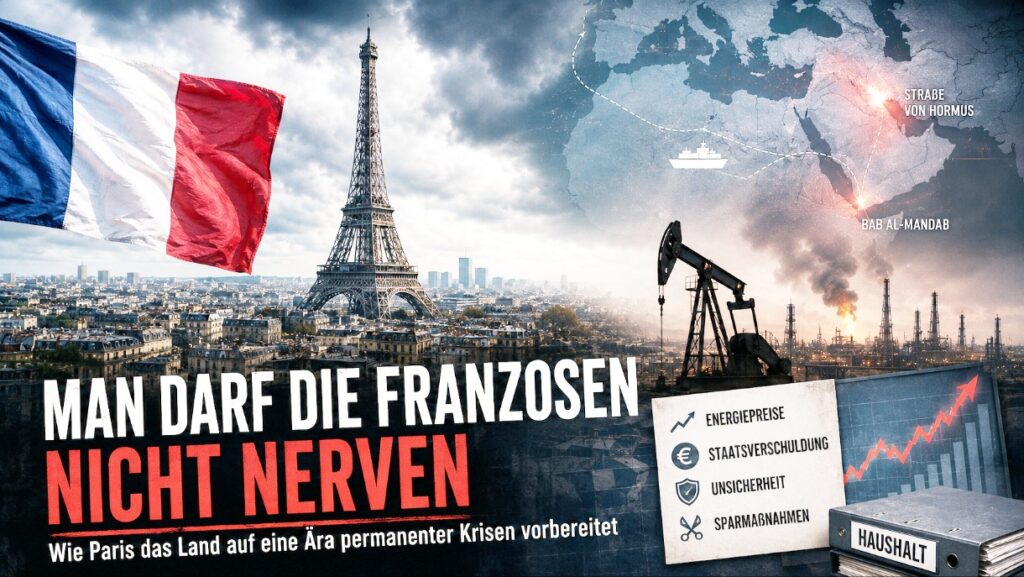
This sentence sounds casual, almost folk-like. “Il ne faut pas emmerder les Français” — we must not cause extra trouble for the French. French Prime Minister Sébastien Lecornu said this when launching a new aid package in response to rising energy prices triggered by the escalating situation in the Middle East. However, it is precisely in this straightforward statement that a significant shift in French politics is revealed.
Paris is clearly beginning to no longer guide the public to respond to a short-term crisis, but is preparing to face a long-term state of emergency.
The French government now discusses geopolitical risks with a calmness that was extremely rare just a few years ago. Lecornu openly stated that the Middle East conflict “will persist in some form.” Even under favorable conditions, it is expected that some degree of stability will not be seen until autumn. At the same time, the government warned of scenarios previously mostly discussed in security policy think tanks: attacks on oil and gas infrastructure, disruptions to maritime trade routes, possible blockades of the Strait of Hormuz or the Strait of Mandeb.
All this marks a fundamental shift in the tone of French politics. The government no longer tries to mask uncertainty with words but increasingly integrates it into national messaging.
A New Language for a Persistent Crisis
Therefore, the real significance of Lecornu’s sentence lies not in the literal content but in its political subtext.
“Do not annoy the French” in this context is not just social understanding and caution. It is an implicit admission of political vulnerability: the French state knows how quickly economic pressure can escalate into open unrest.
The memory of the 2018 “Yellow Vest” protests is crucial to this. Hardly any event shook the French elite as much as these protests did. The movement was initially triggered by a relatively limited increase in fuel taxes, but within weeks it developed into a nationwide wave of protest against declining purchasing power, social inequality, and the perceived arrogance of Emmanuel Macron’s technocratic leadership.
Since then, the Élysée Palace has established a strategic principle: energy prices are no longer purely an economic issue, but a matter of domestic stability.
For this reason, Le Cornu rejected the idea of a general reduction in fuel taxes. Such measures might be popular in the short term, but are fiscally unsustainable in the long run. Instead, the government focuses on providing targeted compensation for specific groups most affected: commuters, caregivers, farmers, taxi companies, and logistics firms.
This is politically very revealing. The French government no longer expects to completely buffer the crisis, but aims to limit its social explosiveness.
France begins to embrace the logic of crisis economics
This reflects a profound shift in France’s national philosophy.
For decades, the French social model was based on an implicit promise: that the state would fully protect the population from global market shocks. Whether financial crises, pandemics, or energy price shocks, Paris’s traditional response was large-scale intervention, price controls, subsidies, or state borrowing.
In the energy crisis brought about by the Russia-Ukraine war, this logic reached a temporary peak. The French administration limited electricity and gas prices, bearing billions of costs through the national budget. Public debt continues to climb and now clearly exceeds 110% of gross domestic product.
However, the available policy space is shrinking. The combined effects of high interest rates, weak economic growth, increased defense spending, and structural deficits are forcing Paris to increasingly prioritize. The government can no longer fully resolve every crisis.
Therefore, a new French crisis policy model is taking shape: selective relief instead of universal guarantees.
This development is not limited to France. Similar trends are appearing throughout Europe. Countries are trying to manage ongoing pressures through administrative means rather than full compensation. But in France, this strategy is particularly politically sensitive because the French public traditionally has higher social expectations of the state than many other European countries.
The Return of Geopolitical Realism
Equally notable is the unprecedented frankness with which French government representatives express geopolitical risks.
A few years ago, Europe generally believed that global economic connections would ultimately stabilize the situation. Energy was primarily viewed as a market issue rather than a geopolitical vulnerability. Since the war in Ukraine, this assumption has begun to crumble.
Today, the Middle East conflict again heightens uncertainty. France indirectly conveys to its citizens a message: the era of predictable globalization is over.
Lecornu’s remarks align with a broader strategic pattern. Europe is psychologically preparing to face a world with more fragile supply chains, more expensive energy, and more frequent geopolitical shocks.
Moreover, security policy armament is accelerating. France plans large-scale investments in defense, military production, and strategic infrastructure. President Macron has long advocated for European “strategic autonomy.” The current crisis gives this approach greater legitimacy.
But arms upgrades, energy security, and industrial resilience all require large amounts of funding. The political challenge is how to make this transformation acceptable to society.
The Psychology of Adaptation
Lecornu’s sentence precisely fulfills its core function here.
The government is trying to walk a fine line: preparing the public for tougher times without resorting to alarmism; showing seriousness without triggering panic; explaining why the state will no longer be able to fully compensate all burdens.
This also explains the obvious technocratic style in government communication. The crisis is not dramatized but managed. The discussion is about targeted aid, burden sharing, resilience, and adaptation.
There is an implicit educational message: citizens need to learn to view uncertainty as the norm.
This is politically extremely risky. France remains a country with a strong protest culture and extreme distrust of elites. Any perception of social injustice can quickly escalate. At the same time, the government seems convinced that a return to the old illusion of stability is impossible.
Therefore, the real meaning is not: “The state protects you from the crisis.”
But rather: The state tries to keep society controllable in an era of ongoing crises.
This is a fundamental difference—perhaps the core turning point of the current political era.
P.T.