
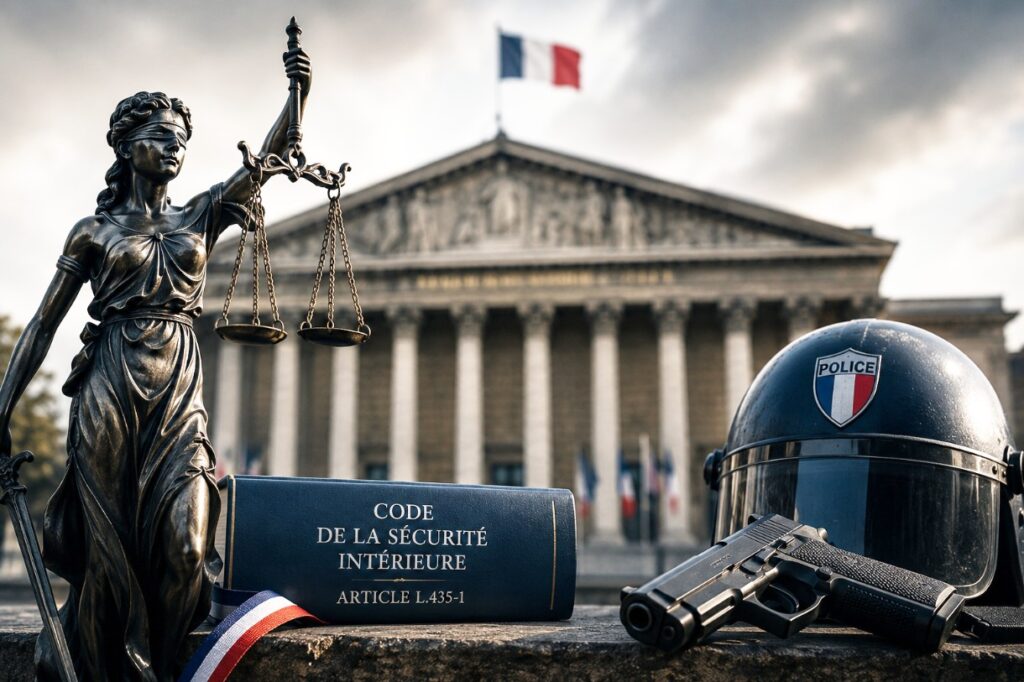
France has taken another step in a debate that has been controversial for years over police violence and internal security. On July 7, 2026 the National Assembly adopted in first reading a law intended to grant police officers and gendarmes expanded legal protection when using their firearms. The government describes the reform as a necessary safeguard for security forces. Critics, by contrast, see it as a significant weakening of rule-of-law oversight mechanisms and warn of far-reaching consequences for the judicial examination of fatal police operations.
Before the law can come into force, it still has to pass the Senate and then undergo the remaining parliamentary procedures.
From the concept of self-defense to a presumption of lawful firearm use
The original bill provided for a presumption of self-defense (“présomption de légitime défense”) for police officers and gendarmes. That phrasing, however, already met with considerable legal objections in advance. The government therefore opted for a legally softened but still far-reaching redraft.
In future it should no longer be presumed that an officer acted in self-defense. Instead, the starting assumption will be that the use of a firearm took place within the statutorily envisaged operational situations and that the requirements of “absolute necessity” and “strict proportionality” were met. This presumption is, however, rebuttable. Public prosecutors and courts can refute it with evidence to the contrary.
The government therefore stresses that the law does not create impunity for police officers. Rather, it is intended to prevent operational personnel from automatically falling under blanket suspicion after every use of a firearm.
The applicable law already dates from 2017
The reform builds on an existing legal framework. Since an amendment in 2017, Article L.435-1 of the French Security Code has detailed under which conditions police and gendarmerie may use their firearms.
A shot is only permissible in narrowly defined situations, for example to ward off imminently life-threatening attacks, to protect third parties, or to prevent immediately impending grave crimes. In addition, the principle already in force today is that any use of a weapon must be “absolutely necessary” and “strictly proportionate.”
The material conditions are not changed by the new law. The real novelty concerns the criminal-law assessment after a firearm use. While prosecutors until now first examined whether all legal requirements had been met, the starting point now shifts in favor of the deployed officers.
Legal experts therefore speak less of a change in substantive police law than of a change in the burden of proof in the investigative procedure.
Government says it offers better protection for operational personnel
Interior Minister Laurent Nuñez defended the reform as a necessary response to the increasing strains on security forces. Police officers and gendarmes must make decisions in split seconds, often under mortal danger. The fact that extensive criminal investigations would automatically be opened after every use of a firearm creates considerable legal uncertainty and could, in an emergency, lead to dangerous hesitation.
The governing majority argues that the reform merely clarifies that officers should initially be regarded as acting lawfully unless evidence to the contrary emerges. Criminal investigations would still be possible. Convictions are by no means ruled out if a disproportionate or unlawful use of a weapon can be proven.
The proposal was supported not only by the governing parties but also by the conservative Republicans and deputies from the Rassemblement National.
Left-wing opposition warns of a “license to kill”
The parliamentary left unanimously rejected the law. Representatives of La France insoumise, the Socialists, Greens and Communists described the reform as a dangerous break with rule-of-law principles. The term “permis de tuer” repeatedly came up in the chamber — a “license to kill.”
Opponents argue that the statutory presumption inevitably changes the starting point of every criminal investigation. Investigative authorities would in future first have to disprove the presumption of lawfulness. This would make judicial oversight more difficult and weaken the position of potential victims or their relatives.
Several organizations of judges, criminal defense lawyers and human rights groups had already spoken out against the law in advance. The French Defender of Rights (Défenseure des droits) also expressed serious constitutional concerns.
Heated debate and protests in parliament
The proceedings were extraordinarily tense. The left-wing opposition sought to delay the parliamentary process with numerous amendments and procedural motions. The government ultimately resorted to procedural instruments to force the vote.
The law was finally passed by 313 votes to 199.
After the result was announced, there were also protests in the public gallery. Representatives of initiatives representing relatives of victims of fatal police shootings loudly chanted “Pas de justice, pas de paix” (“No justice, no peace”) and were then escorted out of the chamber.
Parallel to the parliamentary process, a petition against the law gathered several hundred thousand supporters within a few weeks.
Constitutional questions are likely to continue to occupy lawmakers
Whether the law in its current form will stand remains open. Many constitutional lawyers point out that France is bound both by its own constitution and by the case law of the European Court of Human Rights.
Strasbourg case law, especially regarding the use of lethal force, requires particularly effective and independent investigations. Critics doubt that a statutory presumption in favor of operational personnel is fully compatible with these requirements.
Supporters counter that the presumption has been explicitly designed as rebuttable and therefore neither prevents investigations nor excludes judicial proceedings. Whether this argument will withstand later constitutional or human-rights review will likely be shown only by subsequent case law.
With the first reading in the National Assembly, the political debate is by no means over. The bill is expected to be intensively discussed again in the Senate. Even after a successful completion of the parliamentary process, it seems likely that the Constitutional Council or later also European courts will deal with the new rule. Regardless of the final outcome, the reform once again highlights the difficult balancing act between protecting security forces and ensuring rule-of-law oversight of state violence — a tension that has occupied France for years and will continue to shape political debate.
Andreas M. Brucker