
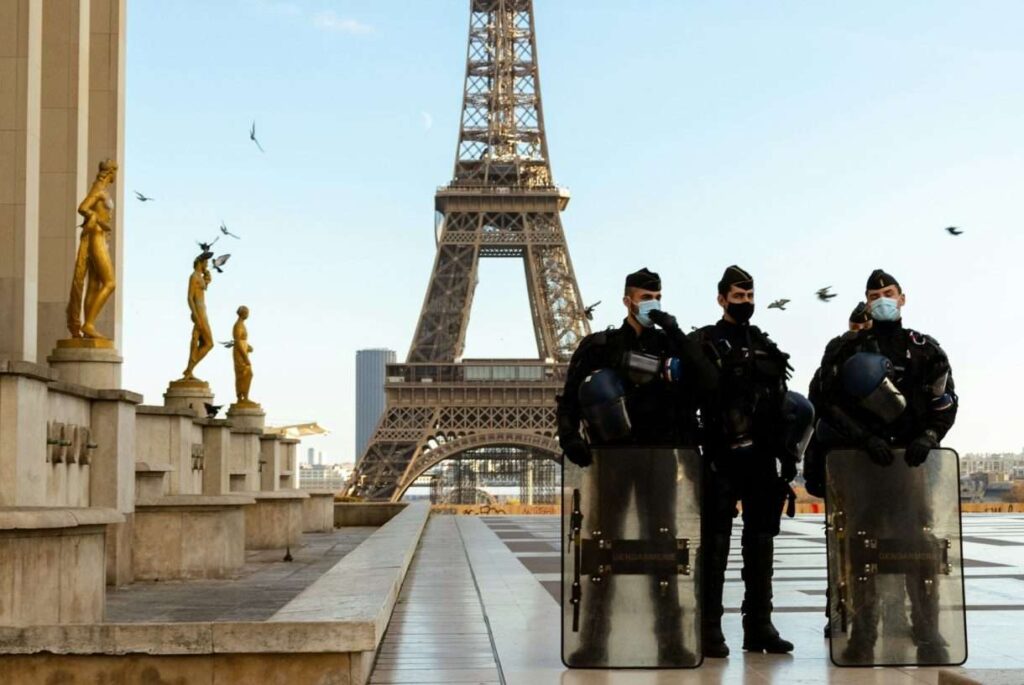
These are images that have become a grim routine in France — burning trash bins, hooded groups, frantically shuttered café doors, and police sirens piercing the night. On the evening of May 21, 2026, that is, during the night between May 21 and 22 — immediately before the French Cup final between OGC Nice and RC Lens in Paris — the situation once again escalated. This time, the protagonists were the supporters of OGC Nice, at the center of serious disturbances that far exceeded the usual level of rivalry between fan groups.
According to French media, about a hundred violent individuals moved in various groups across the northern part of the capital. The locations of the riots were around train stations, bars, and well-known gathering points of the fan scene. Videos spread on social networks within minutes showing scenes more akin to urban battles than to a sporting event: fireworks in public squares, flying objects, aggressive chases between rival groups.
The police responded with tear gas and massive interventions.
Some people ended up in preventive custody.
But the real shock goes much further.
For months now, France has been intensely discussing the return of organized violence in the world of football. The Ministry of the Interior and security authorities have long been warning that Ultra and Hooligan structures are reforming — professionally organized, digitally connected, and significantly more confrontational compared to a few years ago.
Paris in particular holds a strong symbolic value. Every time violence breaks out in the streets of the capital, the debate immediately shifts from the sports pages to national politics. Conservative voices return to talking about an “ensauvagement,” an alleged general barbarization of society. The term now appears as a political slogan, regularly used in television debates, editorials, and election speeches.
On the other hand, left-wing commentators warn against condemning entire groups of fans. Not every Ultra is automatically violent. Many fan groups maintain choreographies, local identities, and an almost folkloric associative culture. This is true. However, it is becoming increasingly clear that a hard core no longer seeks only the stadium atmosphere.
They seek confrontation.
And they seek it in a targeted way.
Security authorities have observed for years that many violent groups consciously organize outside the stadiums. Meetings are formed at the last minute through encrypted chats, social networks, or sudden changes of location. This makes traditional stadium controls ineffective. While in the past the focus was mainly on turnstiles and fan sectors, today the risk progressively shifts to urban centers, station districts, and public spaces.
Precisely where everyday life flows.
This makes the situation politically very delicate. France has one of the largest security apparatuses in Europe — with video surveillance, special police, massive forces, and extensive intervention powers. However, many citizens perceive that public space is becoming increasingly difficult to control. The scenes seen in Paris fuel precisely this concern.
It is no longer just about football.
For some Ultra groups, sport merges with territorial identity, street culture, and the demonstration of power. Some clashes almost resemble ritualized fights for control of territory. There is adrenaline, group pressure, sometimes even political extremism, or simply a desire for escalation. “To be honest, some are just looking for trouble,” a former security agent recently said on French television — a phrase that fairly accurately summarizes where the authorities have been failing for years.
The state’s reaction is therefore harsh: travel bans, stadium bans, increased checks at train stations, and massive police deployments are now almost normal at every high-risk match. But these measures seem to push many groups to organize their violence in an even more flexible and unpredictable way.
A game of cat and mouse.
In the heart of the second largest European metropolis.
And precisely because of this, the riots in Paris today concern not only sports enthusiasts. They touch a sore nerve in French society — the question of why a country with a huge security presence increasingly gives the impression of losing control over parts of its public space.