
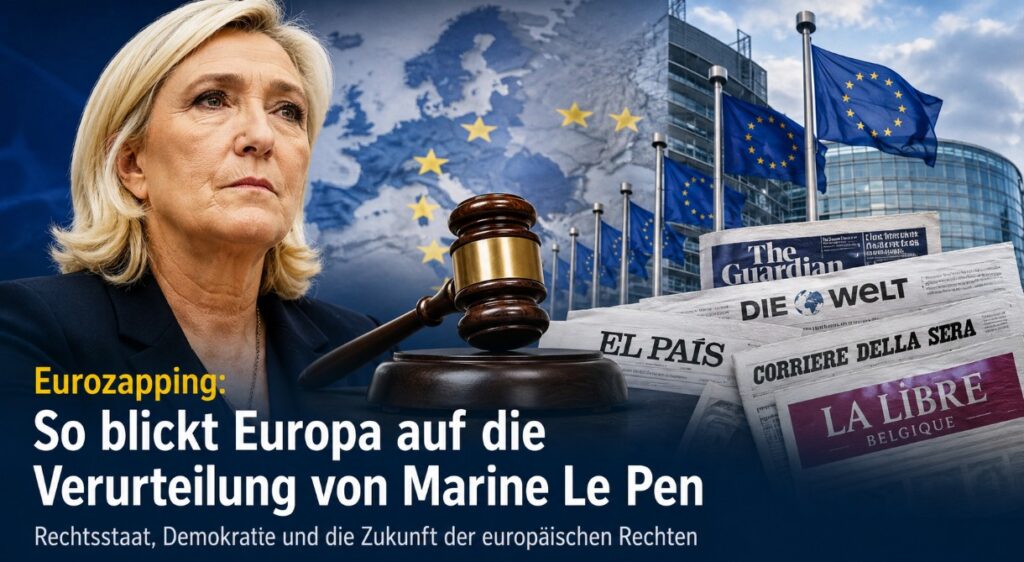
The ruling of the French appeals court in the Marine Le Pen case has attracted attention far beyond the country’s borders. Hardly any European outlet sees the verdict solely as French domestic politics. Rather, the decision is viewed as a gauge of the state of the rule of law, democracy and how Europe deals with the rise of right-wing populist parties.
Marine Le Pen remains convicted for the embezzlement of European Parliament funds. However, the appeals court reduced her ban on standing for office to such an extent that, in principle, she can participate in the French presidential election in 2027. In addition, the judges imposed a one-year sentence under electronic monitoring. Le Pen announced immediately after the ruling that she would take the case to the Court of Cassation and is maintaining her candidacy for the country’s highest office.
Germany: The Rule of Law in Focus
In Germany, reporting centers primarily on the independence of the judiciary. Commentators emphasize that the appeals ruling significantly mitigates the accusation of a politically motivated sidelining of Le Pen, without calling her criminal responsibility into question. At the same time, it is pointed out that the legal dispute is likely to accompany the French presidential campaign at least until early 2027, and therefore remains a lasting political issue.
Italy: Effects on the European Right
Italian media focus above all on the consequences for the right-wing political camp in Europe. Discussion centers on whether Marine Le Pen will remain the dominant figure of the French right despite her conviction, or whether party leader Jordan Bardella will gain greater significance in the long term. Many observers believe that the fact Le Pen can essentially run changes the starting point for the presidential election considerably.
Spain: Between Democracy and the Judiciary
Spanish newspapers deal mainly with the tension between democratic freedom of choice and criminal accountability. The appeals ruling is often interpreted as an attempt to reconcile the punishment of serious offenses with the principle of an open democratic competition. The decision is therefore read less as a political signal than as a judicial balancing act.
Eastern Europe: Different Perspectives
In several Eastern European countries, coverage is noticeably more varied. While government-aligned or conservative outlets sometimes speak of a politically motivated proceeding, other commentators stress that corruption offenses must be pursued consistently regardless of the prominence of the accused. The assessments often reflect domestic political debates and differing views on the role of the judiciary.
Brussels: Signal on the Handling of EU Funds
Within European institutions, the focus is less on Marine Le Pen as a person than on the origin of the case. Since the matter concerns the misuse of European Parliament funds, the verdict is widely seen as a sign that breaches in the handling of European taxpayers’ money will be pursued regardless of political position or public renown.
The affair therefore has a significance that reaches far beyond France. It touches on fundamental questions about the integrity of European institutions and the credibility of joint control mechanisms.
The Marine Le Pen case has long since evolved from a national criminal proceeding into a European debate. For some, the ruling underlines the functioning of the rule of law and the independence of the judiciary. For others, it remains a highly political event with potentially far-reaching consequences for the 2027 French presidential election and the balance of power within the European right.
With the announced appeal to the Court of Cassation, the legal battle is by no means over. Regardless of the outcome of the further proceedings, the Marine Le Pen case is likely to shape political debate in France and beyond for a long time to come.