
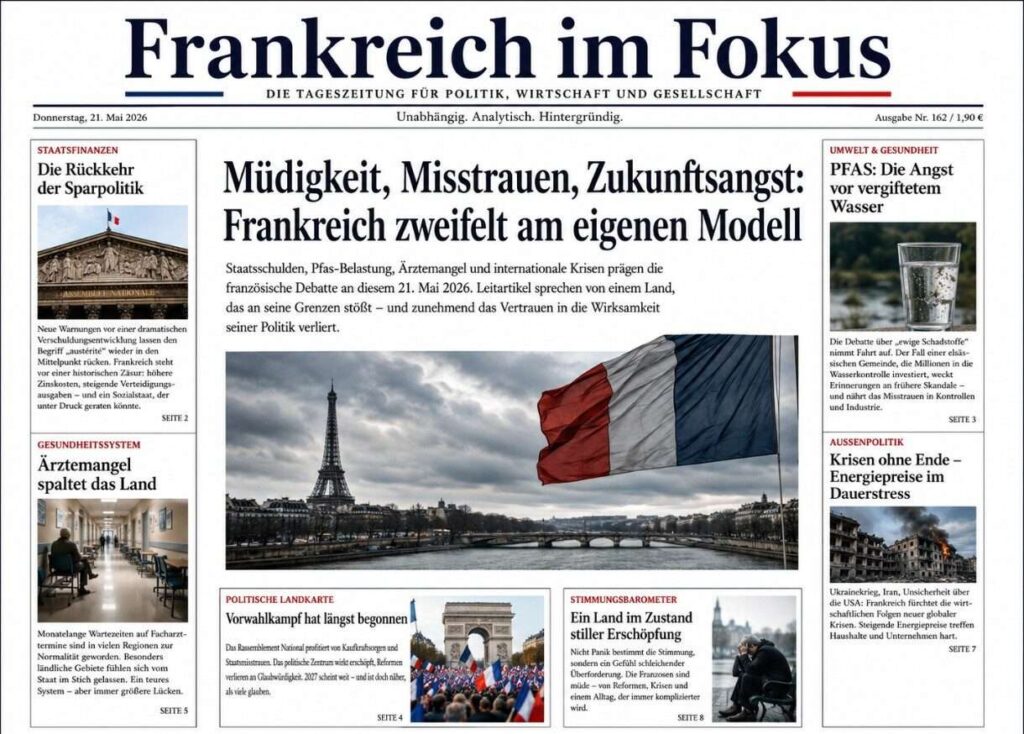
On May 21, 2026, the French media convey an unusually consistent atmosphere. Various topics ranging from finance, environmental toxins, to foreign policy are concentrated as central concerns: France is increasingly losing confidence in the sustainability of its own model.
What stands out is fatigue rather than fear. Political and social debates appear more draining than explosive. Many editorials describe a country where the daily lives of the majority of citizens have not improved despite constant reforms over many years.
Return of Austerity
The debate at the center today is about national debt. Following new warnings from government officials and the financial sector, an upcoming intense phase of fiscal austerity is being publicly discussed. The term “austerity,” long politically taboo, has once again become an important element of public discourse.
This tension arises from structural contradictions:
France is trying to expand its military role in Europe while maintaining a welfare state and coping with high public spending, yet at the same time faces pressures from rising interest costs and low growth.
Many commentators describe the present as a historical turning point. For decades, France was able to alleviate economic problems through debt, but now there is a growing perception that there is less room to maneuver. In particular, the combination of high deficits and geopolitical pressure to increase military spending causes anxiety.
This debate also has a symbolic dimension:
France has traditionally been seen as a strong state with extensive social protection functions, so any discussion about cuts easily turns into a debate about national identity.
PFAS: Fear of Invisible Pollution
At the same time, discussions about PFAS chemicals are receiving great attention. The so-called “forever pollutants” are currently considered one of the most emotionally sensitive environmental issues in France.
In particular, the case of a local authority in Alsace investing millions of euros in monitoring drinking water supply has fueled the controversy. This issue touches a sensitive nerve because it represents a modern form of anxiety that is invisible, long-term, and almost uncontrollable.
Several media compare PFAS with previous health scandals related to asbestos or certain pesticides. However, PFAS differ in that they potentially affect a wide area and the contamination only becomes apparent after many years.
In addition, distrust in national supervisory bodies is growing. Many citizens are questioning whether politics and industry are once again responding too slowly.
An Expensive Health System with Growing Gaps
Almost daily, regional media address the so-called “déserts médicaux” (medical deserts) as a major issue. In particular, the shortage of doctors in rural areas is becoming markedly worse.
In many places, waiting times for specialist appointments lasting several months are now considered normal. Ophthalmology, pediatrics, and gynecology are especially hard hit. As a result, many French people experience conflicting feelings:
The state pours huge amounts of money into the health system, yet concrete medical services are deteriorating.
Political tensions arise especially from regional imbalances. While Paris discusses defense policy, European strategies, and international crises, many people in small towns experience the reality of shrinking basic public services.
This perception of a “forgotten France” has been an important foundation for populist movements for years.
Foreign Policy as an Additional Burden Factor
International affairs also increase overall uncertainty. The war in Ukraine is still ongoing, and there are tensions with Iran as well as uncertainty about the diplomatic role of the United States during the Donald Trump era.
Within France, these crises are increasingly interpreted from an economic perspective. There is greater concern about the financial impact resulting from the rising military tensions themselves:
energy price increases, defense spending growth, and new burdens on national finances are mounting.
As a result, France finds itself in a difficult strategic position. On one hand, President Emmanuel Macron is attempting to solidify his role as a geopolitical leader within Europe, but domestically there is growing perception that international ambitions are increasingly detached from social realities.
The Long Shadow of the 2027 Presidential Election
Although the next presidential election is still far off, it is already having a significant impact on the political dynamics. In particular, the Rassemblement National (National Rally) benefits from concerns over purchasing power, distrust of the state, and regional frustrations.
Marine Le Pen’s political strategy remains notably consistent:
reducing ideological extremism and focusing more on everyday issues.
By contrast, political centrists increasingly appear defensive. Several reforms over the past few years—such as pension system and labor market reforms—have pursued economic policy goals but at the same time have generated social fatigue.
This very gap is what many commentators point out today:
France constantly reforms, but fewer and fewer citizens believe in the effectiveness of these reforms.
A Nation in a State of Quiet Fatigue
The most prominent feature of today’s French debate is the emotional tone. The media describe the country as not on the verge of collapse. Institutions are still functioning, the economy has not collapsed, and France remains one of the important powers in Europe.
However, beneath this there is a growing sense of gradual overload.
Many French people feel that daily life is more complicated, more expensive, and more unstable than a few years ago. At the same time, there is a growing impression that the state is spending more and more money without solving fundamental problems permanently.
This mixture of fatigue, skepticism, and latent loss of control dominates the current public debate.
The mood is not panic but rather
a question of how much longer France’s balance can last.