
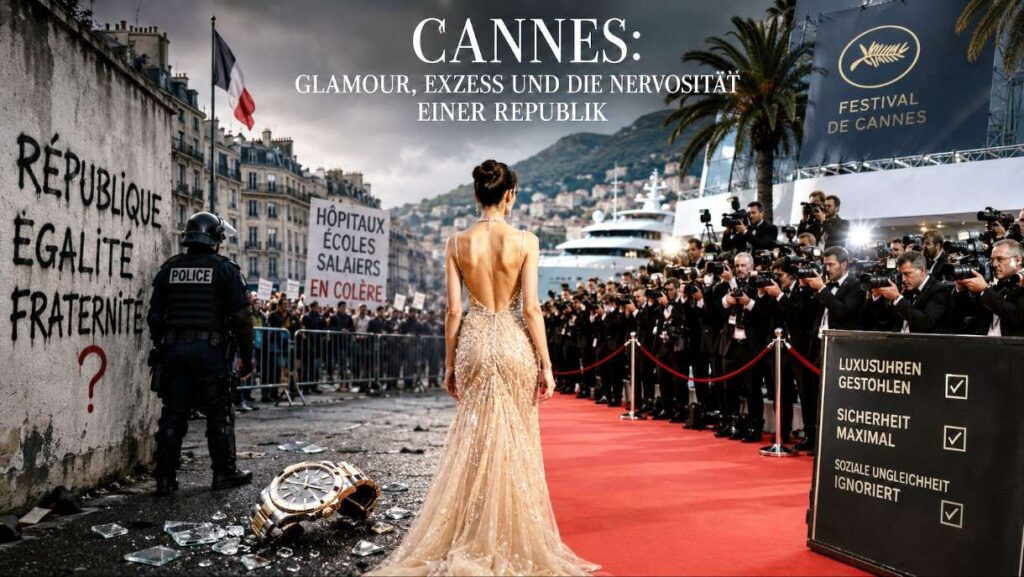
Nowhere depicts France in 2026 more precisely than Cannes’ Croisette. While ministers in Paris debate austerity plans, explain fuel prices, and defend new budget gaps, influencers on the French Riviera stroll the red carpet arm in arm with diamond-studded bags, under the watchful protection of heavily armed police. Cannes has long been more than just a film festival. It has become a political symbol—perhaps even the most authentic portrayal of contemporary France.
At first glance, everything seems as usual: champagne receptions, designer gowns, superyachts, luxury hotels, with international elites celebrating themselves amid flashing cameras and lavish settings. Yet behind the glamour lies a palpable tension. France presents itself to the world like an aging aristocrat who, despite the cracks in his castle, still dresses in his most magnificent evening wear.
The security measures surrounding the film festival now resemble a hybrid of a high-security zone and a military parade. Streets are closed, bags inspected, cameras monitoring every corner. This is not without reason: luxury watch thefts have almost become a part of the Cannes ritual. Nearly every edition of the festival reports thefts of Richard Mille, Rolex, or Patek Philippe watches. Crime is not merely a criminal alert; it has become a performance. Luxury carries its shadows.
Today’s France gives a dual impression of wanting both to flaunt and to hide.
While the president and ministers called for social unity in their Sunday speeches, Cannes displayed another reality: society is sharply divided, the wealthy move within isolated zones, while insecurity outside continues to grow. This can almost be called a republican form of feudalism. Inside there is caviar, haute couture, and cryptocurrency, outside there are sirens, social tensions, and an increasingly powerless state.
This absurd scene is especially highlighted by the omnipresent social media machine. Today’s Cannes is no longer a film festival, but more of a global content production factory. Actors, models, and influencers constantly create an artificially perfect image, which relates to the daily lives of most French people like the Palace of Versailles relates to a suburb of Marseille.
Even the films themselves often become secondary. The key is no longer the films, but exposure. Who wore which dress? Who kissed on which yacht? Who posted the explosive moment of the evening? Cannes is a fast-forwarded snapshot of contemporary France: a nation obsessed with self-viewing, yet almost unable to solve structural problems.
Of course, France has always been a country of performance. Louis XIV understood the power of spectacle better than any modern communications consultant. This great nation has always relied on its myth of cultural superiority. However, past performances at least had a political or economic foundation behind them, whereas today only the superficial scenery seems to remain.
Because alongside growing glamour, social fatigue deepens as well. National debt rises, public services are under pressure, schools and hospitals face long-term funding shortages. Many suburban residents feel permanently disconnected from the promises of the Republic. Yet every year Cannes still sends the same message: France is willing to continue shining, whatever the cost.
This is precisely where its true tragedy lies.
Cannes does not only showcase wealth, but also displays a panic about losing importance. France is desperately clinging to its role as a cultural powerhouse, with an urgency that matches the decline of its economic and geopolitical influence. The film festival thus becomes a national mirror maze: the lights shine beautifully, but distortions abound.
The irony is almost unbearable. While the nation discusses fiscal savings and calls for citizen restraint, Cannes luxury suites cost tens of thousands per night; when unions protest social injustice, tech billionaires party on superyachts along the coast; when the interior minister warns about rising crime, the jewelry stars openly wear is worth more than the annual income of many French people.
Therefore, Cannes is not just a film festival, but a symbol of contemporary Western society — and this symbol is particularly sharp in France. Perhaps precisely because France historically claims to embody equality and social dignity, this contradiction appears harsher here than elsewhere.
In Cannes, one can see a France that no longer fully trusts itself. A nation both eager for admiration and forced to defend itself. Behind every red carpet is a security barrier, behind every luxurious facade hides a fear of collapse, behind every Instagram post lies a desperation to stay relevant.
Perhaps it is this complex atmosphere that explains the recent unique aura of the Côte d’Azur: a mixture of beauty and tension, wealth and unease, glamour and latent crisis.
Cannes still shines, but today it shines more like a precious vase already showing fine cracks.
Commentary by Andreas M. Brucker