
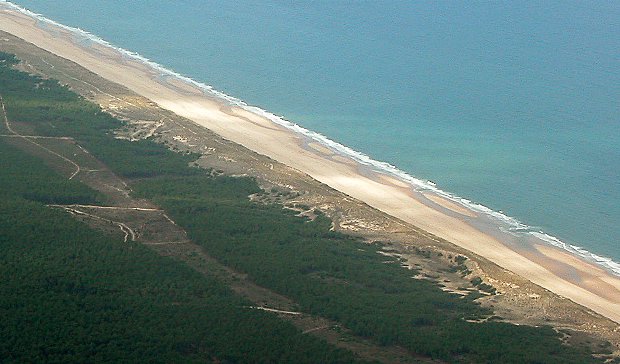
Along the Atlantic coast of France, there is currently a danger that many holidaymakers barely know – and precisely for that reason underestimate. For Thursday, May 21 and Friday, May 22, 2026, authorities warn of a particularly high risk due to so-called Baïnes. Especially the coastal areas in Gironde, Landes, and Pyrénées-Atlantiques are affected. Where kilometer-long sandy beaches stretch to the horizon and the sea often seems calm, a life-threatening situation can arise within seconds.
Baïnes – that sounds almost harmless. However, they are funnel-shaped water basins in the sand that form between the beach and sandbanks off the coast. At high tide, they fill with water; at low tide, they empty again. It is precisely then that strong back currents develop that can pull people far out to sea. And faster than many understand what is happening.
The treacherous thing remains above all one thing: from the outside, these spots often appear calm. No high waves, no threatening roar. On the contrary. Families consciously seek protection there from the powerful Atlantic waves, children splash in the seemingly still water – and suddenly get caught in a current that allows little resistance.
“It happens very, very quickly,” rescue services have been warning repeatedly for years. Those who end up in the undertow often panic and instinctively try to swim against the current. That is exactly what costs strength. Therefore, the authorities’ advice initially sounds paradoxical: do not fight back immediately. Let yourself drift, stay calm, attract attention, and try to move sideways out of the current. Sounds simple. In practice, it requires nerves of steel.
Especially now, at the beginning of the warm days, the risk increases considerably. As soon as temperatures rise, thousands head to the beaches along the French Atlantic coast. Many come from inland, some from abroad. Not everyone is familiar with the peculiarities of the ocean. The Mediterranean Sea often seems more predictable – the Atlantic Ocean, however, plays by different rules. Sometimes gentle, sometimes brutal. Not a swimming pool with a nice setting.
That is why the authorities strongly urge swimming only in supervised areas and taking the flags on the beaches seriously. When a red flag is flying, there is a clear swimming ban. Sounds obvious, but is regularly ignored. “Oh, it’ll probably be fine” – that thought leads every year on the Atlantic coast to dramatic rescue operations.
Anyone who has experienced how quickly the atmosphere can change there never forgets it. Suddenly sunshine, laughter, and beach games. A few seconds later sirens, hectic calls, and rescue swimmers heading out to sea with their boards.
The warning these days is therefore much more than a routine message for the beginning of the season. It serves as a reminder that the sea does not remain a postcard idyll. The Atlantic Ocean is alive, constantly moving, and demands respect. That is precisely where its beauty lies. And its danger.
By C. Hatty