
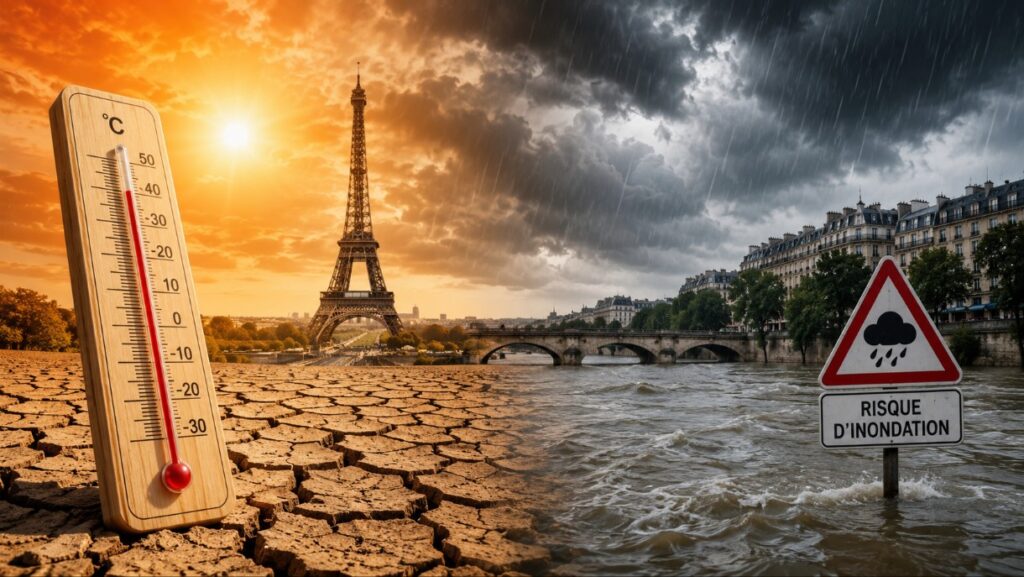
France faces a challenge that goes far beyond conventional environmental policy. According to the High Council for the Climate (Haut Conseil pour le Climat, HCC), the country today is designed for climatic conditions that belong to the past. Roads, railways, buildings, power grids, agricultural land and urban infrastructure were planned for the 20th-century climate. The reality of the 21st century, however, is characterized by more frequent heatwaves, prolonged droughts, heavy rainfall events and an increasing number of climate-related natural hazards.
This finding forms the core of the HCC’s latest report. The experts conclude that while France is aware of the new climate reality, adaptation to climate change is progressing much more slowly than the pace at which the impacts of global warming are intensifying.
Adaptation Is Lagging Behind
The High Council criticizes in particular that the existing policy measures do not meet the challenges. In the experts’ view, there is still a lack of an overarching strategy that effectively links the different policy areas. At the same time, funding for adaptation measures remains limited or is difficult to track.
Cooperation between the state, regions, municipalities and the private sector is also considered insufficient. Many measures still focus on repairing damage after natural disasters rather than limiting their impacts in advance through forward-looking planning.
According to the HCC, climate adaptation means much more than increased use of air conditioning or the construction of additional flood defenses. Rather, France must fundamentally adapt its building regulations, urban planning, water management, agriculture and the protection of natural habitats to the changed climatic conditions.
Planning for a France Up to Four Degrees Warmer
The French government now officially uses a reference scenario that envisages warming of up to four degrees Celsius compared to pre-industrial levels by the end of the century. This scenario is no longer considered an unlikely extreme case, but a realistic basis for planning infrastructure, spatial planning and public investments.
Against this backdrop, existing vulnerabilities are becoming increasingly visible. Railway tracks warp during extreme heat periods, numerous schools and hospitals lack adequate heat protection, power grids come under pressure from rising cooling demand, while water shortages in many regions are becoming an increasing burden. Added to this are coastal areas that are increasingly affected by erosion and sea level rise.
The experts therefore warn against continuing to base today’s investments on the climatic assumptions of past decades. Infrastructure built now must withstand the conditions of the coming decades.
Local Authorities Bear the Main Burden
The role of territorial authorities is particularly emphasized. Regions, départements and municipalities have extensive responsibilities in urban development, transport, water supply and disaster protection. It is precisely at this level that it will be decided how resilient cities and towns will be to the effects of climate change in the future.
However, in many places there is a lack of sufficient financial resources, technical expertise and long-term planning certainty. The HCC therefore calls for stronger support for municipalities and better coordination between the national and regional levels. Only in this way could adaptation measures be implemented nationwide.
Concerns Extend Beyond Adaptation
The High Council’s criticism is not limited to adaptation to climate change. The experts also see French climate policy on a problematic course when it comes to reducing greenhouse gas emissions.
In their assessment, the pace of emissions reduction has recently slowed. As a result, both the interim targets for 2030 and the long-term goal of climate neutrality by 2050 are increasingly under pressure. Causes include changing political priorities and uncertainties around key measures such as energy-efficient building renovations or the expansion of renewable energies. This lack of continuity hampers long-term investments and undermines the credibility of French climate policy.
The High Council makes it clear that climate protection and climate adaptation are not separate policy fields. Both must be advanced in parallel to effectively limit the economic and social consequences of climate change.
The central message of the report is clear: France can no longer plan its future based on the climate assumptions of the past. Adaptation to climate change is no longer an optional environmental measure, but a fundamental prerequisite for the functioning of the economy, infrastructure, public services and the protection of the population.
The real question is therefore no longer whether the climate is changing, but whether the state, the economy and society can adjust quickly enough to this new reality. It is precisely on this point that the High Council for the Climate still sees considerable political need for action.