
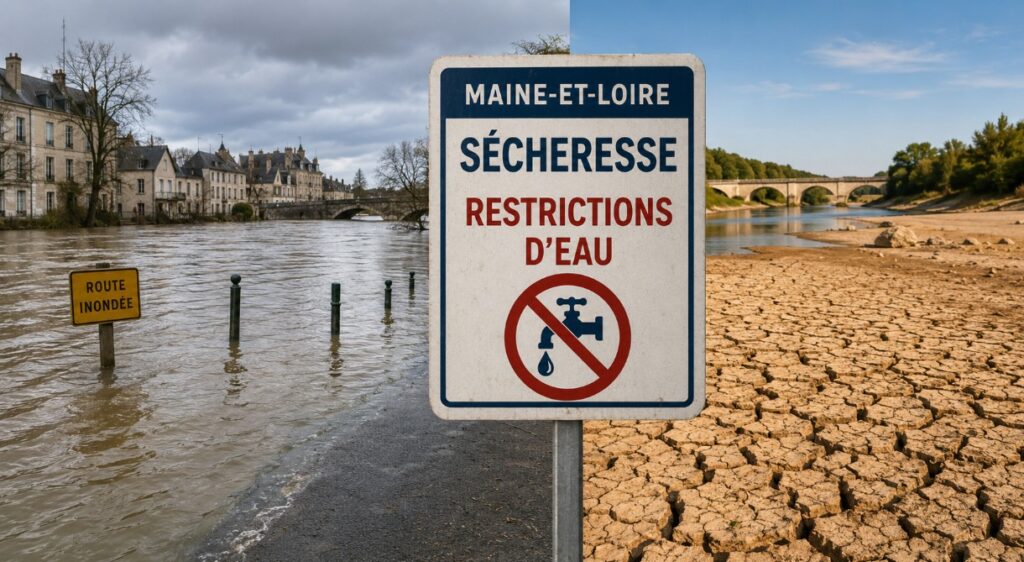
Only at the beginning of March flooded streets, rivers that had overflowed their banks and waterlogged basements shaped the scene in the western French department of Maine-et-Loire. After one of the rainiest winters since weather records began, water seemed to be abundant. But only a few months later a completely different picture has emerged: because of ongoing drought, the first restrictions on water use are already in effect.
For many residents this change seems hardly comprehensible. Fields were under water just recently, and now every drop is supposed to be saved. What at first glance appears to be a contradiction actually illustrates how strongly the water cycle is changing under the influence of climate change. Extreme precipitation and long dry spells are increasingly alternating in short periods of time.
The winter of 2025/2026 was among the wettest in France in more than six decades. For weeks, intense rainfall caused exceptional flooding. The catchment areas of the Loire and the Maine were particularly affected. At times more than 80 departments were under flood warning, and numerous municipalities were later recognized as natural disaster areas.
But an exceptionally wet winter no longer guarantees relaxed water supply in summer. A large share of the precipitation flowed quickly off via rivers and streams instead of slowly seeping into deeper soil layers. Since April many rains have also failed to materialize, while several unusually warm periods have significantly accelerated evaporation. The soils dried out within a few weeks, smaller bodies of water carried ever less water, and the first rivers reached critical levels.
The prefecture of Maine-et-Loire responded with the first water restrictions. Different rules apply depending on the catchment area. Thus irrigation of agricultural land is already subject to restrictions, as is filling private swimming pools, watering gardens, and cleaning vehicles and paved surfaces. The measures are intended to prevent the water shortage from worsening and to protect the supply for the population, agriculture and nature.
Climate researchers do not see this development as an isolated case. Climate change does not necessarily mean less precipitation, but primarily changes its distribution. Rain falls more often in short periods and with great intensity. The result is floods, while longer dry spells and heat waves then rapidly dry out the soils. This very rapid switch between water surplus and water shortage is considered one of the biggest challenges of the coming decades.
Even well-filled groundwater reservoirs after a rainy winter offer no guarantee against summer shortages. What remains decisive is how evenly precipitation is distributed throughout the year and how quickly water evaporates or is consumed due to heat. Regions like Maine-et-Loire therefore face a double task: they must protect themselves against floods and store water for dry months at the same time.
For the people on site this change feels almost unreal. Just a few months ago they were fighting water masses; today saving measures determine everyday life. What used to be considered an exception is increasingly becoming the new normal. Dealing with water will require significantly more foresight in future — because it is not only drought or floods that pose the greatest danger, but the ever-faster alternation between the two extremes.
Author: Andreas M. B.