
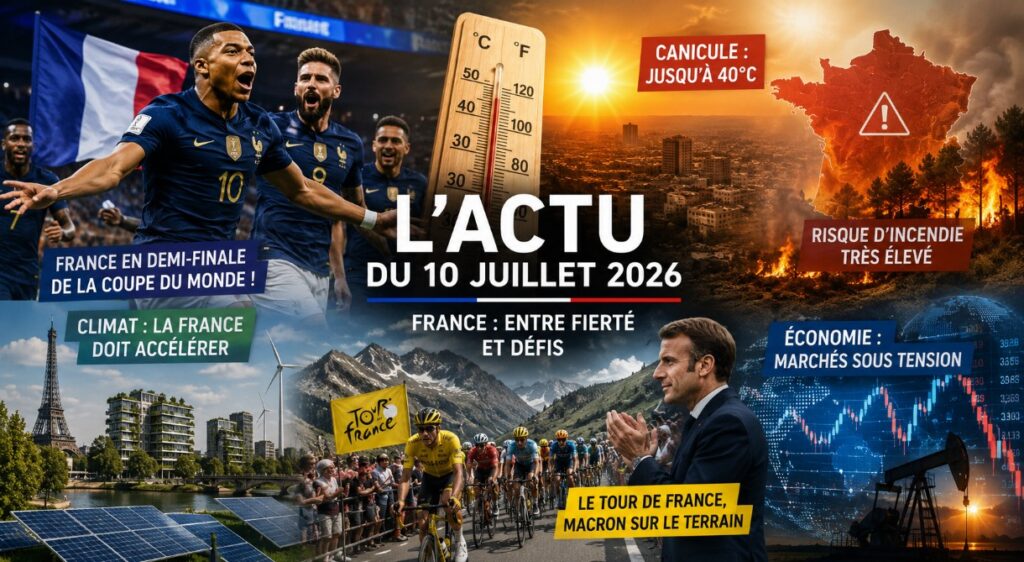
France is experiencing a Friday marked by an unusually broad range of news topics. While the French national football team’s qualification for the World Cup semi-finals is sparking enthusiasm across the country, the consequences of the persistent heatwave and the challenges of climate change are returning to the forefront of political debate. Added to this are the Tour de France, the increased risk of forest fires, and economic uncertainties linked to geopolitical tensions. The French media landscape thus paints a picture of a country torn between sporting confidence and structural questions for the future.
Les Bleus extend their winning streak
The sporting highlight of the day is undoubtedly France’s 2–0 victory over Morocco in the World Cup quarter-finals. By reaching the final four, France has now made it to the World Cup semi-finals for the third consecutive time – a rare level of consistency in international football.
Coach Didier Deschamps has once again succeeded in assembling a top-level team. Kylian Mbappé is receiving particular media attention. The forward confirms his exceptional status and further enhances his World Cup record. Commentators praise not only his ability to score, but also his growing role as a leader within the team.
Attention is already turning to the upcoming semifinal. The hope of another world title is creating a sense of momentum across the country and is pushing often more difficult domestic debates into the background, at least temporarily.
Extreme heat remains the central everyday issue
Outside of sport, the exceptional heatwave continues to affect millions of people. In many regions, temperatures are once again rising to the 40-degree mark, while widespread tropical nights are preventing sufficient recovery.
The consequences are increasingly being felt in everyday life. Hospitals are reporting a rise in heat-related emergencies, particularly among older people and chronically ill patients. At the same time, rail traffic and public infrastructure are experiencing disruptions caused by high temperatures. Warped rails, technical failures, and delays demonstrate the vulnerability of essential service systems to extreme weather conditions.
Agriculture is also suffering from the effects of persistent drought. Water shortages, lower yields, and rising irrigation costs are increasing the economic pressure on many farms.
Climate policy under growing pressure
The current weather situation is giving new momentum to the debate on climate policy in France. The latest report by the High Council for Climate is sparking intense discussions in political and media circles. The central message is clear: while many climate protection measures have been adopted in recent years, there is still a significant lag in adapting to the already noticeable consequences of climate change.
Attention is focused in particular on investments in heat-resilient cities, the expansion of green spaces, the modernization of the healthcare system, and the adaptation of transport infrastructure. Experts emphasize that extreme weather events are likely to occur more frequently and that long-term strategies are therefore needed.
The debate therefore goes far beyond environmental issues. It also concerns economic and social policy as well as public safety, and is increasingly becoming one of the major challenges of the years ahead.
The Tour de France connects sport and politics
Alongside the Football World Cup, the Tour de France is also attracting a great deal of attention. The sixth stage is considered the first real test of endurance for the favorites in the general classification. The high-mountain finish promises a first important decision in the battle for the yellow jersey.
The stage is attracting additional media attention due to the presence of President of the Republic Emmanuel Macron. His presence within the Tour convoy once again recalls the symbolic significance of the race for France. For decades, the Tour has been far more than a sporting event: it is a national showcase that combines sporting achievements, regional identity and international influence.
The simultaneous presence of the head of state also illustrates how closely sport and politics are often linked in France.
The risk of forest fires is worsening
The persistent drought is also increasing the risk of large-scale forest and vegetation fires. In the south of the country, firefighters and civil protection services are on heightened alert.
Many prefectures are strengthening security measures and restricting access to the most exposed forest areas. Reinforcements are ready to intervene to contain fires as early as possible. Under current conditions, simple sparks are often enough to trigger large-scale fires.
The risk of fires is therefore becoming a recurring summer issue and illustrates the growing challenges for French civil protection.
The economy between uncertainty and new technologies
On the business pages, the tone remains cautious. Ongoing geopolitical tensions in the Middle East continue to fuel nervousness in European financial markets. Investors are paying particular attention to developments in energy prices and the possible effects on inflation and economic growth.
At the same time, the impact of artificial intelligence on financial markets is increasingly taking center stage. Automated trading systems, data-driven analyses, and new AI applications are significantly changing the dynamics of stock exchanges. While companies hope for productivity gains, experts warn of new risks associated with highly automated market movements.
The overall economic situation therefore remains characterized by a mix of technological optimism and geopolitical caution.
On 10 July 2026, France is experiencing a day of news that powerfully reflects the complexity of ongoing developments. The enthusiasm sparked by the national team’s success and the fascination generated by the Tour de France offer moments of national confidence. At the same time, the persistent heatwave, the growing risk of fires and the intense debate on climate adaptation serve as reminders that the country is facing long-term structural challenges. French public opinion is therefore focused both on sporting successes and on the political decisions that will durably shape the country’s future.