
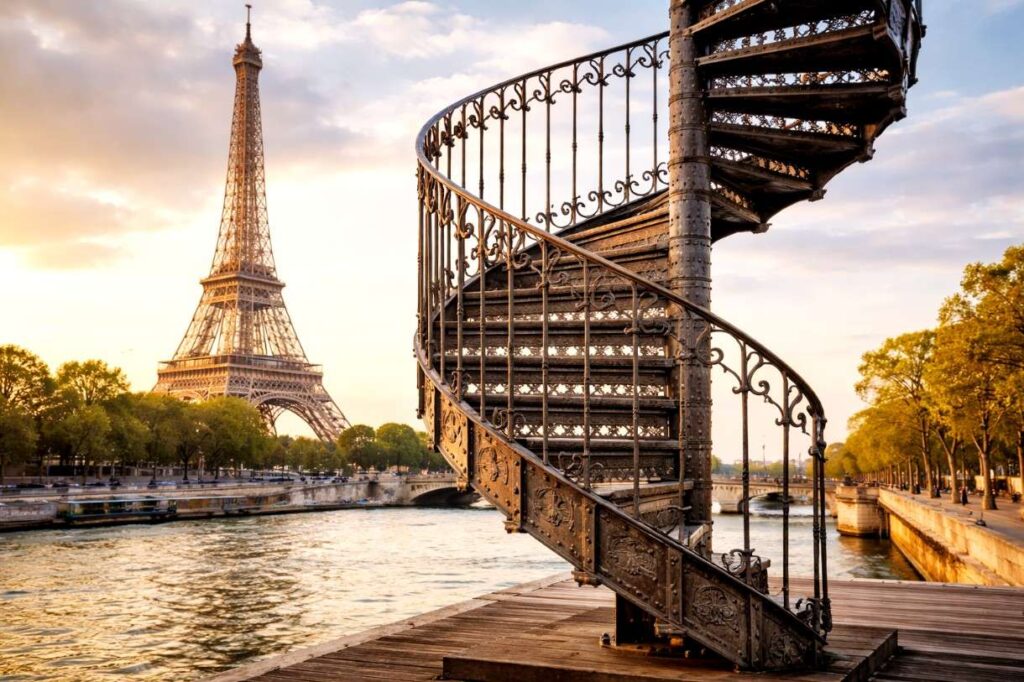
Fourteen steps. Rust-colored. As heavy as a small car. Suddenly worth 450,160 euros. Some might say: that is quite a sum for an old staircase. But anyone who says that underestimates the true value. What was auctioned was not iron. What was auctioned was memory.
On May 21, a section of the original Eiffel Tower spiral staircase changed hands in Paris. The very staircase that once carried visitors to the top of the 1889 World’s Fair—fourteen steps trodden by those well-dressed, astonished, perhaps slightly out-of-breath visitors. For decades, these steps bore countless footsteps, stories, and world history. Today, they hover somewhere between artwork, relic, and capital investment.
The Eiffel Tower has a peculiar ability to feel both familiar and unreal. Everyone knows it. Everyone has seen it—whether on a mug, a fridge magnet, in a film scene, or in a blurry mobile phone photo at night. That is precisely why a real piece of the structure possesses an almost magical appeal. As if one could break off a little piece of Paris from the haze of a postcard and take it home.
Of course, no one buys a staircase to use it for going up and down.
What people buy is the story it tells.
The story begins in the 19th century, when Gustave Eiffel built his iron monster and half of Paris protested in outrage. Writers and artists fiercely opposed the tower, calling it a blemish on the city, a presumptuous factory chimney. Today, that outrage seems almost endearing. Because the tower long ago ceased to destroy the city; it has consumed it. Without it, Paris is almost impossible to imagine.
Perhaps this is precisely where the mystery of such auctions lies. People do not collect objects, but the feeling of being close to a myth. A piece of the Berlin Wall, a stone from Yankee Stadium, a seat from the Concorde—once history clings to them like aged paint, these objects become valuable.
And the Eiffel Tower? It is a master of this transformation.
In 1983, during modernization work, the staircase originally located between the second and third floors was removed. A total of 24 sections were dismantled, 20 of which went into private collections. Some fragments were placed in locations that have since become symbolic themselves: near the Statue of Liberty in New York, or somewhere in Japan—a country where nostalgia for France has long run high. The staircase was scattered around the world like a relic of a secular age.
It sounds a little crazy—and perhaps it is.
But luxury markets rarely operate according to reason. They rely on aura. Few cities produce this aura as consistently as Paris. The Eiffel Tower is not merely steel standing on the Champ de Mars; it exists in countless longings. For love, for elegance, for an idea of Europe that remains romantic even in the rain and literary even shrouded in smoke.
Thus, the person who paid €450,160 did not buy a fragment of a building, but an emotionally triggered short circuit. An object that immediately generates stories. Visitors will stop in front of it and inevitably ask: “Is this real?” A small private lecture then begins, about the Belle Époque, world exhibitions, and French arrogance.
Perhaps this is also a silent protest against the contemporary age. Everything is digitalized, images vanish in an instant, memories are locked away in smartphone archives. But a 1.4-ton piece of steel has weight. It visibly ages. It rusts. It takes up space. It is not something that can simply be swiped away like an app.
After all, who wouldn’t want to own a small piece of Paris?
Even if it means shelling out half a million euros.
Article by M. Legrand