
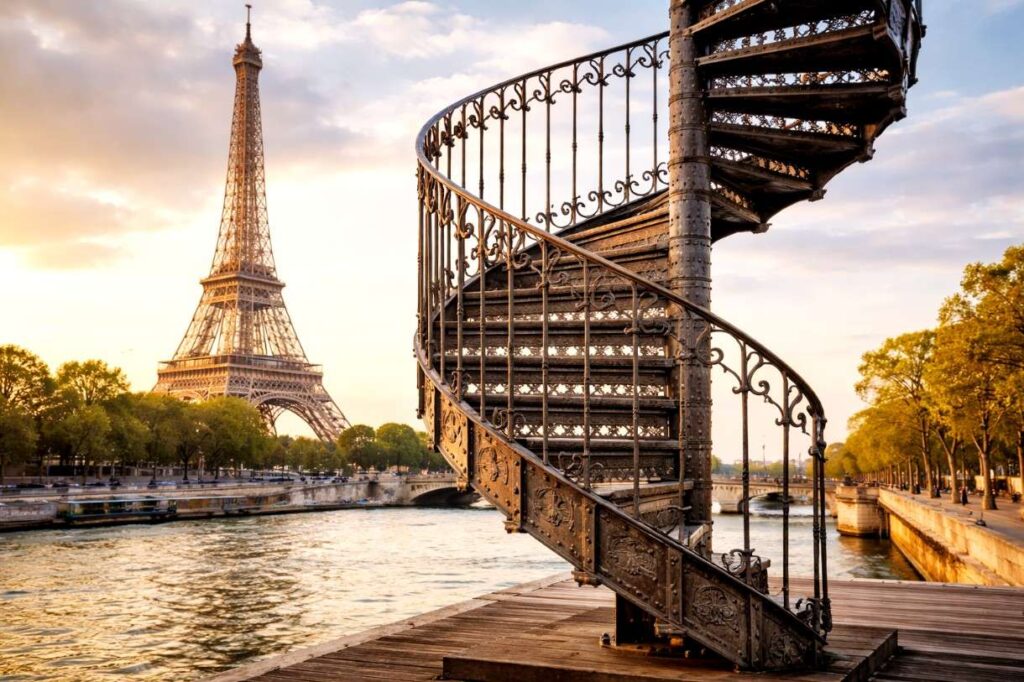
Fourteen steps. Rust-colored. As heavy as a small car. And suddenly worth 450,160 euros. You could say: that is quite a lot of money for an old staircase. But anyone who speaks like that underestimates the real product. In Paris, no iron was auctioned off. Memory was auctioned off.
A segment of the original spiral staircase of the Eiffel Tower changed ownership on May 21st. The staircase that visitors to the 1889 World Exhibition once climbed — neat, amazed, perhaps slightly out of breath. Fourteen steps that carried feet, stories, and world history for decades. Now they stand somewhere between art object, relic, and capital investment.
The Eiffel Tower has this special quality of seeming both completely familiar and yet unreal at the same time. Everyone knows it. Everyone has seen it — on mugs, fridge magnets, film scenes, or vague night photos taken with a phone. Precisely for this reason, a real piece of the structure radiates an almost magical attraction. As if you could break a bit of Paris out of the postcard mist and take it home with you.
Of course, no one buys a staircase to go upstairs with it.
You buy tellability.
The story begins in the 19th century, when Gustave Eiffel had his iron monster built and half of Paris protested indignantly. Writers and artists condemned the tower, calling it a blot on the cityscape, a chimney with delusions of grandeur. Nowadays, that indignation seems almost endearing. Because long ago the tower did not disfigure the city, but swallowed it. Without it, Paris is hardly imaginable anymore.
Maybe that is precisely the secret of such auctions. People don’t collect objects, but proximity to a myth. A piece of the Berlin Wall, a stone from Yankee Stadium, a seat from the Concorde — things become valuable as soon as history clings to them like old lacquer.
And the Eiffel Tower? It is a master of that transformation.
In 1983, the original staircase between the second and third floors was dismantled during a modernization. It resulted in 24 parts, twenty of which came into private hands. Some segments ended up in places that have themselves become symbols: near the Statue of Liberty in New York or somewhere in Japan, where French nostalgia has been flourishing for decades. The staircase spread across the globe like relics of a secular era.
That sounds a bit strange — it probably is.
Maybe that is precisely the secret of such auctions. People don’t collect objects, but proximity to a myth. A piece of the Berlin Wall, a stone from Yankee Stadium, a seat from the Concorde — things become valuable as soon as history clings to them like old lacquer.
And the Eiffel Tower? It is a master of that transformation.
In 1983, the original staircase between the second and third floors was dismantled during a modernization. It resulted in 24 parts, twenty of which came into private hands. Some segments ended up in places that have themselves become symbols: near the Statue of Liberty in New York or somewhere in Japan, where French nostalgia has been flourishing for decades. The staircase spread across the globe like relics of a secular era.
That sounds a bit strange — it probably is.
But luxury markets rarely operate on reason. They thrive on aura. And hardly any city produces aura as reliably as Paris. The Eiffel Tower does not stand made of steel on the Champ de Mars for no reason; it stands in countless desires. For love, for elegance, for that idea of Europe where even rain seems romantic and cigarette smoke literary.
Anyone who pays 450,160 euros is therefore buying less an architectural fragment than an emotional short circuit. An object that instantly evokes stories. Visitors linger before it. Questions arise naturally: “Is that real?” And then the short private lecture about Belle Époque, world exhibitions, and French grandeur mania begins.
Perhaps there is also a quiet protest against the present in it. Everything is digitizing, images flash by, memories disappear in smartphone archives. But a piece of steel weighing 1.4 tons has weight. It visibly ages. It rusts. It claims space. It cannot be wiped away like an app.
And let’s be honest: who would not want to own a small piece of Paris?
Even if you have to lay down half a million euros for it.
An article by M. Legrand