
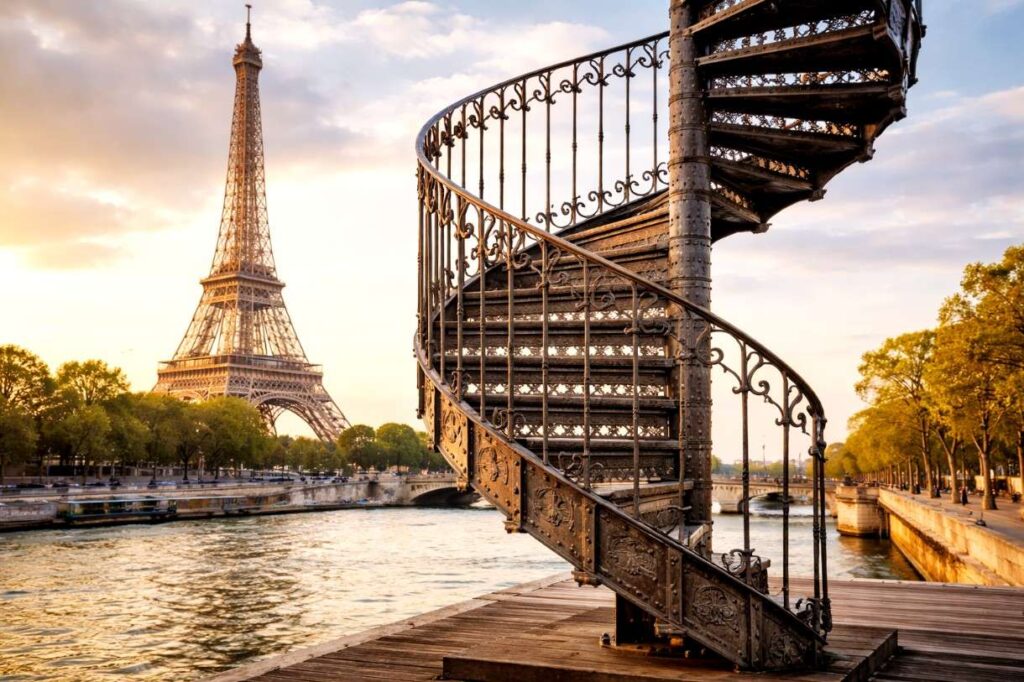
14 steps. Rusty color. As heavy as a small car. And suddenly worth 450,160 euros. Someone might say: too much money for old stairs. But those who say that are truly underestimating the real value. What went up for auction in Paris was not iron. What went up for auction was memory.
A section of the original spiral staircase of the Eiffel Tower, which visitors to the 1889 World’s Fair climbed, changed owners on May 21. In other words, it was the stairs that those who shone with wonder and were slightly out of breath stepped on. 14 steps upon which many footsteps and stories have accumulated over decades and intertwined with world history. Now they lie somewhere between artwork, relic, and investment.
The Eiffel Tower has a very unique ability. It feels completely familiar yet unreal. Everyone knows it, and has seen it anywhere—from cups or fridge magnets, movie scenes, to blurry nighttime cellphone photos. For that reason, a real piece of the building exerts an almost magical attraction. It’s as if you cut out a piece of Paris from the mist on a postcard and bring it home.
Of course, nobody is buying the stairs to climb to the top.
What they are buying is the power to tell a story.
The story goes back to the 19th century. Gustave Eiffel built his gigantic iron structure, and half of the citizens of Paris were angry and protested. Writers and artists criticized the tower, describing it as an eyesore and an arrogant chimney. Today, that anger is almost touching. Because the tower did not damage the city; it embraced it. It is hard to imagine Paris without the tower.
Perhaps the secret of these auctions lies here. People collect proximity not to objects but to myths. Pieces of the Berlin Wall, stones from Yankee Stadium, chairs where the Concorde sat — when history clings to these items like old paint, they become precious.
In that case, the Eiffel Tower is a master of such transformation.
In 1983, as part of renovation work, the original staircase between the 2nd and 3rd floors was dismantled. It was divided into 24 parts, of which 20 became privately owned. Some pieces were placed at iconic locations such as near the Statue of Liberty in New York or in Japan, where French nostalgia has long been very popular. The stairs were scattered across the world like relics of a secular era.
This story itself may sound somewhat crazy and perhaps it is true.
But the luxury market does not move rationally. It relies on aura. And there is no city that consistently creates a more mysterious aura than Paris. The Eiffel Tower is not simply an iron structure standing in the Place du Mars; it stands amid countless desires. It symbolizes love and elegance, even rainy days are romantic, and cigarette smoke embodies the literary ideal of Europe.
Those who pay 450,160 euros are buying an emotional passage rather than a mere architectural fragment. It is an object that immediately generates stories. Visitors stand before it and naturally ask, “Is this real?” Then a small private lesson begins—about the Belle Époque, universal expositions, and French arrogance.
Perhaps this is a quiet resistance to modern times. Everything is digitized, images flash by in seconds, and memories are buried in smartphone archives. The 1.4-ton iron piece is different. It possesses substantial power. It notably ages, rusts, and takes up space. It cannot be pushed away like an app.
Honestly, who wouldn’t want to own a very small piece of Paris?
Even if you have to pay nearly half a million euros for it.
Contribution: M. Legrand