
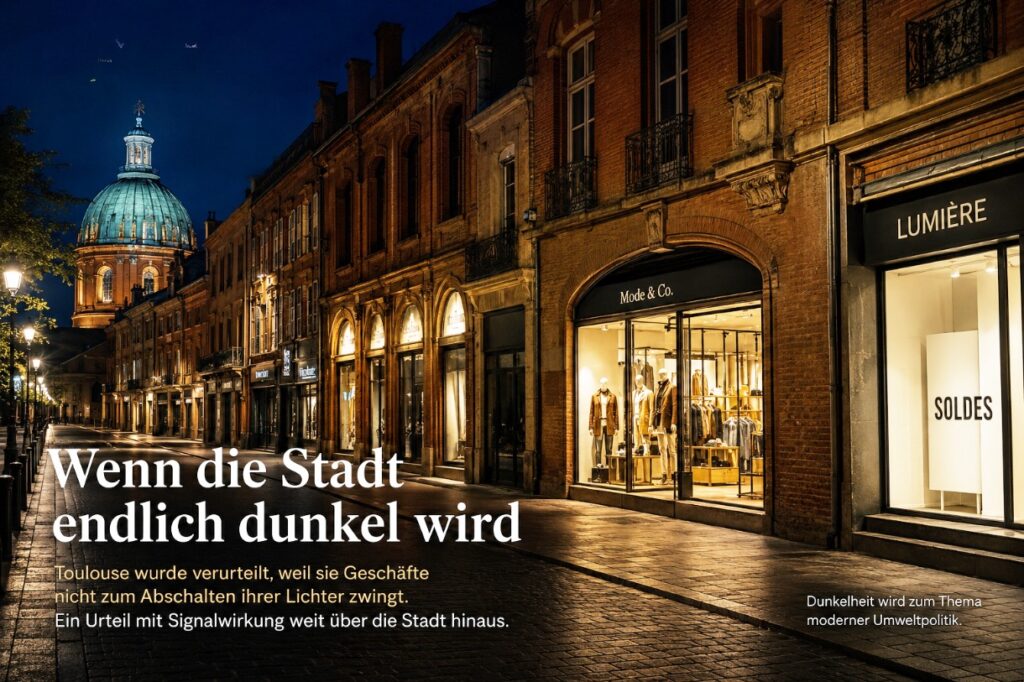
In Toulouse, they like to shine. The pink façades of this southern French metropolis glow at night like the sets of an old movie, the cafés cast a warm light onto the streets, and the shop windows shine late into the night. Those who stroll through the old town immediately feel this urban promise: nothing sleeps here. Life pulses here.
And that is exactly where the problem suddenly lies.
Because now an administrative court has condemned the city — not for a spectacular scandal, nor for corruption or mismanagement, but for too many lights being on. Toulouse had not sufficiently forced shops to turn off their lighting at night. An almost unnoticed ruling. And perhaps for that very reason, with explosive potential.
It seems like a dispute about neon tubes and shop windows. But in reality the case speaks of a profound cultural change. France is beginning to reconsider. The night, for decades the stage of modernity, is slowly turning into a political space.
For a long time, light was considered a sign of progress. The more illuminated a city was, the more modern it seemed. Those who slept in the nighttime darkness appeared provincial or poor. Paris was not called “City of Light” by chance. Light meant security, elegance, prosperity. It was the glow of the department stores, the boulevards, the Republic itself.
Today, that old certainty sounds a bit outdated.
Because permanent artificial lighting has acquired a second meaning: energy consumption, environmental impact, disruption of natural rhythms. Insects die on illuminated facades. Migratory birds lose their orientation. People sleep worse. Even trees get confused by the constant light — as if the city had decided not to give even the seasons of the year a rest.
And so something remarkable begins: darkness acquires a new value.
Not romantically idealized as in the poems of the 19th century, but administrative, ecological, almost technocratic. Suddenly, mayors discuss lighting schedules. Authorities control luminous advertising. Environmental organizations patrol city centers at night with cameras, like detectives of an over-illuminated civilization.
You have to imagine it: activists document boutiques illuminated at two in the morning. It almost seems like a scene from a silent French comedy.
But beneath the extravagance lies seriousness.
The real question is: how much lighting does a society that never stops need?
Modern cities thrive on visibility. Restaurants want to attract customers. Shops compete for attention. Tourism demands atmosphere. Light stages consumption like a theater. A dark shopping street immediately seems abandoned, even threatening. That is why many municipalities avoid strict controls — no one wants to see cities go dark.
But at the same time the moral climate changes.
What was once considered vibrant now sometimes seems wasteful. The luxuriously lit façade already sometimes exudes a bit of anachronism, almost defiance. As if to say: we remain the same. No matter how much electricity prices rise. No matter how many times climate change is discussed.
That is why the verdict against Toulouse strikes a sensitive nerve. It forces the city to act against its own culture of light. Not voluntarily. Not symbolically. But legally.
Perhaps this is where the real change begins.
Because laws against light pollution have existed in France for a long time. What is new is the political will to enforce them. For decades, many regulations were more decorative — like traffic signs on empty roads. Now the judiciary suddenly discovers its ability to enforce.
Other cities might take notice. Marseille. Lyon. Nice. Where nighttime illumination is part of urban marketing, there is now an increasing risk of similar proceedings. This could cause conflicts. Merchants already warn of security problems and loss of appeal. Environmental organizations, on the other hand, see a historic lever.
It is not just about lamps.
It is about how modern cities want to project themselves. Constantly illuminated, consumption-oriented, permanently visible? Or more consciously, sparingly, perhaps even silently?
Those who walk down a really dark street at night notice something quickly: the darkness has its own dignity. The sounds change. The facades disappear. The sky reappears. Suddenly, stars are visible over the city — an almost forgotten experience. Something crazy, isn’t it?
Maybe that’s the real moral of this sentence. That precisely an administrative decision about the lighting of shop windows reveals something much greater than municipal legislation. A cultural shift in mood.
The modern city is slowly learning that not all light means progress.
And that a society sometimes becomes sensible precisely when it is willing to turn off the neon.
An article by M. Legrand