
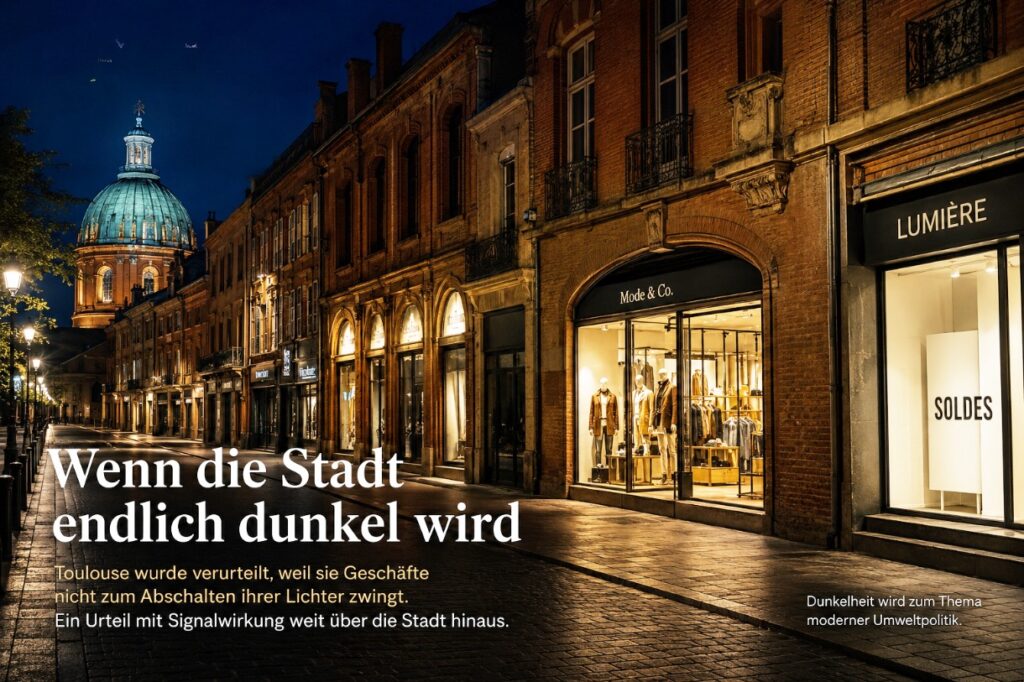
Toulouse likes things that shine. The pink façades of the southern French metropolis gleam at night like the sets of an old film, cafés cast warm light into the alleys, and shop windows flicker late into the night. Anyone walking through the old town can immediately sense the promise of this city center: nothing here will sleep. Life pulses here.
But this suddenly became a problem.
An administrative court penalized the city, not because of a sensational scandal, corruption, or mismanagement, but because the lights were too bright. The ruling states that Toulouse did not sufficiently require shops to switch off their lights at night. This almost imperceptible decision may be powerful precisely because of that.
The case may seem to be a dispute about neon lights and shop windows, but in reality, it reflects a profound cultural shift. France is beginning to change its way of thinking. The night, long a stage for modernity, is gradually becoming a political space.
For a long time, light was a symbol of progress. The more brightly a city shone, the more modern it appeared. Spending the night in dark areas seemed provincial or poor. It is no coincidence that Paris is called the “City of Light” (Ville Lumière). Light meant safety, elegance, and prosperity. It was the light of department stores, boulevards, and the Republic itself.
Today, this old belief suddenly seems somewhat outdated.
Constant artificial light now has a second meaning: energy consumption, environmental pollution, and the disruption of natural rhythms. Insects die on illuminated building façades, migratory birds lose their way, and people struggle to sleep. Even trees are confused by the constant brightness, as if the city had decided not to give the seasons any chance to rest.
This is how an extraordinary process began: darkness started to gain new value.
This was not the romantic idealization of nineteenth-century poets, but an administrative, ecological, even technical-bureaucratic approach. Suddenly, markets began discussing lighting hours, authorities inspected neon signs, and environmental organizations patrolled city centers at night like police officers, cameras in hand.
Imagine this: activists documenting boutique shops that still have their lights on at two in the morning. It almost looks like a scene from a quiet French comedy.
But the paradox behind it reveals its seriousness.
The real question is: how much light does a society that never stops actually need?
Modern cities depend on visibility to survive. Restaurants want to attract customers, shops compete for attention, and tourism needs atmosphere. Light presents consumption like a stage play. Dark shopping streets immediately seem desolate, sometimes even threatening. This is precisely why many local governments try to avoid strict regulations—no one wants to see city centers decline.
But at the same time, the moral climate is changing.
What was once considered lively is now sometimes seen as wasteful. Dazzling upscale shop windows can now feel outdated, even somewhat rebellious. As if they were saying: we will keep doing this. No matter how much electricity prices rise. No matter how climate change is discussed.
Thus, the ruling in Toulouse struck a very sensitive nerve. It forced the city to actively change its lighting culture. Not voluntarily, not symbolically, but by legal compulsion.
Perhaps this is precisely where the real change begins.
France already has laws regulating light pollution. The new development is that there is now genuine political will to take the matter seriously. For decades, many regulations were merely decorative, like isolated traffic signs. Now, courts are suddenly beginning to enforce them.
Other cities will take notice as well. Marseille, Lyon, Nice—cities where nighttime brightness is part of urban marketing. The risk of similar lawsuits is increasing there. This could lead to conflict. Retailers have already warned of possible safety concerns and a loss of attractiveness. At the same time, environmental groups see this as a historic turning point.
This is no longer just about lighting.
It is about how modern cities want to present themselves. Always lit, consumption-oriented, continuously visible? Or more conscious, economical, perhaps quieter?
If you walk down a very dark street at night, you quickly realize: darkness has a special dignity. Sounds change, sights disappear, and the sky becomes visible again. Suddenly, stars appear above the city—an almost forgotten experience. Strange, isn’t it?
Perhaps that is the true meaning of this ruling. An administrative decision about shop-window lighting reveals something more important and far-reaching than the Municipal Code. A change in cultural atmosphere.
Modern cities are slowly learning. Not every light necessarily represents progress.
Sometimes, society becomes wise only when it is ready to switch off the neon lights.
Author: M. Legrand