
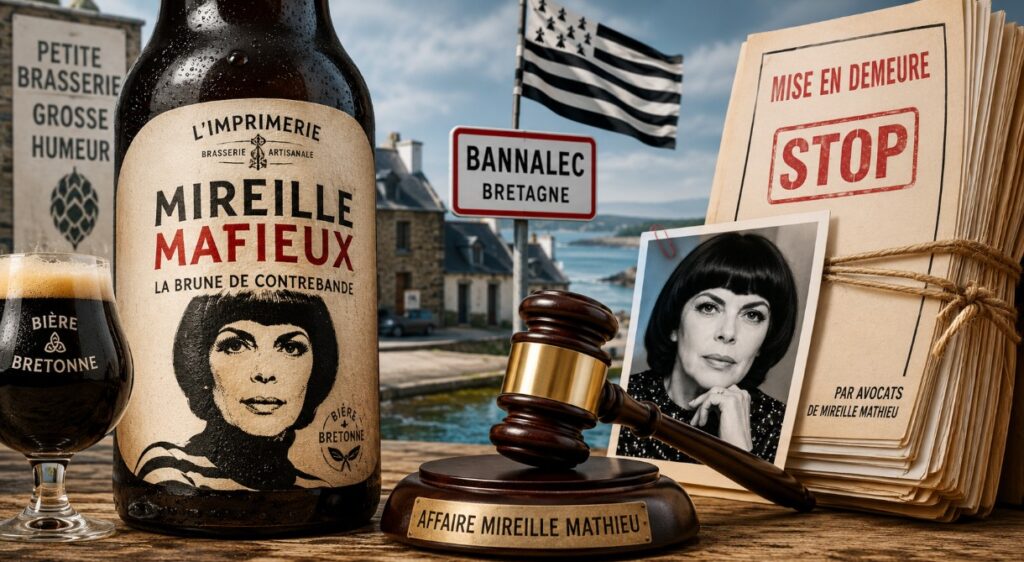
In France sometimes a baguette, an offended chansonnier or a misnamed camembert is enough – and half the country falls into a philosophical state crisis. This time, however, a beer label from Brittany was enough to ignite a national debate about humor, satire and wounded vanities.
The leading role? Of course Mireille Mathieu. France’s eternal pageboy, walking cultural heritage and probably the only woman in Europe whose hairstyle allows no democratic process to prevail even in gale-force eleven.
A small brewery called “L’Imprimerie” from Bannalec in Brittany had the brilliant or completely mad idea to name a dark beer “Mireille Mafieux” — accompanied by the subtitle “la brune de contrebande”. Smuggler brown, then. For that alone someone really deserves a medal for Gallic pun-terror.
But the humor landed with the party involved about as well as ketchup on foie gras.
The singer’s lawyers are demanding according to French media not only an immediate sales halt, but also the complete destruction of the remaining bottles. Destruction! As if it were radioactive nuclear waste rather than craft beer from Brittany. You can almost picture a dramatic scene: men in white protective suits carrying boxes full of beer bottles into nothingness, while melancholic accordion music plays in the background.
Brewery shareholder Aurélien Picard will by now have discovered that irony can be a surprisingly expensive hobby. New labels, destroyed stock, possible damages — for a small business that sounds about as relaxing as a tax audit on a sinking fishing boat.
Almost more absurd: this is already the second celebrity dispute for the same brewery in a short time. Just a few weeks ago there was an uproar over a beer called “John Lemon.” Yes, really. Apparently their motto is: Why choose simple drink names when you can pick fights with international icons instead?
One must give the Bretons this much: they certainly do not lack creativity. Other breweries simply call their beers “Blonde,” “Triple,” or “IPA.” In Bannalec, every tap lineup, by contrast, sounds like the opening act of a comedy festival.
And suddenly all of France is debating a question that feels delightfully French: Who owns humor?
Are you allowed to parody famous names? At what point does satire stop and commerce begin? And why do some celebrities react to puns about as sensitively as vampires to garlic?
The truth probably lies somewhere between trademark law and wounded pride. Famous personalities’ names now have enormous economic value. An image now functions like a luxury label. Every joke, every caricature, and every wink-product potentially scratches at the carefully polished brand layer.
Still, a bitter aftertaste remains.
But of course the idea is ridiculous that a small Breton brewery would suddenly be seen as a serious threat to the legacy of a national chanson icon. As if a few hundred beer bottles could topple France’s cultural pedestal. If that were really possible, one should be more concerned about the stability of that pedestal.
Perhaps that is precisely the point of this story: France defends its icons with the iron hand of an atomic state — even when the attack consists only of hops, malt and a poorly conceived pun.
And somewhere in a Breton pub a regular is probably sitting in front of his beer and asks dryly:
“What’s the next step? Is Gérard Depardieu going to sue a cheese board?”
One would now hardly rule that out.
An article by M. Legrand