
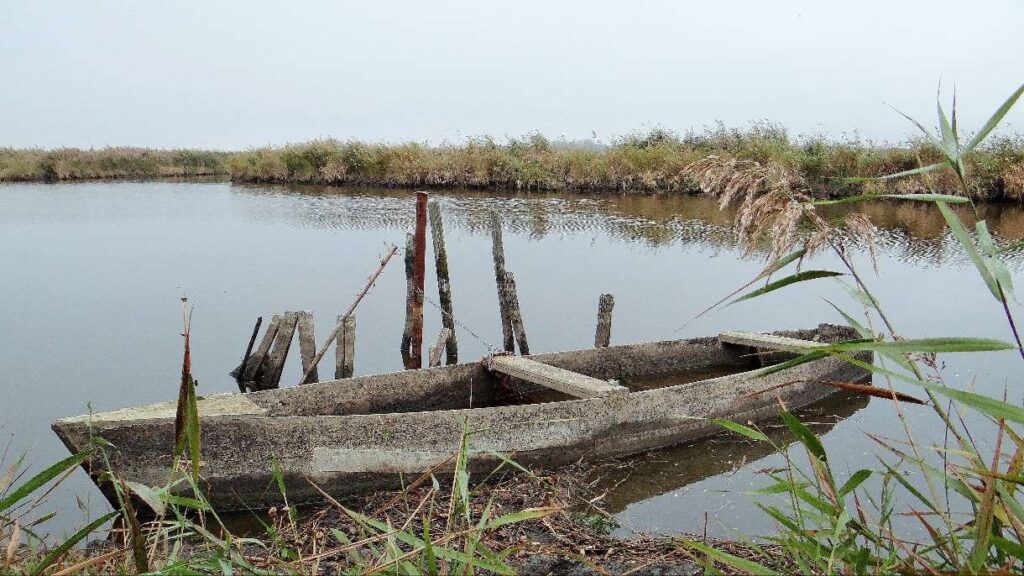
France loves grand gestures. Lavender fields that color Provence like a stage set, the Atlantic coast posing with rugged elegance, and Paris selling its boulevards as an eternal promise. And then, there is a place like the Grand Brière—a landscape that makes no noise. It just is. Damp, dark, and quiet. Almost mundanely resisting. That is why it strongly attracts people.
West of Saint-Nazaire, a world like a forgotten chapter of Europe begins. Passing through the canals of the Grand Brière marshlands early in the morning, you first see almost nothing. Mist drifts over the water like an old curtain. Reeds rustle quietly. Somewhere a bird raises an alarm call. Then suddenly, from the faint mist, a flat black boat slowly glides out—silently, almost like a ghost.
You can’t help but wonder. How much of such landscapes remain in Europe?
The Grand Brière is one of the largest wetlands in France. But numbers don’t mean much. What matters is the feeling. A unique sensation of floating between water and land. Between present and past. The region holds something primal, and modernity seems barely to have touched it.
For centuries, the residents have lived almost entirely by the blessings brought by the wetlands. Fish, peat, wild birds, reeds. It was not an easy life, but rather a constant pact with the wind, moisture, and perseverance. Peat was used for warmth, reeds covered the roofs, and canals served as roads. Even today, many houses stoop under thick thatched roofs, seeming to resist the Atlantic winds as little as possible.
Some villages look as if they have accidentally remained from another era.
Saint-Joachim in particular has this quiet uniqueness. It is neither a picturesque museum village nor a neatly restored outdoor paradise. Rather, it is a place where the past quietly continues to live. Instead of garden gnomes, boats sit in front of the houses, and the elderly repair nets. Curtains, probably known even to grandmothers, hang behind the windows. It sounds romantic, but in reality it was harsher. Life in the Brière was tough, and the moisture soaked into bones and walls.
Still, a distinctive culture was born from it.
Especially in cuisine.
For example, conger eel holds an almost mythical status. Anguille en persillade — conger eel with parsley and garlic — remains a local specialty today. A simple, hearty, oily, and rich dish. It is not suited for those cautious about flavor. Conger eel symbolizes the history of Brière. Fishermen would chase it for hours through narrow canals at night, sometimes in bad weather. Those who succeeded brought back more than just food. A good catch meant security.
Nowadays, small restaurants serve the old recipes along with white wine from the Loire Valley. This combination feels like time travel through cuisine and seems to be a form of resistance against the uniformity of modern cooking.
However, the real secret lies deeper.
Beneath the wetlands lie remnants of ancient forests. Peat miners occasionally unearth black oak trunks preserved for thousands of years in oxygen-poor soil. These dark giants seem almost unreal, like relics from a sunken world. Standing beside them, one can feel the scale of time. Not the hectic time of smartphones, but geological time — slow, heavy, and relentless.
Archaeologists have discovered tools, traces of settlements, and evidence of early human use in this area. The Brière also tells the story of climate history. Where the water surface now shines and reeds dominate, there was once a forest. The wetlands have become a sort of natural memory of Europe.
It is only natural that scientists pay attention. Wetlands store large amounts of carbon, regulate the water cycle, and protect biodiversity. Wetlands were once considered worthless or dangerous, but are now valued as treasures of the ecosystem. It sometimes takes centuries for humanity to recognize the value close to home.
The fauna of the Grand Brière reinforces this impression even more. Herons walk around the shallow waters like bored aristocrats, marsh harriers circle above the reeds, cormorants spread their wings sitting on poles, looking like evil priests of a water cult. In spring, the wetlands seem to explode with sound. Frogs croak, insects buzz their wings, birds all call out simultaneously. At times, this landscape feels less like western France and more like the Amazon.
And it is precisely within this that beauty lies.
The Grand Brière rejects hurried glances. It is not simply a place to pass through and tick off on the tourist checklist. This landscape demands slow time, silence, and attentiveness. Those always searching for the next photo spot will probably miss the essence.
That may be why this area is relatively unknown. It doesn’t fit into modern travel lists. There are no grand spectacles, no magnificent castles, no ‘Instagram spots’ where people line up to take photos. Instead, there is only fog, water, wind, and time.
Is that enough?
Amazingly, yes.
The Grand Brière is a rare place in Europe that reminds us of the feeling of untouched nature. It is a place that continues to keep its mysteries. While all other places have been explained, guided, and marketed, here secrets still remain.
And that may be the greatest luxury of this place.
Article by M. Legrand