
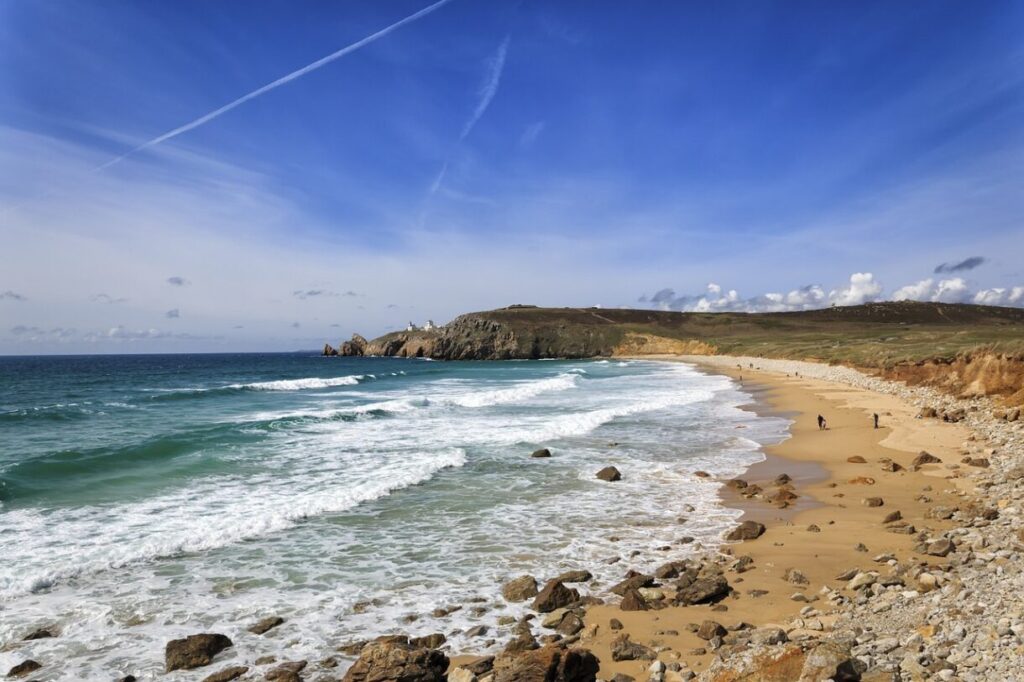
Those who spend their summer holiday in Brittany usually associate the region with fresh Atlantic air, a strong sea breeze and pleasantly mild temperatures. The Morbihan department in particular was long considered a refuge for anyone struggling with summer heat in southern France or inland areas. But this reputation is increasingly being called into question. The current heatwave makes it clear that even the Breton coast is no longer protected from exceptionally high temperatures.
Many holidaymakers are therefore experiencing their arrival this summer with mixed feelings. Instead of welcome relief from the heat, they are met with temperatures well above 30 degrees Celsius. Even early in the morning, the air already feels warm, while the nights often provide little of the hoped-for rest. Those who had expected the Atlantic to reliably temper the heat are now looking at the thermometer in surprise.
Especially in the popular holiday resorts around Carnac, Quiberon, Vannes and the Gulf of Morbihan, the heat is noticeably changing the rhythm of daily holiday life. The beaches fill up shortly after sunrise, as many visitors want to make use of the pleasant morning hours. Once the sun reaches its peak, numerous families retreat beneath shade-giving pine trees or spend the midday hours in their holiday homes, hotels or motorhomes. It is only in the evening, when a light breeze gradually returns, that the promenades and small coastal towns come back to life.
Campsites are also feeling the change. Operators report significantly higher demand for shaded pitches. Fans have become some of the most sought-after items in nearby supermarkets, and some holidaymakers are already asking about air-conditioned accommodation when booking. Just a few years ago, this question played hardly any role on the Breton coast.
For many families, Brittany holds special significance. Some have spent their summers in Morbihan for decades and have always appreciated its balanced climate. The surprise is all the greater when familiar holiday destinations suddenly reach temperatures that were once more commonly associated with southern France. Some holidaymakers even spontaneously opt for day trips to stretches of coast more exposed to the Atlantic, where the wind makes the warmth feel somewhat more pleasant. Others change their entire daily routine and rediscover the region in the early morning hours or only after sunset.
The reasons for this development lie in an exceptionally stable high-pressure system over Western Europe. It prevents cooler air masses from the Atlantic from reaching the coast unhindered. Instead, hot air flows all the way to the far west of France. At the same time, the temperature of the Atlantic is also slowly rising. As a result, the sea is losing part of the cooling effect that has shaped Brittany’s climate for many decades.
These changes are not without consequences for the tourism industry. Hotels, holiday resorts and campsites are increasingly investing in sun protection, additional shade and modern cooling systems. Buildings that previously managed without air conditioning are reaching their limits during prolonged heat periods. Operators are responding with new services and adapting their facilities to the changing conditions. After all, many guests today expect a certain degree of protection from the heat even in traditionally cooler regions.
It is not only holidaymakers and hosts who face new challenges. Nature is also suffering from persistently high temperatures. Meadows and soils dry out faster than before, and even in Brittany, which is otherwise comparatively wet, the risk of vegetation and wildfires is increasing. Municipalities regularly remind visitors to take particular care when barbecuing, smoking or parking on dry grass. Sometimes a small spark is enough to cause major damage.
Despite everything, Morbihan has not lost its special charm. The spectacular coastal landscapes, offshore islands and maritime way of life continue to attract numerous visitors. In addition, temperatures are often still several degrees lower than in southern France. Those who adapt their daily schedule, go swimming early, spend the midday hours quietly and move excursions to the evening can still experience Brittany as an attractive travel destination.
Nevertheless, this summer clearly shows that climatic conditions are changing. Regions that were long regarded as natural retreats from summer heat are now feeling the effects of climate change ever more clearly. What was once considered a safe recommendation for pleasantly cool holidays no longer seems self-evident today. That is the real message of this heatwave: not only is the weather changing, but so too are holidaymakers’ expectations and the demands placed on a region that, for decades, promised its guests one thing above all – a refreshing break from the summer heat.
An article by M. Legrand